Introduction
As smart home and building automation systems become more flexible, many users and system integrators are looking for reliable ways to connect Zigbee devices with open-source platforms.
A Zigbee2MQTT motion sensor provides a practical solution by allowing Zigbee motion sensors to communicate with platforms such as Home Assistant through Zigbee2MQTT.
Compared with traditional wired motion detectors, Zigbee motion sensors offer easier installation, lower power consumption, and flexible deployment for applications including smart lighting, security monitoring, and energy-saving automation.
This guide explains how Zigbee motion sensors work with Zigbee2MQTT, what to consider when selecting a compatible sensor, and how they can be applied in smart homes, hotels, offices, and smart buildings.
What Is Zigbee2MQTT?
Zigbee2MQTT is an open-source software solution that connects Zigbee devices with smart home platforms through a compatible Zigbee Zigbee Gateway (or Coordinator).
Instead of relying only on proprietary gateways, Zigbee2MQTT allows users to integrate a wide range of Zigbee devices into customized automation systems.
A typical Zigbee2MQTT system includes:
- Zigbee motion sensor
- Zigbee Zigbee Gateway (or Coordinator)
- Zigbee2MQTT software
- Home automation platform such as Home Assistant
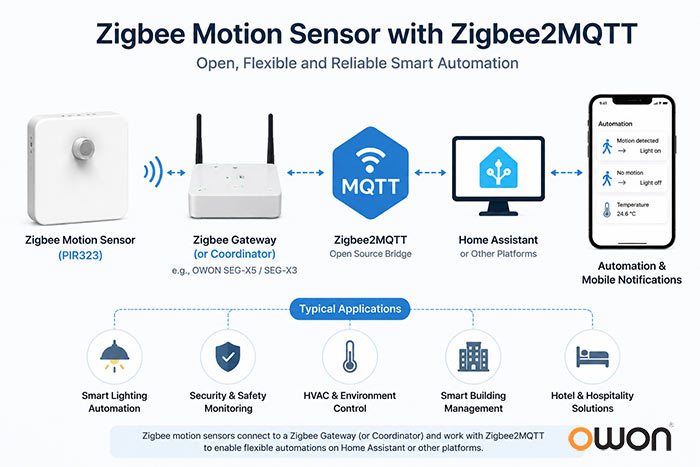
The communication structure is:
Zigbee Motion Sensor → Zigbee Zigbee Gateway (or Coordinator) → Zigbee2MQTT → Automation Platform
This flexible architecture is popular among smart home enthusiasts, developers, and professional integrators.
How Does a Zigbee Motion Sensor Work with Zigbee2MQTT?
A Zigbee motion sensor detects human movement through sensing technology such as PIR (Passive Infrared).
When movement is detected:
- The sensor sends a Zigbee signal.
- The Zigbee Zigbee Gateway (or Coordinator) receives the signal.
- Zigbee2MQTT transfers the device information to the automation platform.
- The system executes predefined actions.
For example:
- Motion detected in hallway → Turn on lights
- No movement detected → Turn off lighting
- Motion detected during abnormal hours → Trigger security notification
This makes Zigbee motion sensors a key component in intelligent automation systems.
Why Choose a Zigbee2MQTT Compatible Motion Sensor?
When selecting a Zigbee motion sensor for Zigbee2MQTT projects, compatibility is only one factor. Professional deployments should also consider reliability, installation flexibility, and sensing capability.
1. Zigbee 3.0 Compatibility
Zigbee 3.0 provides improved interoperability between different Zigbee devices and gateways.
A reliable Zigbee2MQTT motion sensor should support:
- Standard Zigbee communication
- Stable wireless connection
- Integration with compatible Gateway (or Coordinator)
For example, OWON Zigbee motion sensors are based on Zigbee 3.0 communication and are designed for smart home and building automation applications.
2. Reliable Motion Detection Performance
For lighting automation and security applications, detection reliability is critical.
Important specifications include:
- Detection range
- Detection angle
- Installation location
- False trigger prevention
For example, OWON PIR323 supports PIR motion detection with a typical indoor detection distance of up to 5 meters and a wide detection angle, making it suitable for room-level automation.
3. Battery-Powered Installation Flexibility
One major advantage of Zigbee motion sensors is wireless installation.
Battery-powered sensors can be installed without additional wiring, making them suitable for:
- Existing buildings
- Apartment retrofits
- Hotels
- Office spaces
The OWON PIR323 Zigbee multi-sensor uses two AAA batteries and supports low-power operation for flexible deployment.
4. Multi-Sensor Capability
Basic motion sensors only detect movement.
However, some smart automation projects require additional environmental data.
A multi-sensor can combine:
- Motion detection
- Temperature monitoring
- Humidity measurement
- Vibration detection
The OWON PIR323 is an example of a Zigbee multi-sensor that combines PIR motion detection with environmental sensing functions.
This allows more advanced automation scenarios, such as:
- Occupancy-based HVAC control
- Environmental monitoring
- Smart building automation
How to Connect a Zigbee Motion Sensor to Zigbee2MQTT
The exact setup process depends on the Zigbee Gateway (or Coordinator) and automation platform, but the general workflow is similar.
Step 1: Prepare Your Zigbee Network
You will need:
- Zigbee Gateway (or Coordinator)
- Zigbee2MQTT installation
- Supported Zigbee motion sensor
- Automation platform (optional)
Step 2: Enable Device Pairing
Put Zigbee2MQTT into pairing mode.
Then reset the motion sensor and allow it to join the Zigbee network.
For example, the PIR323 setup process requires a Zigbee gateway and mobile application, then the sensor can be added to the gateway network through the pairing process.
Step 3: Configure Automation Rules
After successful pairing, the motion sensor can trigger automation.
Examples:
Smart Lighting
Motion detected:
→ Turn on corridor lights
Energy Saving
No occupancy:
→ Reduce unnecessary lighting usage
Security
Unexpected movement:
→ Send notification alerts
Zigbee2MQTT Motion Sensor Applications
Smart Home Automation
Residential users commonly deploy Zigbee2MQTT motion sensors for:
- Hallway lighting
- Bathroom automation
- Bedroom lighting
- Security notifications
Wireless installation makes them ideal for home upgrades.
Hotels and Hospitality
Hotels can use Zigbee motion sensors for:
- Guest room automation
- Corridor lighting control
- Energy management
Compared with traditional wired systems, Zigbee solutions provide easier installation and scalability.
Offices and Commercial Buildings
In offices and commercial environments, motion sensors support:
- Occupancy-based lighting
- Energy-saving automation
- Smart building management
They are especially useful in retrofit projects where installing new wiring is difficult.
Zigbee2MQTT vs ZHA: Which One Should You Choose?
Both Zigbee2MQTT and ZHA can connect Zigbee devices with Home Assistant.
| Zigbee2MQTT | ZHA | |
|---|---|---|
| Device compatibility | Wide range of supported devices | Home Assistant native integration |
| Configuration flexibility | Advanced options | Simpler setup |
| Suitable users | Advanced users and integrators | General smart home users |
The best choice depends on project requirements, device compatibility, and the desired level of customization.
Example: OWON Zigbee Motion Sensor for Zigbee-Based Projects
For projects requiring a reliable Zigbee motion sensor, selecting the right hardware is important.
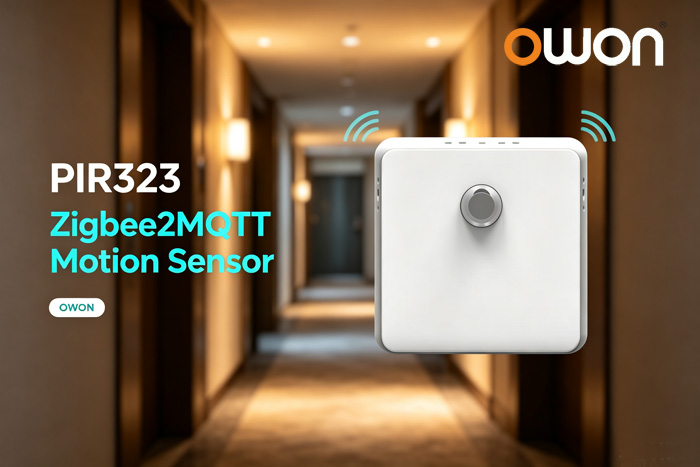
For example, OWON PIR323 is a Zigbee 3.0 multi-sensor designed for smart home and building automation applications.
It combines:
- PIR motion detection
- Temperature and humidity sensing
- Optional external temperature monitoring
The sensor supports flexible installation methods, including wall mounting and tabletop placement.
This type of multi-functional Zigbee sensor can help reduce the number of separate devices required in automation projects.
Tips for Installing Zigbee Motion Sensors
Proper installation improves detection accuracy.
Recommended practices:
- Avoid installing near heaters, air conditioners, or direct sunlight
- Choose locations with suitable detection coverage
- Keep the sensor within Zigbee network range
The PIR323 quick guide recommends avoiding installation locations close to pets, HVAC equipment, heaters, sunshine, or areas with rapid temperature changes.
Frequently Asked Questions
Can Zigbee motion sensors work with Zigbee2MQTT?
Yes. Many Zigbee motion sensors can work with Zigbee2MQTT when paired with a compatible Zigbee Gateway (or Coordinator).
How do I connect a Zigbee motion sensor to Zigbee2MQTT?
Generally, enable pairing in Zigbee2MQTT, reset the sensor, and add it to your Zigbee network through a compatible Gateway (or Coordinator).
Is Zigbee2MQTT better than ZHA?
Both platforms have advantages. Zigbee2MQTT offers broad device compatibility and advanced configuration options, while ZHA provides native Home Assistant integration.
Can Tuya Zigbee motion sensors work with Zigbee2MQTT?
Some Tuya Zigbee devices can work with Zigbee2MQTT depending on device support, firmware, and Gateway (or Coordinator) compatibility.
What applications use Zigbee2MQTT motion sensors?
Common applications include smart lighting, security monitoring, hotels, apartments, offices, and smart building automation.
Conclusion
A Zigbee2MQTT motion sensor provides a flexible way to integrate Zigbee devices into open automation systems.
For smart home users, it enables customized lighting and security automation.
For professional integrators, Zigbee2MQTT-compatible sensors provide scalable options for apartments, hotels, offices, and smart building projects.
When selecting a Zigbee motion sensor, consider not only Zigbee2MQTT compatibility but also detection performance, battery life, installation flexibility, and additional sensing capabilities.
By combining reliable Zigbee communication with intelligent sensing functions, Zigbee motion sensors can become an important foundation for modern automation solutions.
Related reading:
[ Zigbee2MQTT Door Sensor: Integration Guide for Home Assistant and Smart Automation ]
Post time: Aug-06-2026


