Introduction
As HVAC systems in North America become more energy-efficient, multi stage heating and cooling systems are increasingly common in both residential and commercial buildings.
Unlike traditional single-stage systems, these systems require more advanced control logic. This is where a multi stage thermostat becomes essential.
Whether you are working with a 2-stage furnace, a heat pump, or a hybrid HVAC system, choosing the right thermostat directly impacts comfort, efficiency, and system performance.
What Is a Multi Stage Thermostat?
A multi stage thermostat is designed to control HVAC systems that operate at multiple levels of heating or cooling output.
Instead of simply turning the system ON or OFF, the thermostat can:
-
Activate different heating stages based on demand
-
Adjust system output gradually
-
Maintain more stable indoor temperatures
This type of control is commonly used in:
-
2-stage furnaces
-
multi stage heat pumps
-
advanced HVAC systems in modern buildings
What Does Multi Stage Mean in HVAC?
In HVAC systems, a “stage” refers to a level of heating or cooling output.
A single-stage system usually has only one operating level: fully on or fully off. When the thermostat calls for heating or cooling, the equipment runs at full capacity until the set temperature is reached.
A two-stage system has two levels of operation. The first stage runs at a lower capacity for normal heating or cooling demand, while the second stage activates when the indoor temperature is far from the setpoint or when outdoor conditions require more output.
A multi stage HVAC system may include multiple heating or cooling stages, allowing the system to operate more gradually and efficiently. This helps reduce temperature swings, improve comfort, and avoid unnecessary equipment cycling.
For HVAC professionals, matching the thermostat stage capacity with the HVAC equipment is essential. A thermostat that does not support the required number of stages may limit system performance or prevent certain HVAC functions from operating correctly.

How Does a Thermostat for 2-Stage Furnace Work?
A thermostat for 2 stage furnace manages two levels of heating:
Stage 1 (Low Heat)
-
Runs most of the time
-
Maintains steady temperature
-
Improves energy efficiency
Stage 2 (High Heat)
-
Activates when more heating is required
-
Quickly reaches set temperature
A properly configured multi stage thermostat ensures:
-
Smooth transitions between stages
-
Reduced temperature swings
-
Lower energy consumption
Single-Stage vs Multi Stage Thermostats
The difference between a single-stage thermostat and a multi stage thermostat is mainly how they control HVAC equipment output.
A single-stage thermostat can only turn heating or cooling fully on or fully off. This works for basic HVAC systems, but it may create larger temperature swings and more frequent system cycling.
A multi stage thermostat can control more than one level of heating or cooling output. This allows the HVAC system to run at lower capacity when demand is low and higher capacity only when needed.
| Feature | Single-Stage Thermostat | multi stage Thermostat |
| HVAC Operation | Controls one level of heating or cooling | Controls two or more heating and cooling stages |
| Comfort | Larger temperature fluctuations | More consistent indoor temperature |
| Energy Efficiency | Equipment always runs at full capacity | Runs at lower capacity when possible, helping improve efficiency |
| Equipment Wear | More frequent on/off cycling | Reduced cycling for smoother operation |
| Noise Level | Louder due to full-capacity operation | Quieter during normal operation |
| Typical Applications | Basic residential HVAC systems | Heat pumps, two-stage furnaces, multi stage air conditioners, dual fuel systems, and light commercial HVAC |
| Best For | Standard heating and cooling systems | Modern high-efficiency HVAC systems requiring better comfort and performance |
Benefits of Using a Multi Stage HVAC Thermostat
Improved Comfort
By gradually adjusting heating or cooling output, a multi stage HVAC thermostat avoids sudden temperature changes and maintains a more consistent indoor environment.
Higher Energy Efficiency
multi stage systems operate at lower capacity most of the time, reducing energy usage compared to single-stage systems.
Reduced Equipment Wear
Frequent ON/OFF cycling is minimized, extending the lifespan of HVAC equipment.
Better System Control
Advanced thermostats allow integration with:
-
remote sensors
-
scheduling systems
-
building management platforms
Are Multi Stage HVAC Systems Worth It?
For many modern HVAC projects, multi stage systems are worth considering because they provide better comfort control and more efficient operation than basic single-stage systems.
A multi stage HVAC system can run at a lower output level during normal conditions and only move to a higher stage when additional heating or cooling is required. This helps reduce short cycling, improve indoor comfort, and lower operating noise.
However, the value depends on the application. Larger homes, apartment units, premium residential projects, and light commercial buildings usually benefit more from multi stage control than very small spaces with simple HVAC equipment.
The key point is compatibility. To get the full benefit of a multi stage HVAC system, the thermostat must support the same staging logic as the equipment.
Key Features to Look for in a Multi Stage Thermostat
multi stage Compatibility
Ensure the thermostat supports:
-
2-stage heating
-
multi stage cooling
-
heat pump systems
Remote Sensors
A WiFi thermostat with remote sensors helps balance temperature differences across rooms, which is especially important in multi stage systems.
Humidity Control
For advanced HVAC applications, a multi stage thermostat with humidity control improves indoor comfort—particularly in furnace-based heating systems.
It helps maintain proper indoor humidity levels, preventing dry air during winter heating while improving overall air quality and comfort.
WiFi Connectivity
WiFi-enabled thermostats allow:
-
remote control
-
cloud integration
-
energy monitoring
How to Choose a Multi Stage Thermostat for Your HVAC System
Choosing the best multi stage thermostat is not only about selecting the most advanced model. The right choice depends on HVAC compatibility, installation requirements, and project goals.
HVAC professionals should evaluate the following factors:
Stage Compatibility
Check whether the thermostat supports the required heating and cooling stages, such as 2-stage heating, 2-stage cooling, or 4H/2C heat pump control.
Heat Pump Support
If the project uses a heat pump, the thermostat should support O/B reversing valve control, auxiliary heat, emergency heat, and multi stage compressor operation.
Remote Sensor Capability
For larger homes, apartments, or multi-room projects, remote sensors can help balance hot and cold spots and improve comfort across different areas.
Humidity Control
In premium residential or commercial HVAC applications, humidity control can improve indoor comfort and support better air quality management.
Installation and Integration
For professional deployments, contractors and system integrators should also consider C-wire requirements, installer setup menus, API availability, mobile app control, and long-term platform support.
Applications of Multi Stage Thermostats
Residential Homes
Modern homes often use 2-stage furnaces or heat pumps to improve comfort and efficiency.
Apartment Buildings
multi stage systems combined with remote sensors help balance temperatures between rooms, making them ideal for smart thermostat for apartment deployments.
Commercial Buildings
Offices and retail spaces require scalable HVAC control. multi stage thermostats provide flexibility and efficiency for these environments.
multi stage Thermostats for Heat Pumps
Heat pump systems often require more advanced thermostat logic than conventional furnace and air conditioning systems.
A multi stage thermostat for heat pump applications may need to control:
- Compressor stages
- O/B reversing valve
- Auxiliary heat
- Emergency heat
- Dual fuel or hybrid heat switching
For example, a 2-stage heat pump may require Y1 and Y2 compressor control, while backup heating may require W1/AUX and W2/E terminals. If the thermostat does not support these functions, the heat pump system may not operate as intended.
This is why HVAC professionals should verify thermostat compatibility before installation, especially for heat pump systems with auxiliary heat or emergency heat.
For a deeper technical explanation, refer to our heat pump thermostat compatibility guide covering wiring, system selection, auxiliary heat, and emergency heat requirements.
Multi Stage Thermostat Wiring: Key Terminals to Check
Multi stage thermostat wiring depends on the HVAC system configuration and the number of heating and cooling stages. Common 24VAC terminals may include Y1 and Y2 for compressor or cooling stages, W1 and W2 for heating stages, O/B for heat pump reversing valve control, AUX/E for auxiliary or emergency heat, and C for continuous thermostat power.
Before selecting a multi stage thermostat, installers should verify the HVAC equipment terminals, supported heating and cooling stages, heat pump configuration, and auxiliary heat requirements. Wiring requirements can vary between conventional furnace/AC systems and multi-stage heat pump systems.
| Terminal | Typical Function |
|---|---|
| Y1 | First-stage compressor/cooling |
| Y2 | Second-stage compressor/cooling |
| W1 | First-stage heating |
| W2 | Second-stage heating |
| O/B | Heat pump reversing valve |
| AUX/E | Auxiliary/emergency heat |
| C | 24VAC common |
Example: Multi Stage WiFi Thermostat Options from OWON
For HVAC professionals, system integrators, and distributors, selecting a reliable thermostat platform is essential for long-term project stability.
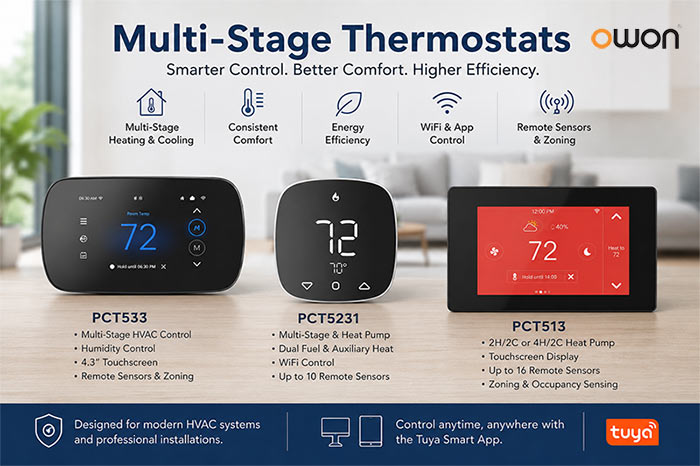
As an example, OWON provides several WiFi thermostat platforms designed for North American 24VAC HVAC systems, including conventional HVAC systems, heat pumps, dual fuel applications, and multi stage heating and cooling projects.The following examples illustrate how different thermostat platforms can address different HVAC project requirements.
PCT5231 – WiFi Thermostat for Multi Stage and Heat Pump Applications
The OWON PCT5231 supports most 24V heating and cooling systems, including conventional systems, heat pumps, auxiliary heat, emergency heat, and dual fuel / hybrid heat applications. It also supports up to 10 remote sensors for room-level comfort balancing, making it suitable for residential, apartment, and light commercial HVAC deployments.
PCT533 – Advanced Multi Stage Thermostat with Humidity Control
The OWON PCT533 is designed for advanced HVAC projects that require multi stage control, heat pump compatibility, humidity control, energy tracking, occupancy sensing, and a premium touchscreen interface. It is suitable for high-end residential and commercial HVAC applications.
PCT513 – Touchscreen Thermostat for Zoning-Focused Projects
The OWON PCT513 supports multi stage conventional systems and 4H/2C heat pump systems. With support for up to 16 remote zone sensors, it is suitable for projects that require room-level temperature balancing and advanced zoning-style comfort control.
These solutions enable HVAC professionals to build scalable, efficient, and connected climate control systems.
Project Type
| HVAC Project | Recommended Thermostat |
| 2-Stage Furnace | PCT5231 |
| Heat Pump with Auxiliary Heat | PCT5231 |
| Premium Residential HVAC | PCT533 |
| Multi-Room Comfort | PCT513 |
| Apartment HVAC | PCT5231 |
| Light Commercial Buildings | PCT533 |
Frequently Asked Questions
What is a multi stage thermostat?
A multi stage thermostat is designed to control HVAC systems with two or more heating or cooling stages. Unlike a single-stage thermostat that simply turns equipment fully on or off, it can switch between different output levels to improve comfort, reduce energy consumption, and optimize HVAC performance.
What is the difference between a one-stage and two-stage thermostat?
A one-stage thermostat controls HVAC equipment with a single output level, while a two-stage thermostat can control low-stage and high-stage heating or cooling. Two-stage control provides more stable comfort and better efficiency when paired with compatible HVAC equipment.
Can a multi stage thermostat work with a heat pump?
Yes. A compatible multi stage thermostat can work with heat pump systems if it supports compressor staging, O/B reversing valve control, auxiliary heat, and emergency heat.
Are multi stage thermostats more efficient?
Yes. They improve energy efficiency by operating at lower capacity when possible.
Does OWON offer multi stage thermostats?
Yes. OWON offers WiFi thermostats for North American 24VAC HVAC systems, including models that support multi stage conventional systems, heat pumps, auxiliary heat, emergency heat, remote sensors, and dual fuel applications.
Conclusion
As HVAC systems evolve, multi stage technology has become a standard in modern heating and cooling systems. Choosing the right multi stage thermostat ensures better comfort, improved energy efficiency, and reliable system performance.
For HVAC professionals and system integrators, adopting flexible and scalable thermostat solutions—such as OWON’s WiFi thermostat lineup—provides a strong foundation for future-ready HVAC systems.
Related reading:
[ Heat Pump Thermostats Explained: Compatibility, Wiring and System Selection ]
Post time: Mar-19-2026


