Let’s be honest.
When most people hear “smart home”, they usually imagine something like this:
“Alexa, turn on the lights.”
A few smart bulbs.
A door sensor.
Maybe a thermostat that saves some energy.
Nice. Convenient. Easy to explain.
But here is the interesting question:
What happens when smart home stops being only about convenience and starts solving more meaningful problems in everyday life?
Because smart home users are changing.
The same people who started with simple automations are now looking for more practical solutions:
How can I make my home safer?
How can I know if something unusual happens when nobody is around?
How can technology help my family members live more independently?
And this is where a new opportunity is quietly appearing.
Not in futuristic robots.
Not in complicated medical equipment.
But in something much more practical:
Smart home elderly care automation.
For smart home retailers, distributors and brand owners, this could become one of the most interesting categories to watch.
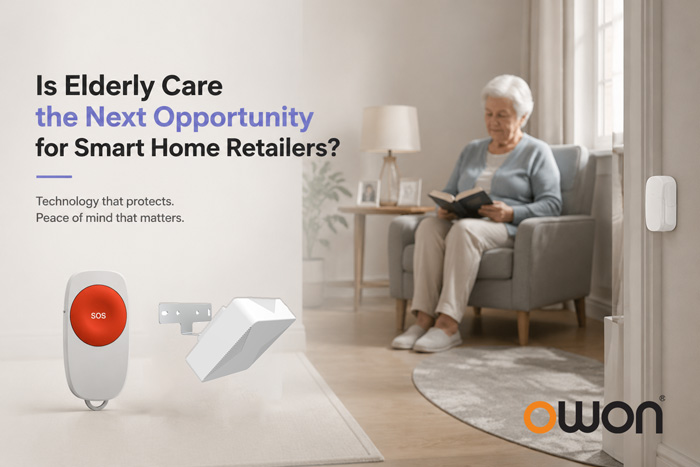
Smart Home Users Are Looking for More Than Convenience
If you sell smart home products, you probably know your typical customer.
Someone interested in:
- Home Assistant
- Zigbee devices
- DIY automation
- Energy saving
- Home security
But there is one thing many retailers overlook.
These customers rarely stop after building a basic smart home.
They start with:
“Can I automate my lights?”
Then:
“Can I reduce my energy usage?”
Then eventually:
“Can technology help me create a safer home environment?”
For some users, that naturally extends to family care.
A customer who buys a Zigbee door sensor today might later search:
“How can I receive an alert if something unusual happens at home?”
“How can I know whether an elderly family member is safe?”
“How can I support independent living without installing a complicated system?”
The market is changing.
Smart home is slowly moving from:
“Make life easier.”
to:
“Make life safer.”
Why Home Assistant Users Are Exploring Elderly Care Automation
If you spend enough time around the Home Assistant community, you will notice something.
These users rarely stop at basic automation.
A project often starts with:
“Maybe I’ll automate my hallway light.”
A few months later:
“Maybe I should monitor energy consumption.”
Then:
“Maybe I should create a smarter safety system for my home.”
This is exactly why Home Assistant and Zigbee2MQTT are interesting for elderly care applications.
These users are already comfortable combining different devices:
- Motion sensors
- Door sensors
- Temperature sensors
- Smart plugs
- Cameras
- Emergency buttons
They are not necessarily looking for one expensive all-in-one healthcare product.
They prefer flexible systems that they can adapt to their own needs.
And this is where open smart home ecosystems create new possibilities.
Elderly Care Is Not Only a Healthcare Market
When retailers hear “elderly care”, many immediately think:
“That sounds like medical equipment.”
And that is understandable.
But there is another growing category:
Independent living support.
The goal is not to replace caregivers.
The goal is to help older people stay comfortable and independent while giving families more confidence.
This creates opportunities for companies already selling:
- Smart home products
- Security devices
- Home automation equipment
- IoT accessories
Because many elderly care scenarios are actually built from familiar smart home components.
The difference is the purpose behind them.
A motion sensor is not only for turning on lights.
It can also help monitor activity patterns.
A door sensor is not only for security.
It can help provide awareness of daily routines.
A button is not only a remote control.
It can become a simple way to request assistance.
Three Smart Home Categories Creating New Elderly Care Opportunities
1. Fall Detection: When Someone Cannot Ask for Help
One of the biggest concerns for families with elderly members living alone is obvious:
What happens if something goes wrong and nobody knows?
Traditional emergency buttons require the person to press them.
But after a serious fall, that may not always be possible.
This is where fall detection sensors become valuable.
A product like the FDS315 Zigbee Fall Detection Sensor focuses on detecting abnormal situations and creating automated alerts through a smart home system.
For retailers, the opportunity is not simply selling a sensor.
It is offering peace of mind.
The customer is not buying another gadget.
They are buying confidence.
2. Emergency Buttons: Simple Solutions Still Matter
Sometimes the smartest technology is also the simplest.
An elderly user does not always want:
- another complicated app
- another password
- another device to learn
Sometimes they simply need one action:
Press a button.
A Zigbee panic button can become part of an elderly care automation setup, allowing users to trigger alerts when assistance is needed.
Simple products often succeed because they solve one clear problem.
3. Leakage Monitoring: Small Problems Before Bigger Problems
Not every elderly care scenario is dramatic.
Many challenges are small but important.
For example:
- hygiene monitoring
- unexpected leakage
- bathroom-related assistance
A Zigbee urine leakage detector can help caregivers or family members receive earlier notifications instead of discovering problems later.
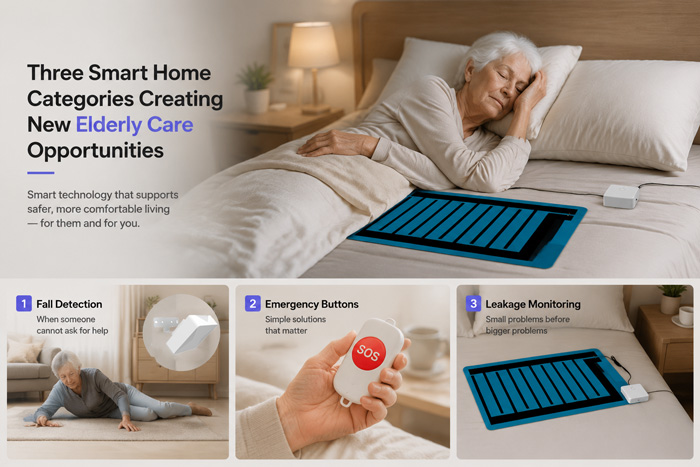
This is a good example of how smart home technology can support daily care without becoming intrusive.
Why Zigbee2MQTT Compatibility Matters in Elderly Care
For many smart home customers, especially advanced users, the first question is no longer:
“Does it have an app?”
The question is:
“Does it work with my system?”
This is why Zigbee2MQTT compatibility has become increasingly important.
Many users already have:
- Home Assistant
- Zigbee coordinators
- Existing automation systems
They do not want every device to bring a new ecosystem, a new cloud platform and a new mobile app.
For retailers and brand owners, open ecosystem support creates a practical advantage:
Your products can fit into systems customers already trust.
That means fewer compatibility concerns and a wider potential audience.
Is Elderly Care the Right Product Direction for Every Retailer?
Probably not.
And that is actually a good thing.
The best opportunities are usually not for everyone.
Elderly care smart home products make the most sense for businesses already selling:
- Smart home devices
- Security products
- Zigbee products
- Home automation solutions
Especially those targeting customers who value:
- Privacy
- Local control
- Custom automation
- Long-term reliability
If your customers already understand Zigbee and Home Assistant, elderly care automation is not a completely new market.
It is simply a new application built on top of an ecosystem they already know.
The Future of Smart Home May Be About Caring, Not Just Controlling
For years, smart home was mainly about control.
Turn lights on.
Adjust temperature.
Lock doors.
But the next stage may be different.
Smart home technology will increasingly help people:
- live independently
- stay safer
- support family members
- monitor important situations
For retailers and distributors, this creates an opportunity to move beyond selling individual sensors.
You are not just selling devices.
You are helping customers build solutions for real human needs.
And sometimes, the most valuable automation is not the one that saves five seconds.
It is the one that gives someone peace of mind.
Related reading:
[Why More Elderly Care Providers Are Turning to Non-Contact Fall Detection]
Post time: Jul-20-2026