Introduction
As hybrid inverter technology continues to evolve, energy meters have become far more than simple measurement devices. Today’s hybrid inverter platforms depend on accurate, real-time energy data to manage solar generation, battery storage, grid interaction, and household loads efficiently.
For manufacturers developing residential and commercial inverter solutions, selecting the right Modbus energy meter is now an important engineering decision rather than a hardware purchasing task. Communication reliability, protocol compatibility, measurement accuracy, and future scalability all influence system performance and user experience.
One example is the OWON PC4713, a communication-ready energy meter platform developed for hybrid inverter, energy storage, and energy management applications. Throughout this guide, it is used as an example to illustrate the capabilities manufacturers typically evaluate when selecting an energy metering solution.
This guide explains the key factors hybrid inverter manufacturers should consider before integrating an energy meter into their next-generation inverter platforms.
Why Hybrid Inverter Manufacturers Prefer Modbus Energy Meters
Among the many communication options available today, Modbus remains one of the most widely adopted standards across the solar and energy storage industry.
Unlike proprietary communication protocols, Modbus provides an open and standardized method for exchanging real-time operating data between hybrid inverters, energy meters, battery management systems, and energy management platforms.
For inverter manufacturers, this means:
- Faster software development
- Easier third-party integration
- Lower engineering costs
- Better compatibility with global markets
- Long-term product scalability
This is why a Modbus energy meter continues to be the preferred choice for many inverter OEMs and ODM partners.
As inverter functionality becomes increasingly sophisticated, communication reliability has become just as important as measurement accuracy.
What Manufacturers Evaluate Before Selecting an Energy Meter
Selecting an energy meter involves much more than comparing electrical specifications.
Engineering teams typically evaluate whether the meter can support long-term product development, software integration, and deployment across multiple markets.
The most common evaluation criteria include:
Communication Protocols
The meter should support communication methods commonly adopted within inverter ecosystems, including Modbus RTU and Modbus TCP. These protocols simplify data exchange between the inverter and external monitoring devices while reducing software customization.
Bidirectional Energy Measurement
Modern hybrid inverters require accurate monitoring of imported and exported electricity.
A bidirectional energy meter enables the inverter to distinguish between:
- Grid import
- Grid export
- Solar generation
- Building consumption
This real-time information supports battery charging strategies, export limitation, and self-consumption optimization.
Flexible Electrical Compatibility
Many manufacturers develop inverter platforms for multiple regions.
Supporting single-phase, split-phase, and three-phase systems allows one meter platform to be deployed globally while reducing engineering effort and inventory complexity.
Flexible CT Options
Project sizes vary from residential rooftop PV systems to commercial battery storage installations.
Supporting multiple CT ratings enables manufacturers to standardize their inverter platforms across different applications without changing communication architecture.
Buyer Checklist: Questions Every Hybrid Inverter Manufacturer Should Ask
Before selecting an energy meter platform, engineering teams should evaluate the following questions:
✔ Does the meter support both Modbus RTU and Modbus TCP?
✔ Is RS485 communication available for reliable field deployment?
✔ Can the same meter platform support single-phase, split-phase, and three-phase systems?
✔ Does the manufacturer provide MQTT or API interfaces for future EMS integration?
✔ Can the meter support different CT ratings for residential and commercial projects?
✔ Is bidirectional measurement available for battery storage and export limitation?
✔ Can the platform be customized for OEM or private-label projects?
✔ Does the supplier have experience supporting long product life cycles and firmware updates?
Answering these questions early in the development process can significantly reduce integration risk and shorten product development cycles.
Communication Requirements for Modern Hybrid Inverter Platforms
Communication capabilities are becoming one of the most important selection criteria for inverter manufacturers.
A modern energy meter should do much more than transmit measurement data. It should also provide a flexible communication platform capable of supporting current and future energy management architectures.
Most manufacturers today expect support for:
- Modbus RTU over RS485
- Modbus TCP over Ethernet
- MQTT communication for cloud connectivity
- HTTP API integration
- Real-time data acquisition
- Stable long-term communication performance
As energy ecosystems continue to evolve, inverter platforms increasingly need to exchange information not only with energy meters, but also with battery systems, home energy management systems, EV chargers, and cloud services.
Choosing a communication-ready meter platform today helps manufacturers prepare for future software updates and system expansion without redesigning hardware.
The following sections examine how these requirements can be addressed in a practical hybrid inverter solution.
Example Solution: OWON PC4713 for Hybrid Inverter Integration
While every project has unique requirements, inverter manufacturers generally look for an energy meter platform that combines accurate measurement with flexible communication and long-term scalability.
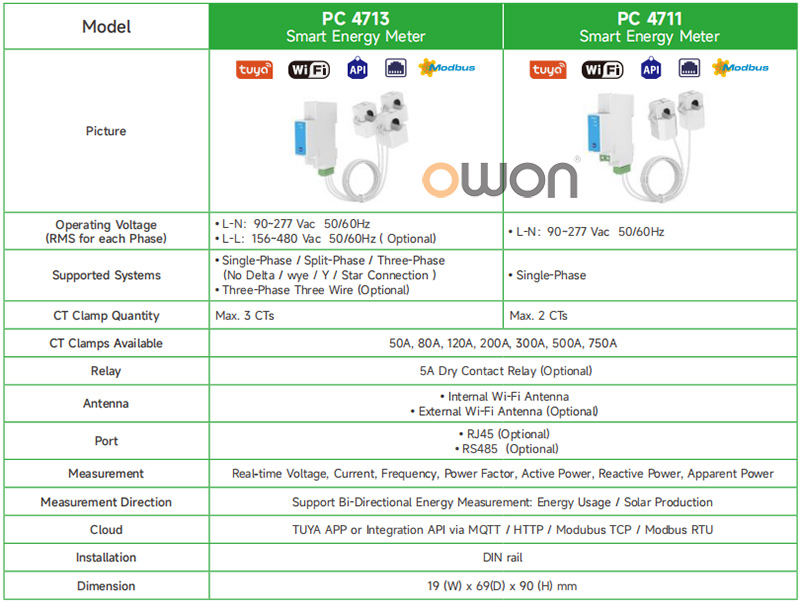
The OWON PC4713 is an example of a communication-ready energy meter platform developed specifically for OEM, solar, battery storage, and energy management applications.
Rather than focusing on a single communication method, the PC4713 integrates multiple industrial and IoT communication technologies into one platform, allowing manufacturers to simplify product development while supporting different customer requirements.
Key capabilities include:
- Single-phase, split-phase, and three-phase compatibility
- Bidirectional active energy measurement
- Modbus RTU communication via RS485
- Modbus TCP communication via Ethernet
- MQTT protocol support
- HTTP API support
- RJ45 Ethernet interface
- CT options from 50A to 750A
- Optional dry-contact relay output
This flexibility allows manufacturers to use a single metering platform across residential solar systems, commercial battery storage projects, and hybrid inverter product families.
Instead of redesigning hardware for different communication requirements, engineering teams can focus on firmware development and application optimization.
Common Integration Challenges
Although integrating an external energy meter may appear straightforward, manufacturers often encounter several challenges during product development.
Communication Compatibility
Even when both devices support Modbus, differences in register mapping, polling intervals, and firmware implementation can increase software development time.
Selecting a mature communication platform helps minimize these integration challenges.
Export Limitation
Many countries now require export limitation or zero-export functionality for residential PV systems.
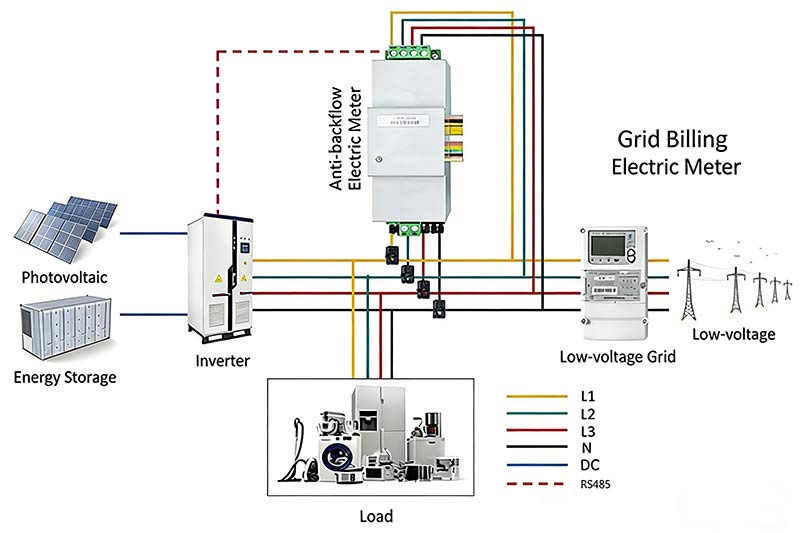
To comply with these regulations, hybrid inverters must continuously monitor power flow at the grid connection point.
For projects requiring zero-export or anti-backflow operation, an anti export energy meter provides the real-time power flow data needed for inverter control and grid compliance.
Future Software Expansion
Today’s inverter platforms are expected to support much more than solar generation.
Future integration often includes:
- Battery Energy Storage Systems (BESS)
- Home Energy Management Systems (HEMS)
- EV Charging
- Virtual Power Plants (VPP)
- Cloud Energy Platforms
Selecting an expandable communication platform today helps manufacturers avoid unnecessary hardware redesigns in future product generations.
Feature Comparison Table
| Selection Criteria | Why It Matters |
|---|---|
| Bidirectional Energy Measurement | Enables battery charging, export limitation, and solar self-consumption |
| Modbus RTU | Industry-standard inverter communication |
| Modbus TCP | Ethernet-based industrial integration |
| RS485 Interface | Reliable long-distance communication |
| MQTT Support | Cloud and EMS connectivity |
| HTTP API | Third-party software integration |
| Flexible CT Options | Supports residential and commercial applications |
| Multi-System Compatibility | Single-phase, split-phase, and three-phase deployment |
| Relay Output | Supports export control and intelligent load management |
Industry Trend: Communication Is Becoming More Important Than Measurement
Several years ago, energy meters were primarily selected based on measurement accuracy.
Today, purchasing priorities have shifted.
Hybrid inverter manufacturers increasingly evaluate communication capability before measurement specifications.
This shift is driven by three industry trends:
- The rapid growth of residential battery storage
- Increasing demand for cloud-based energy management
- Greater integration between solar, storage, EV charging, and smart home systems
As a result, communication-ready energy meters are becoming a key component of next-generation inverter platforms.
Manufacturers are no longer selecting a meter solely to measure electricity—they are selecting a platform capable of exchanging data across an entire energy ecosystem.
FAQ
Why do hybrid inverter manufacturers prefer Modbus energy meters?
Modbus is an open and widely adopted industrial communication protocol that simplifies integration between hybrid inverters, energy meters, battery systems, and energy management platforms.
Is RS485 still relevant for modern hybrid inverter systems?
Yes. RS485 remains one of the most reliable communication interfaces for field installations due to its long communication distance, noise immunity, and compatibility with Modbus RTU.
Why is bidirectional energy measurement important?
In modern PV and battery storage projects, a bidirectional energy meter provides the real-time energy flow data needed to improve system efficiency, optimize battery charging, and maximize solar self-consumption.
Can one energy meter platform support multiple inverter models?
Many manufacturers prefer a scalable meter platform that supports different electrical systems, CT ratings, and communication methods, allowing multiple inverter models to share the same hardware architecture.
What should manufacturers consider besides measurement accuracy?
Communication protocols, firmware compatibility, API availability, CT flexibility, OEM customization, and long-term product support are often equally important when selecting an energy meter platform.
Conclusion
Selecting the right Modbus energy meter is no longer simply a hardware decision. For hybrid inverter manufacturers, it directly influences communication reliability, software integration, battery optimization, export limitation, and future product scalability.
A communication-ready platform that combines bidirectional measurement, Modbus RTU, Modbus TCP, RS485, MQTT, and API support can significantly reduce development effort while improving compatibility across residential, commercial, and energy storage applications.
As the energy industry continues to move toward intelligent and interconnected systems, choosing a scalable energy meter platform today will help manufacturers accelerate product development and better prepare for tomorrow’s energy management requirements.
Post time: Jun-11-2026