Introduction
As energy costs increase and energy management becomes more important, organizations need better visibility into how electricity is generated, consumed, and optimized.
A modern Ethernet energy meter provides real-time electrical measurement together with reliable network communication, allowing energy data to be integrated into monitoring platforms, energy management systems (EMS), building management systems (BMS), and industrial automation solutions.
Compared with traditional standalone meters, Ethernet-based energy monitoring devices can transmit measurement data directly through local networks, helping users improve energy visibility and simplify system integration.
Today, Ethernet energy meters are used across a wide range of applications, including smart homes, commercial buildings, solar PV systems, industrial facilities, and energy management projects.
As a smart energy meter manufacturer, OWON develops energy monitoring solutions designed for system integrators, OEM partners, solar applications, and smart energy projects.
What Is an Ethernet Energy Meter?
An Ethernet energy meter is an electrical measurement device that uses Ethernet communication to transmit power and energy data to monitoring platforms or management systems.
Unlike traditional meters that only display local readings, Ethernet-based meters allow users to collect and analyze energy information remotely.
Typical measurement parameters include:
- Voltage
- Current
- Active power
- Reactive power
- Apparent power
- Frequency
- Power factor
- Energy consumption
- Energy production
An Ethernet energy meter usually connects to a local network through an Ethernet port and communicates with software platforms through industrial communication protocols.
Depending on the model, an energy meter with Ethernet communication may support protocols such as:
- Modbus TCP
- MQTT
- HTTP API
This makes Ethernet meters suitable for projects requiring stable data transmission and flexible integration.
Why Ethernet Power Meters Are Used in Modern Energy Monitoring Projects
An Ethernet power meter is often selected when projects require reliable communication, centralized monitoring, and long-term scalability.
Stable Network Communication
Ethernet provides a wired communication connection that is not affected by wireless interference or signal coverage limitations.
This makes Ethernet power meters suitable for:
- Commercial buildings
- Industrial facilities
- Solar installations
- Energy management projects
- Large residential properties
Easy Integration with Energy Platforms
Modern energy projects often require data sharing between multiple systems.
An Ethernet energy meter can connect with:
- EMS platforms
- BMS systems
- SCADA systems
- Industrial controllers
- Cloud energy platforms
This allows operators to monitor energy consumption, identify trends, and optimize energy usage.
Scalable Multi-Device Deployment
For projects with multiple monitoring points, Ethernet-based communication allows multiple meters to be connected through existing network infrastructure.
This is especially useful for:
- Office buildings
- Factories
- Multi-unit properties
- Solar installations
Ethernet Energy Meter vs WiFi Energy Meter: How to Choose
Both Ethernet and WiFi energy meters are widely used, but they serve different application requirements.
| Feature | Ethernet Energy Meter | WiFi Energy Meter |
|---|---|---|
| Communication | Wired network | Wireless network |
| Stability | Very high | Depends on WiFi environment |
| Installation | Requires network cable | Easier installation |
| Best for | EMS, BMS, industrial, commercial projects | Residential and smart home applications |
| Integration | Strong industrial compatibility | Convenient cloud and app access |
A WiFi energy meter is often preferred for simple residential monitoring where easy installation and mobile app access are important.
An Ethernet energy meter is usually preferred when stable communication, professional integration, and long-term deployment are required.
However, many modern energy monitoring projects combine different communication methods depending on application needs.
Why Energy Meters with Ethernet Ports Simplify Integration
An energy meter with Ethernet port provides a direct connection to network infrastructure, reducing the complexity of communication design.
For system integrators and energy solution providers, Ethernet connectivity offers several advantages:
Direct Network Connection
Ethernet meters can connect directly to:
- Network switches
- Local servers
- EMS platforms
- Building automation systems
Support for Industrial Protocols
Many Ethernet energy meters support communication protocols designed for professional applications.
Examples include:
Modbus TCP
Widely used in:
- EMS
- BMS
- SCADA
- Industrial automation
MQTT
Suitable for:
- IoT platforms
- Cloud applications
- Smart energy solutions
HTTP API
Useful for:
- Custom software integration
- Data platforms
- Remote monitoring applications
Choosing an energy meter with Ethernet communication gives project developers more flexibility when designing energy monitoring architectures.
Choosing a 3 Phase Ethernet Energy Meter
For many commercial and industrial applications, a 3 phase energy meter with Ethernet communication is required.
Three-phase systems are commonly used in:
- Commercial buildings
- Manufacturing facilities
- Solar systems
- EV charging infrastructure
- Large residential properties
When selecting a three-phase Ethernet energy meter, consider:
Electrical System Compatibility
The meter should support the required system type:
- Three-phase four-wire systems
- Three-phase three-wire systems
- Split-phase systems
- Single-phase systems
Measurement Requirements
Professional projects may require monitoring:
- Energy consumption
- Solar generation
- Grid import/export
- Power quality parameters
Communication Requirements
For integration projects, support for protocols such as:
- Modbus TCP
- Modbus RTU
- MQTT
can simplify connection with existing platforms.
Typical Applications of Ethernet Energy Meters
The flexibility of Ethernet communication makes Ethernet energy meters suitable for a wide range of energy monitoring applications.
Smart Homes and Residential Energy Management
As home energy systems become more connected, homeowners increasingly want to monitor electricity consumption in real time rather than waiting for monthly utility bills.
An Ethernet power monitor can provide stable local communication for:
- Whole-home energy monitoring
- Residential solar systems
- Home battery storage
- EV charger monitoring
- Home energy management platforms
Compared with wireless communication, Ethernet offers consistent network performance for installations where a wired LAN connection is already available.
Commercial Buildings
Commercial buildings often monitor multiple electrical loads, including:
- HVAC systems
- Lighting
- Elevators
- Common-area equipment
- Tenant electricity consumption
An Ethernet power meter allows energy data from different distribution panels to be collected by a central EMS or BMS, helping facility managers identify energy-saving opportunities and improve operational efficiency.
Solar PV and Battery Storage Systems
Modern solar installations require more than measuring electricity consumption.
An Ethernet energy meter with bidirectional measurement can monitor:
- Solar generation
- Building consumption
- Grid import
- Grid export
- Battery charging and discharging
When integrated with an Energy Management System (EMS), this data helps optimize self-consumption, peak shaving, and overall energy performance.
Industrial Energy Monitoring
Factories and manufacturing facilities often require continuous monitoring of production equipment and electrical distribution systems.
Because industrial environments typically prioritize communication stability, an energy meter with Ethernet communication is well suited for:
- Production lines
- Pumps and motors
- Compressors
- Distribution panels
- Factory EMS platforms
Example: Ethernet Energy Meter for Smart Energy Projects
As a manufacturer of smart energy meters, OWON develops energy monitoring solutions for residential, commercial, industrial, and renewable energy applications.
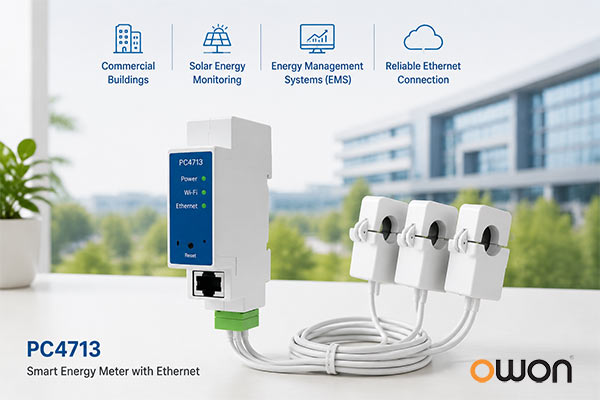
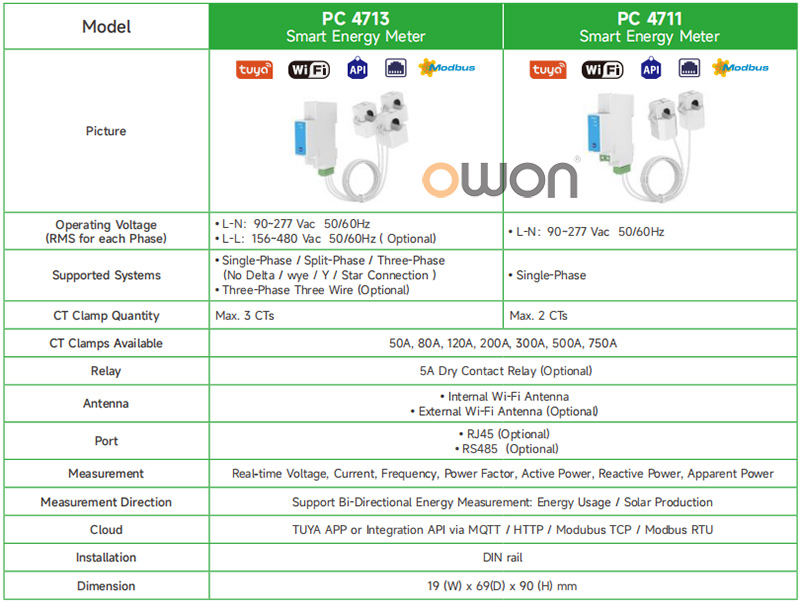
One example is the OWON PC4713 Ethernet Energy Meter, designed for projects that require accurate electrical measurement together with flexible communication options.
Key capabilities include:
- Supports single-phase, split-phase, three-phase four-wire, and three-phase three-wire electrical systems
- Ethernet communication (10/100 Mbps)
- Available with WiFi or Ethernet communication options
- Supports Modbus TCP, MQTT, and HTTP API for system integration
- Bidirectional energy measurement for solar import and export monitoring
- Real-time monitoring of voltage, current, active power, reactive power, apparent power, frequency, and power factor
- Compatible with EMS, BMS, solar monitoring platforms, and custom energy management software
Rather than serving as a standalone meter, the PC4713 is designed to become part of a connected energy monitoring system that can grow with future project requirements.
Frequently Asked Questions
What is an Ethernet energy meter?
An Ethernet energy meter measures electrical parameters such as voltage, current, power, and energy consumption while transmitting data through an Ethernet network. It enables real-time monitoring and easy integration with energy management platforms.
What is the difference between an Ethernet energy meter and a WiFi energy meter?
The main difference is the communication method.
Ethernet energy meters use wired network connections, offering stable communication for professional projects.
WiFi energy meters communicate wirelessly, making installation easier in residential and light commercial applications.
The most suitable option depends on the project environment and integration requirements.
Can an Ethernet energy meter connect to an EMS?
Yes. Many Ethernet energy meters support industrial communication protocols such as Modbus TCP, allowing them to integrate with Energy Management Systems (EMS), Building Management Systems (BMS), SCADA platforms, and other monitoring software.
Can Ethernet energy meters be used in residential applications?
Yes. Although Ethernet energy meters are widely used in commercial and industrial projects, they are also suitable for residential energy monitoring where a stable wired network is preferred.
Typical residential applications include:
- Whole-home energy monitoring
- Solar PV systems
- Home battery storage
- High-end smart home installations
What should I consider when choosing an Ethernet energy meter?
Before selecting an Ethernet energy meter, consider:
- Electrical system compatibility
- Communication protocols
- Measurement functions
- Solar monitoring capability
- Platform integration requirements
- Future scalability
Choosing a solution that supports open communication protocols and multiple electrical system types can simplify future expansion.
Conclusion
An Ethernet energy meter is more than a device for measuring electricity—it is an important part of a modern energy monitoring system.
Whether the application involves a smart home, commercial building, solar PV installation, or industrial facility, Ethernet communication provides reliable data transmission and flexible integration with energy management platforms.
For project developers, system integrators, and OEM partners, selecting an energy meter with the right communication options, electrical compatibility, and monitoring capabilities helps build scalable and future-ready energy management solutions.
Post time: Jun-17-2026