A hotel room thermostat plays an important role in both guest comfort and HVAC management. Beyond basic temperature adjustment, modern thermostats can support occupancy sensing, temperature limits, scheduling, remote monitoring, and connected HVAC control.
For hotel owners, HVAC contractors, and system integrators, choosing the right thermostat requires more than selecting a WiFi-enabled device. HVAC compatibility, guest controls, occupancy detection, installation requirements, and management capabilities should all be considered.
This guide explains how hotel room thermostats work, why hotels may limit thermostat settings, and what to look for when selecting a thermostat for hotel HVAC projects.
What Is a Hotel Room Thermostat?
A hotel room thermostat controls the heating and cooling equipment serving an individual guest room or suite.
Depending on the property, the thermostat may work with conventional HVAC equipment, heat pumps, or other compatible room HVAC systems. Some PTAC units can also work with external wall thermostats when they provide a compatible thermostat interface.
Traditional thermostats primarily provide local temperature adjustment. A modern smart hotel thermostat can add features such as WiFi connectivity, occupancy sensing, scheduling, temperature limits, remote room sensors, and remote management.
These capabilities become increasingly valuable when a hotel needs to manage HVAC operation across many guest rooms.

How Does a Hotel Room Thermostat Work?
At the room level, thermostat operation is relatively simple:
Guest → Thermostat → HVAC Equipment
The thermostat measures room temperature, compares it with the selected setpoint, and sends heating or cooling commands to compatible HVAC equipment.
Connected thermostats can add another management layer:
Management Platform → Network → Thermostat → HVAC Equipment
Depending on the thermostat and system architecture, authorized staff may be able to monitor room conditions or manage supported thermostat functions remotely.
This can make connected thermostats useful for hotels looking to improve HVAC visibility and reduce unnecessary room-by-room adjustments.
Why Are Hotel Room Thermostats Sometimes Locked?
Guests sometimes find that a hotel room thermostat is locked or does not allow temperature adjustment beyond a certain range.
This does not necessarily indicate a malfunction.
Hotels may configure temperature limits or thermostat locks to balance guest comfort, HVAC equipment protection, and property energy-management policies. Guests may still be allowed to adjust room temperature within an approved range while administrator or installer settings remain protected.
Some users search for a hotel thermostat override or bypass when encountering these restrictions. However, thermostat settings vary by property and model. If normal guest controls do not work as expected, contacting hotel staff is preferable to using undocumented override procedures.
For hotel operators, thermostat lock and temperature-limit functions can therefore be useful selection criteria.
Why Is a Hotel Room Thermostat Not Cooling?
Another common problem is a hotel room thermostat that will not cool or appears not to be working.
Possible causes include an incorrect operating mode, configured temperature limits, compressor protection delays, HVAC control settings, or a problem with the heating and cooling equipment itself.
In connected HVAC environments, occupancy or energy-management settings may also affect room operation.
If normal thermostat controls do not resolve the problem, hotel staff or qualified HVAC personnel should inspect the system.
For hotel operators, access to thermostat status and operating information can make troubleshooting across multiple rooms more efficient.
7 Essential Features of a Smart Hotel Room Thermostat
When choosing thermostats for a hotel project, WiFi connectivity alone should not determine the decision. Buyers should evaluate the complete HVAC application.
1. HVAC Compatibility
Start with the existing HVAC equipment.
Check the control voltage, wiring terminals, heating and cooling stages, heat pump requirements, auxiliary heat, emergency heat, and other system-specific controls.
For retrofit projects, thermostat compatibility should be confirmed before large-scale deployment.
2. Temperature Limits and Lock Controls
Hotels may want to give guests control over comfort while preventing unauthorized changes to important thermostat settings.
Temperature limits and lock functions can help balance guest control with property HVAC policies.
3. Occupancy Sensing
Occupancy sensing can provide information about whether a guest room or space is occupied.
When supported by the thermostat and overall HVAC control strategy, occupancy information can contribute to more appropriate temperature management for occupied and unoccupied spaces.
4. Remote Management
WiFi-connected thermostats can support remote access to selected functions, depending on the device and management platform.
For larger hotel properties, this can simplify thermostat monitoring and management across multiple rooms.
5. Scheduling
Programmable schedules allow thermostat operation to follow defined time periods and HVAC requirements.
More advanced scheduling may also incorporate temperature, fan, or sensor-related settings depending on the thermostat.
6. Remote Room Sensors
Remote sensors can provide temperature or occupancy information from locations away from the thermostat itself.
This can be useful in suites or larger guest rooms where the thermostat’s wall location may not accurately represent conditions in the occupied area.
Remote sensing should not be confused with true HVAC zoning, which requires appropriate zone-control equipment.
7. System Integration
For connected hotel projects, buyers should also consider how thermostats fit into the broader system architecture.
Depending on the solution, integration may involve WiFi networks, cloud platforms, APIs, gateways, or centralized management software.
Hotel Thermostats for 24VAC HVAC, Heat Pumps and PTAC Applications
North American hotels use different types of HVAC equipment, so thermostat compatibility should always be checked at the project level.
For hotels using 24VAC HVAC systems, thermostat wiring may include terminals for heating, cooling, fan control, heat pump reversing valves, auxiliary heat, and emergency heat.
Heat pump projects require particular attention to O/B control, supported heating and cooling stages, and auxiliary or emergency heating.
PTAC systems require separate compatibility verification. Some PTAC units provide an external wall-thermostat interface, while others use proprietary controls. Buyers should confirm the PTAC’s thermostat interface and wiring requirements before selecting a replacement thermostat.
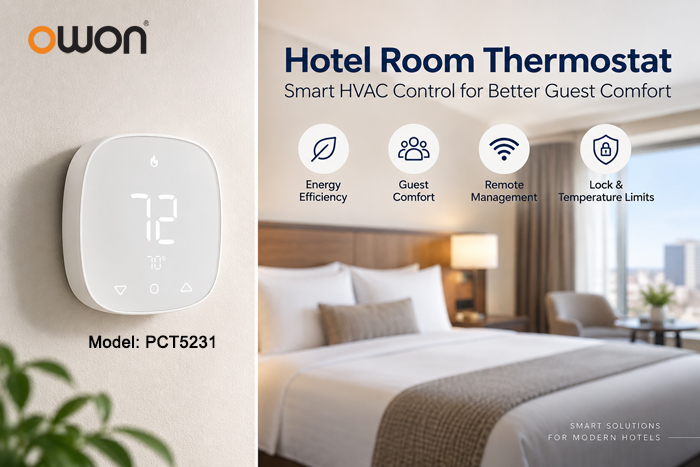
PCT5231 as a Hotel Room Thermostat Option
For hotel projects using compatible North American 24VAC HVAC systems, the OWON PCT5231 WiFi thermostat is one option to consider for guest-room temperature control.
The PCT5231 works with most 24V heating and cooling systems and supports conventional HVAC, heat pumps, auxiliary and emergency heat, and dual-fuel or hybrid heating configurations.
Several of its features are particularly relevant to hotel room applications:
• Occupancy, temperature and humidity sensing
• Up to 10 remote sensors
• 7-day Fan/Temp/Sensor scheduling
• Thermostat lock function
• Preheat and precool
• Daily, weekly and monthly energy usage information
• WiFi connectivity and mobile remote control
• Optional C-wire adapter for compatible retrofit applications
The PCT5231′s remote sensors also support occupancy, temperature, and humidity sensing and can be wall-mounted or placed on a tabletop.
These capabilities make the PCT5231 particularly relevant where a hotel project requires a combination of 24VAC HVAC control, occupancy awareness, remote room sensing, scheduling, and connected thermostat management.
For suites or larger guest spaces, remote sensors can also provide room-condition information from locations beyond the thermostat’s wall position.
As with any hotel retrofit, compatibility should be confirmed against the actual HVAC equipment and wiring before deployment.
Centralized HVAC Management for Hotel Projects
For a single room, local thermostat control may be sufficient. Across dozens or hundreds of guest rooms, management requirements become more complex.
Connected thermostats can form part of a broader hotel HVAC management architecture. Depending on the selected thermostat, cloud service, and integration platform, authorized operators may be able to access thermostat status, temperature settings, operating modes, schedules, and other supported functions remotely.
This can help property teams manage room conditions, apply temperature policies, prepare rooms for occupancy, and identify HVAC issues more efficiently.
For system integrators, API and platform integration should also be evaluated when thermostats need to connect with a larger hotel automation or building management system.
How to Choose a Hotel Room Thermostat for Retrofit Projects
Before purchasing thermostats for a hotel retrofit, start with the existing HVAC architecture.
Determine whether the property uses conventional 24VAC HVAC, heat pumps, PTAC units, or another control architecture. Then check:
• HVAC wiring and control voltage
• Heating and cooling stages
• C-wire availability
• Occupancy requirements
• Temperature limits and lock controls
• Remote sensor requirements
• Network connectivity
• Remote management
• System integration requirements
For larger deployments, testing the thermostat with the actual HVAC equipment before full-scale installation can help verify compatibility and installation requirements.
A hotel thermostat should therefore be evaluated based on:
HVAC Compatibility + Guest Control + Occupancy + Connectivity + Management
—not WiFi connectivity alone.
Frequently Asked Questions
Do hotel rooms have thermostats?
Yes. Many hotels provide individual thermostats for guest-room temperature control. Available functions depend on the HVAC system, thermostat, and property management strategy.
Why do hotels lock thermostats?
Hotels may use thermostat locks or temperature limits to protect important settings, manage HVAC operation, and allow guest comfort adjustments within defined ranges.
How do I adjust a hotel room thermostat?
Use the normal guest-accessible temperature, mode, and fan controls. Available settings vary by hotel and HVAC system. If the thermostat is locked or does not respond normally, contact hotel staff.
Why is my hotel room thermostat not cooling?
Possible causes include operating mode, temperature limits, HVAC delays, thermostat configuration, or an equipment issue. Persistent problems should be checked by hotel staff or HVAC personnel.
Can hotel room thermostats detect occupancy?
Some models can. For example, the PCT5231 specification includes occupancy, temperature, and humidity sensing in both the thermostat and its compatible remote zone sensors.
Can a hotel use a WiFi thermostat with a heat pump?
Yes, provided the thermostat supports the specific heat pump configuration. Buyers should verify O/B control, heating and cooling stages, auxiliary heat, emergency heat, and wiring requirements.
Can a 24VAC thermostat work with a PTAC?
It depends on the PTAC. Some PTAC units provide a compatible external thermostat interface, while others use proprietary controls. Compatibility should be verified with the PTAC specifications before installation.
Choosing the Right Hotel Room Thermostat
The right hotel room thermostat should provide reliable guest comfort while fitting the property’s HVAC and management requirements.
For North American projects, buyers should evaluate 24VAC compatibility, heat pump control, occupancy sensing, temperature limits, thermostat locks, remote sensors, connectivity, and system integration before making a selection.
For hotels using compatible 24VAC HVAC systems, the OWON PCT5231 provides one option combining multi-stage HVAC control, occupancy sensing, remote sensors, scheduling, lock functions, and WiFi connectivity.
For hotel owners, HVAC contractors, and system integrators planning new installations or retrofit projects, identifying the existing HVAC architecture is the best starting point for selecting the appropriate thermostat solution.
Related reading:
[Hotel Room Management: Why Smart IoT Solutions Are Transforming Hospitality]
Post time: Oct-24-2025


