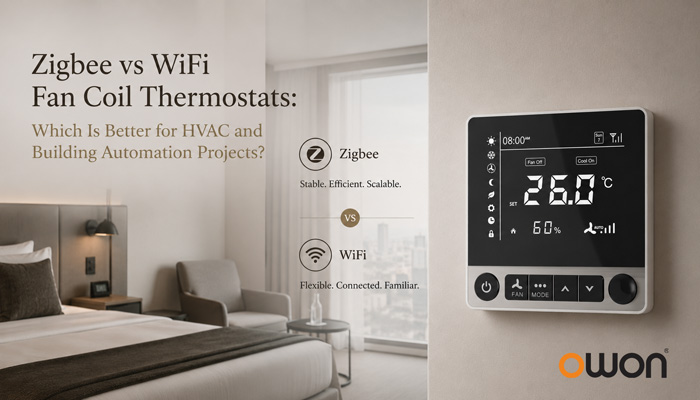
If you are planning an HVAC project, sooner or later someone will ask a seemingly simple question:
“Should we use a Zigbee thermostat or a WiFi thermostat?”
At first glance, the answer appears straightforward. Both can control a fan coil unit. Both can provide remote access. Both can help improve comfort and energy efficiency.
Then the project grows from one room to fifty.
Or from fifty rooms to five hundred.
And suddenly, that simple question becomes a lot more interesting.
The reality is that choosing a fan coil unit thermostat is no longer just about temperature control. It is also about scalability, maintenance, integration, and how much complexity you want to deal with a year from now.
As many experienced engineers will tell you, almost every system looks simple before deployment.
The real test begins after installation.
Why Connectivity Matters in Fan Coil Unit Control
A modern FCU thermostat does much more than turn heating or cooling on and off.
In commercial buildings, hotels, apartments, and mixed-use properties, thermostats often become part of a much larger system that includes:
- Energy management
- Occupancy control
- Remote maintenance
- Building automation
- Centralized monitoring
Because of this, the communication technology behind the thermostat can have a significant impact on how the entire project performs over time.
Choosing the wrong connectivity method is a bit like choosing the wrong foundation for a building. Everything may look fine on day one, but the consequences tend to appear later.
How WiFi Fan Coil Thermostats Work
WiFi thermostats are familiar to almost everyone.
Each thermostat connects directly to the local wireless network and communicates through the existing WiFi infrastructure.
For many projects, this approach works perfectly well.
Advantages of WiFi Thermostats
The biggest advantage is simplicity.
There is no dedicated gateway required.
Most installers already understand WiFi networks.
Deployment can be relatively straightforward, especially for small projects.
WiFi is often an excellent choice when:
- Managing a small number of rooms
- Upgrading residential properties
- Prioritizing fast installation
Things to Consider
As the number of devices increases, WiFi networks can become more demanding to manage.
Each thermostat becomes another client on the network.
In larger buildings, maintaining stable connectivity across hundreds of devices can become a project of its own.
And while nobody enjoys troubleshooting HVAC systems, troubleshooting HVAC systems and WiFi networks at the same time is rarely anyone’s favorite activity.
How Zigbee Fan Coil Thermostats Work
A Zigbee fan coil thermostat operates differently.
Instead of connecting directly to WiFi, devices communicate through a Zigbee mesh network and connect to the wider system through a gateway.
If you have ever watched a well-organized team complete a project, that is roughly how a Zigbee mesh network behaves.
Devices help relay communications across the network, creating a flexible and scalable architecture.
Advantages of Zigbee Thermostats
For larger projects, Zigbee offers several benefits:
- Low-power communication
- Reliable mesh networking
- Centralized device management
- Easy expansion across multiple rooms
The more devices you add, the more valuable these advantages often become.
Things to Consider
Zigbee typically requires a gateway.
Initial network planning can also require slightly more thought than a simple WiFi deployment.
Fortunately, spending a little extra time during planning often saves a lot of time later.
Engineers tend to appreciate that trade.
Zigbee vs WiFi: A Practical Comparison
| Factor | Zigbee | WiFi |
|---|---|---|
| Small Projects | Good | Excellent |
| Hotel Deployment | Excellent | Good |
| Multi-Room Management | Excellent | Moderate |
| Scalability | Excellent | Moderate |
| Device Density | Excellent | Moderate |
| Installation Simplicity | Good | Excellent |
| Centralized Control | Excellent | Good |
Neither technology is universally better.
The right choice depends on the type of project you are building.
Why Many Hotel and Building Automation Projects Prefer Zigbee
This is where things become particularly relevant for system integrators and building automation professionals.
Hotels are rarely deploying a thermostat in isolation.
A typical room may also include:
- Door sensors
- Motion sensors
- Smart plugs
- Relays
- Energy monitoring devices
- Gateways
These devices work together to support energy management and occupancy-based automation.
When a guest leaves the room, the thermostat can switch to an energy-saving mode.
When occupancy is detected again, comfort settings can automatically return.
The goal is not simply temperature control.
The goal is intelligent room management.
And this is where Zigbee often fits naturally.
Easier Multi-Room Deployment
Hotels, student housing, serviced apartments, and commercial buildings may contain hundreds or even thousands of rooms.
Managing large numbers of devices through a centralized Zigbee architecture is often simpler than maintaining hundreds of individual WiFi endpoints.
Better Support for Retrofit Projects
Many existing buildings were not designed with modern building automation in mind.
Running new cables is expensive.
Replacing existing infrastructure is disruptive.
Zigbee’s wireless architecture makes it particularly attractive for retrofit projects where minimal disruption is a priority.
The Growing Importance of Open Zigbee Ecosystems
Over the past few years, another trend has emerged.
System integrators increasingly want flexibility.
They do not necessarily want devices tied to a single platform, cloud service, or vendor ecosystem.
Instead, they want hardware that can fit into their own software architecture.
This is one reason why open Zigbee ecosystems have gained so much attention.
Why Zigbee2MQTT Is Becoming Popular
If you work in integration projects, you have probably encountered Zigbee2MQTT.
Its popularity comes from a fairly simple idea:
Allow Zigbee devices to communicate through MQTT, making integration with custom applications and third-party platforms much easier.
For system integrators, that flexibility can be extremely valuable.
The attraction is not Zigbee2MQTT itself.
The attraction is control.
Control over data.
Control over integrations.
Control over how the final solution is built.
Home Assistant and Open Integration
The same principle applies to Home Assistant.
Many integrators use Home Assistant and Zigbee2MQTT environments to validate concepts, test interoperability, or develop custom solutions.
As a result, compatibility with open ecosystems is becoming an increasingly important consideration when selecting HVAC devices.
A Real-World Example: A European Hotel Retrofit Project
One European hotel system integrator faced a familiar challenge.
The objective was to reduce room energy consumption while preserving the existing HVAC infrastructure.
The hotel wanted to avoid major construction work and costly rewiring.
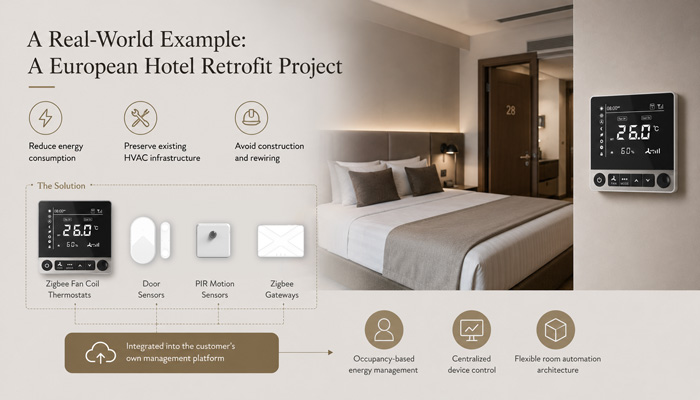
The solution combined:
- Zigbee fan coil thermostats
- Door sensors
- PIR motion sensors
- Zigbee gateways
All devices were integrated into the customer’s own management platform.
The result was a more flexible room automation architecture that supported occupancy-based energy management and centralized device control.
Interestingly, the customer originally approached the project looking for a thermostat.
The broader device ecosystem came later.
That is often how building automation projects evolve in the real world.
OWON PCT504 Zigbee Fan Coil Thermostat
A good example of this approach is the OWON PCT504 Zigbee Fan Coil Thermostat.
Designed for commercial HVAC applications, it supports:
- Zigbee 3.0 communication
- Fan coil unit control
- Building automation deployments
- Hotel energy management projects
It is also compatible with Zigbee2MQTT and included in the official supported device list, making it attractive for projects that prioritize open integration.
For many system integrators, thermostat selection is no longer only about temperature control.
It is also about how easily the device fits into a larger automation architecture.
When WiFi Makes Sense
WiFi remains an excellent choice in many situations.
Particularly when:
- The project is relatively small
- Device counts are limited
- Simplicity is the primary goal
- Existing WiFi infrastructure is already well managed
In these environments, WiFi can be efficient, cost-effective, and easy to deploy.
When Zigbee Makes Sense
Zigbee becomes increasingly attractive when projects involve:
- Hotels
- Apartments
- Student housing
- Commercial buildings
- Multi-room HVAC systems
- Energy management projects
- Building automation integrations
As the number of devices grows, Zigbee’s scalability and centralized management advantages often become more apparent.
Conclusion
When choosing between a Zigbee fan coil thermostat and a WiFi fan coil thermostat, the real question is not which technology is better.
The real question is which technology better supports the long-term goals of your project.
For smaller deployments, WiFi may provide exactly the simplicity you need.
For larger HVAC and building automation projects, Zigbee often offers advantages in scalability, centralized management, and integration flexibility.
And as open ecosystems such as Zigbee2MQTT continue to gain traction, that flexibility is becoming increasingly valuable for system integrators looking to build solutions that remain adaptable long after the installation is complete.
Post time: Jun-17-2026