The Smart HVAC Market Is Expanding Beyond Equipment
For decades, HVAC manufacturers primarily focused on producing heating and cooling equipment such as furnaces, heat pumps, boilers, air handlers, and fan coil units.
Today, however, customer expectations are changing.
Property owners, HVAC contractors, and building operators increasingly expect connected HVAC systems that provide:
- Remote control
- Mobile app access
- Energy reporting
- Smart scheduling
- Occupancy-based automation
- Integration with smart home and building management platforms
As a result, many HVAC equipment manufacturers are expanding beyond traditional hardware and adding smart thermostats to their product portfolios.
The question is no longer whether smart thermostats should be offered, but how manufacturers can introduce them efficiently and profitably.
Why HVAC Brands Are Adding Smart Thermostats
A thermostat is often the primary interface between the user and the HVAC system.
Without a modern thermostat, even advanced HVAC equipment may appear outdated to end users.
Manufacturers are adding smart thermostats to achieve several business goals:
Increase Product Value
Smart controls allow HVAC brands to offer more complete solutions rather than standalone equipment.
Improve Customer Retention
When customers use the manufacturer’s thermostat, mobile app, and ecosystem, brand loyalty typically increases.
Create Product Differentiation
Many HVAC systems have similar heating and cooling performance specifications.
Smart thermostat features help create meaningful market differentiation.
Support Energy Efficiency Initiatives
Smart controls can improve HVAC efficiency through scheduling, occupancy control, and temperature optimization.
Common Approaches Used by HVAC Equipment Manufacturers
Manufacturers typically choose one of three approaches when adding smart thermostats.
Option 1: Develop Everything In-House
This approach provides complete control over hardware, software, and branding.
However, it requires significant investment in:
- Hardware engineering
- Firmware development
- Mobile app development
- Cloud infrastructure
- HVAC compatibility testing
- Regulatory certifications
For many manufacturers, development timelines can exceed 18 to 24 months.
Option 2: Rebrand Existing Thermostats
Some companies purchase generic thermostats and simply add their logo.
While this approach reduces costs, it often limits customization and product differentiation.
Option 3: Partner with an OEM or ODM Manufacturer
This has become the most common strategy.
An experienced thermostat manufacturer can provide:
- Proven hardware platforms
- HVAC compatibility
- Certification support
- Firmware customization
- App integration
- Private label branding
This approach significantly reduces development risk while accelerating time to market.
Features Modern HVAC Customers Expect
When selecting thermostat solutions, manufacturers should consider the features most frequently requested by today’s customers.
Heat Pump Compatibility
Heat pump adoption is growing rapidly across North America.
Modern thermostats should support:
- Single-stage heat pumps
- Multi-stage heat pumps
- Auxiliary heat
- Emergency heat
- Dual fuel systems
Failure to support these applications can limit market opportunities.
Mobile App Control
Remote access has become a standard expectation for both residential and commercial users.
Users want the ability to:
- Adjust temperature remotely
- View HVAC status
- Receive alerts
- Monitor energy usage
Remote Sensors
Remote room sensors help improve comfort in larger homes, apartments, and commercial spaces.
A modern 24VAC thermostat with remote sensor support can significantly improve temperature consistency across multiple zones.
Smart Home and Building Integration
Many projects now require compatibility with:
- Alexa
- Google Assistant
- Smart Home Platforms
- Property Management Systems
- Building Management Systems
Integration capabilities are becoming increasingly important for HVAC brands.
Considerations for Heat Pump Manufacturers
Heat pump manufacturers often face unique thermostat requirements.
A suitable smart thermostat for heat pump applications should support:
- Reversing valve control
- Auxiliary heat
- Emergency heat
- Multi-stage operation
- Hybrid heating systems
As electrification initiatives continue to expand, thermostat compatibility is becoming a critical purchasing factor.
How Manufacturers Accelerate Development with Existing Thermostat Platforms
Many HVAC equipment manufacturers discover that developing a smart thermostat entirely from scratch can significantly extend project timelines and increase engineering costs.
Instead, many choose to start with an existing thermostat platform and customize it to fit their equipment, control logic, branding requirements, and cloud infrastructure.
This approach allows manufacturers to focus on their core HVAC expertise while reducing risks associated with hardware design, wireless communication, certification, and software development.
For example, thermostat platforms that already support conventional HVAC systems, heat pumps, auxiliary heat, dual fuel switching, remote sensors, mobile apps, and cloud connectivity can often be adapted much faster than developing a new product from the ground up.
A Practical Example
Many HVAC equipment manufacturers prefer to start with proven thermostat platforms rather than building new products from scratch.
For example, OWON provides several thermostat platforms that are frequently used in OEM and customization projects for HVAC manufacturers.
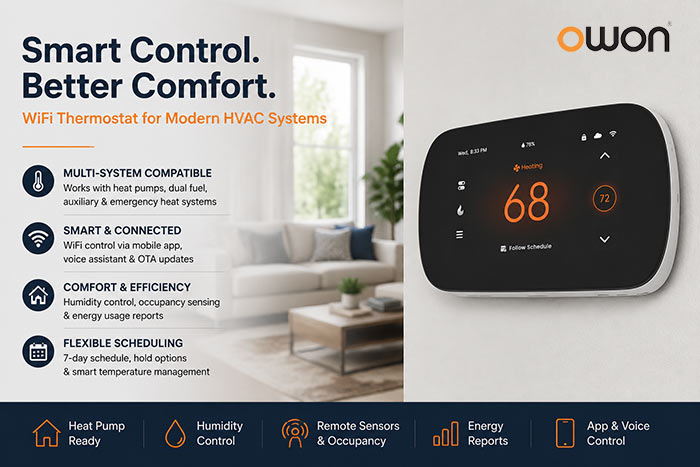
The PCT5231 WiFi thermostat supports conventional HVAC systems, heat pumps, auxiliary heat, emergency heat, dual fuel switching, hybrid heating applications, and up to 10 remote room sensors. This makes it suitable for manufacturers seeking a flexible 24VAC thermostat platform for residential and light commercial HVAC equipment.
For projects requiring a premium user experience, the PCT533 offers a 4.3-inch touchscreen interface, humidity control, occupancy sensing, energy usage tracking, remote sensors, and support for humidifiers and dehumidifiers. It is often used as a foundation for advanced smart thermostat solutions.
Rather than starting from a blank sheet of paper, manufacturers can customize hardware, firmware, cloud connectivity, and branding based on proven platforms, reducing development time and accelerating product launches.
Questions HVAC Manufacturers Should Ask Before Selecting a Thermostat Partner
Before choosing a thermostat supplier, manufacturers should evaluate:
Can the platform support future feature upgrades?
Technology expectations continue to evolve.
Is firmware customization available?
Custom HVAC logic and branding may be required.
Can the mobile app be branded?
Many manufacturers prefer a consistent customer experience.
Does the platform support North American HVAC systems?
Compatibility should be thoroughly validated.
Are OEM and ODM services available?
Different projects require different levels of customization.
Real-World OEM Example
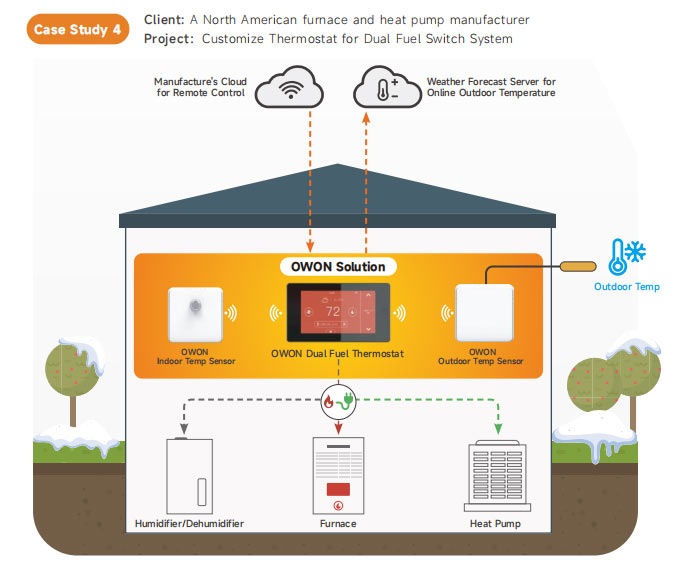
A common example involves heat pump and furnace manufacturers seeking a thermostat capable of controlling dual fuel systems.
OWON previously customized a thermostat solution for a North American HVAC manufacturer that required automatic switching between a heat pump and a conventional heating system based on outdoor temperature conditions.
The project involved custom control logic, integration with the customer’s communication protocol, outdoor temperature acquisition, and support for humidification and dehumidification control. By leveraging an existing thermostat platform instead of creating a new device from scratch, development complexity and time-to-market were significantly reduced.
Conclusion
As connected HVAC solutions become the industry standard, smart thermostats are increasingly becoming an essential part of the overall product offering.
For HVAC equipment manufacturers, adding smart thermostats can improve product differentiation, strengthen customer relationships, and create new revenue opportunities.
By partnering with an experienced thermostat development and manufacturing provider, HVAC brands can bring connected HVAC solutions to market faster while focusing on their core expertise in heating and cooling equipment.
Related reading:
[Bulk 24VAC WiFi Thermostat Supply: Driving Contract Profitability Through Tuya SaaS Integration]
Post time: Jun-16-2026