As commercial buildings become increasingly connected, energy monitoring is no longer limited to monthly utility bills. Building owners, facility managers, system integrators, and energy service providers now rely on real-time energy data to improve operational efficiency, reduce energy costs, and support sustainability goals.
In many modern projects, communication reliability has become just as important as measurement accuracy. As a result, more commercial energy monitoring systems are incorporating Ethernet-enabled devices as part of their infrastructure strategy.
An Ethernet energy meter provides stable network connectivity, supports centralized data collection, and helps integrate energy information into broader energy management systems. For smart buildings, solar installations, and commercial energy monitoring projects, Ethernet communication is becoming an increasingly important design consideration.
Why Connectivity Matters in Commercial Energy Monitoring
Commercial facilities generate energy data from multiple systems, including:
- HVAC equipment
- Lighting systems
- Elevators
- EV charging stations
- Solar power systems
- Battery energy storage systems
- Tenant sub-metering networks
This information is often transmitted to energy management systems (EMS), building management systems (BMS), or cloud platforms for analysis and optimization.
If communication becomes unreliable, operators may lose visibility into energy usage patterns and operational performance. For this reason, communication architecture is now considered a key part of energy monitoring system design.
How Ethernet Energy Meters Fit into Modern EMS Architectures
Modern energy management systems depend on continuous data collection from multiple electrical assets.
A typical deployment may include:
- Energy meters installed at electrical distribution panels
- Ethernet switches connecting multiple monitoring points
- Centralized EMS or BMS platforms
- Cloud-based analytics dashboards
- Remote monitoring and reporting tools
In this architecture, the energy meter acts as the field-level data source while Ethernet provides a stable communication pathway between measurement devices and management platforms.
This approach allows facility operators to monitor multiple loads, buildings, or energy assets from a centralized system.
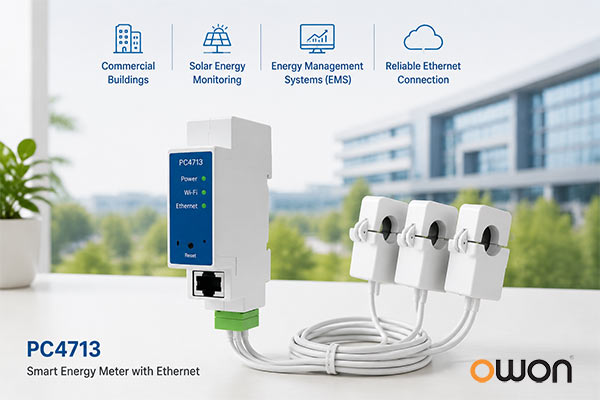
What Is an Ethernet Energy Meter?
An Ethernet energy meter is a power monitoring device that transmits measurement data through a wired Ethernet network.
Unlike standalone meters that only display local readings, Ethernet-enabled meters can provide energy data to cloud platforms, EMS software, BMS systems, and remote monitoring applications.
Typical monitoring parameters include:
- Voltage
- Current
- Power factor
- Frequency
- Active power
- Reactive power
- Apparent power
- Energy consumption
- Energy production
This makes Ethernet energy meters suitable for projects that require both accurate measurement and reliable data communication.
Benefits of Ethernet Energy Meters in Commercial Buildings
Stable Network Connectivity
Commercial buildings often contain reinforced concrete structures, electrical rooms, metal cabinets, and equipment that can influence wireless communication performance.
A wired Ethernet connection helps provide consistent communication quality across the monitoring network.
Easier Integration with Existing Infrastructure
Most commercial facilities already operate Ethernet-based IT networks.
Energy meters that support Ethernet can often be integrated into existing infrastructure without requiring additional wireless gateways.
Support for Centralized Energy Management
Many organizations use centralized energy management systems to monitor energy performance across multiple facilities.
Ethernet communication supports continuous data collection for:
- Energy reporting
- Utility cost allocation
- Load analysis
- Demand management
- Sustainability reporting
Suitable for Solar and Energy Storage Projects
Modern commercial energy systems frequently include:
- Rooftop solar
- Battery storage
- EV charging infrastructure
- Load management systems
These projects often require real-time monitoring of both electricity consumption and energy production. Ethernet communication helps ensure energy data remains available for monitoring platforms and operational decision-making.
Ethernet vs WiFi Energy Meters: Choosing the Right Option
Both Ethernet and WiFi have important roles in modern energy monitoring.
WiFi is often selected for:
- Retrofit projects
- Small commercial sites
- Fast deployments
- Locations where network cabling is difficult
Ethernet is often preferred when:
- Existing network infrastructure is available
- Centralized monitoring is required
- Building automation systems are involved
- Long-term communication stability is important
The choice depends on project requirements rather than a single technology being universally better.
Key Selection Criteria for an Ethernet Energy Meter
When evaluating an Ethernet energy meter, communication is only one part of the decision.
System integrators and project designers should also consider:
Supported Electrical Systems
- Single-phase
- Split-phase
- Three-phase
- Three-phase three-wire
Measurement Functions
- Active power
- Reactive power
- Apparent power
- Power factor
- Frequency
Energy Monitoring Requirements
- Energy consumption
- Solar production
- Bidirectional measurement
- Historical data analysis
Integration Requirements
- Energy management systems
- Building management systems
- Cloud platforms
- Third-party software
Selecting a meter that supports both communication and measurement requirements can simplify future system expansion.
Example: Ethernet Energy Meter for Smart Building and Solar Projects
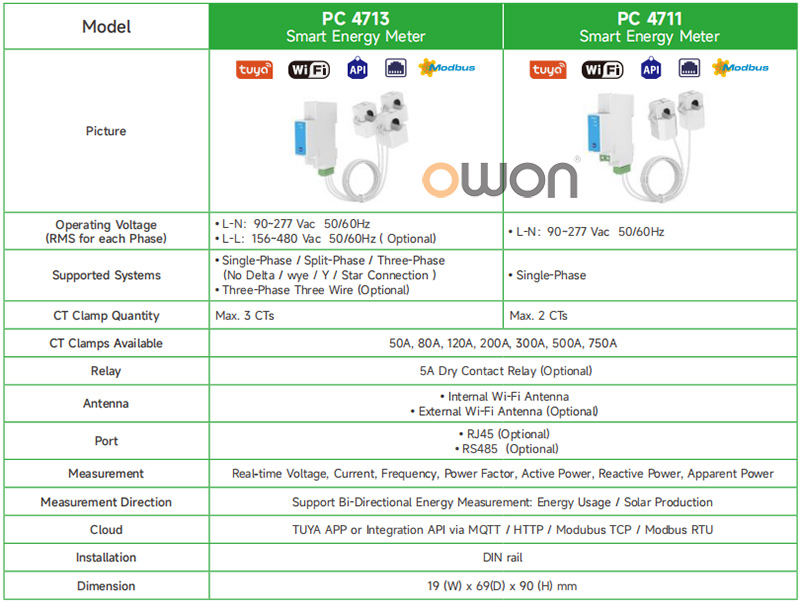
The OWON PC4713 Smart Energy Meter was developed for projects requiring advanced energy monitoring and flexible network connectivity.
Key capabilities include:
- Ethernet (10/100 Mbps)
- WiFi connectivity
- Tuya platform compatibility
- Single-phase support
- Split-phase support
- Three-phase support
- Three-phase three-wire compatibility
- Active power measurement
- Reactive power measurement
- Apparent power measurement
- Bidirectional energy monitoring
- Historical energy analytics
The meter allows users to monitor both energy consumption and solar production while providing access to real-time and historical energy data through mobile applications. It also supports automation within the Tuya ecosystem.
For system integrators, smart building projects, and commercial energy monitoring deployments, Ethernet connectivity provides additional flexibility when integrating energy data into larger management platforms.
Typical Commercial Deployment Scenarios
Smart Buildings
Monitor HVAC systems, lighting loads, elevators, and common-area electrical consumption from a centralized platform.
Solar and Energy Storage Projects
Track imported energy, exported energy, and on-site energy generation for improved operational visibility.
Multi-Site Energy Monitoring
Collect energy data from multiple buildings and facilities using existing Ethernet infrastructure.
Building Energy Management Systems
Provide real-time energy data for optimization, reporting, and performance analysis.
FAQ
Why do commercial buildings use Ethernet energy meters?
Many commercial facilities already have Ethernet infrastructure in place, making wired communication a practical option for centralized energy monitoring.
Is Ethernet better than WiFi for energy monitoring?
Both technologies are widely used. The most suitable choice depends on the project environment, communication requirements, and system architecture.
Can Ethernet energy meters support solar monitoring?
Yes. Meters that support bidirectional measurement can monitor both energy consumption and energy production.
What measurement data should a commercial energy meter provide?
Commercial projects often require voltage, current, power factor, frequency, active power, reactive power, apparent power, and energy data. The PC4713 supports these monitoring functions.
Can Ethernet energy meters be integrated into EMS platforms?
Yes. Ethernet-based communication can simplify integration with energy management and building management systems.
Final Thoughts
As commercial buildings continue to adopt digital energy management strategies, communication architecture is becoming an increasingly important part of project design.
An Ethernet energy meter provides reliable connectivity, supports centralized monitoring, and helps improve energy visibility across smart building, solar, and energy management projects.
For system integrators, facility operators, and energy management professionals, selecting the right communication method today can help create a more scalable and future-ready monitoring system tomorrow.
Post time: Jun-17-2026