Why You Are No Longer Just Choosing a Product
If you are sourcing a Zigbee door sensor, there is a good chance you already passed the “product comparison phase”.
At this point, everything probably looks similar to you.
Same shape. Same Zigbee 3.0 label. Same basic functions. Even similar datasheets that all seem written on a Monday morning by different people who never met each other.
But once you move beyond trial orders, things quietly change.
Because now you are no longer asking:
“Which sensor is better?”
You are asking something more serious:
“Which supplier will still make my life easy in 12 months?”
And trust me, those are two very different questions.
What a “Reliable Supplier” Actually Means (In Real Life)
A reliable Zigbee door sensor manufacturer is not the one with the most impressive brochure.
It is the one that does not surprise you later.
At scale, reliability usually means:
- you reorder the same product and it behaves the same
- your customers do not suddenly start opening support tickets for no reason
- your warehouse team does not discover “version 2.1” that nobody told you about
In other words:
reliable means boring, but in a very profitable way
The Criteria You Actually Care About
Let’s skip the theory and go straight to what matters in practice.
1. Batch Consistency (The Thing Nobody Cares About Until It Breaks)
At small volume, everything works fine.
At larger volume, you start noticing small differences:
- slightly different Zigbee response timing
- minor battery behavior changes
- firmware differences between batches
Individually, these are not disasters.
Collectively, they are the reason your support team stops smiling.
2. Real-World Ecosystem Behavior
You will hear customers mention Home Assistant compatible Zigbee sensor or Zigbee2MQTT compatible sensor.
But here is the translation:
They are not asking for “compatibility”.
They are asking:
“Will this thing just work without me thinking about it?”
And honestly, that is a very reasonable expectation.
Because in real deployments, nobody wakes up excited to debug a door sensor.
3. OEM / White Label Flexibility
If you are building a brand, this is where things get interesting.
You are not just buying hardware.
You are buying:
- your logo on the product
- your packaging
- your SKU identity
- your ability to repeat it without redesigning everything
A supplier without OEM flexibility is fine if you are a reseller.
But if you are building a brand, it quickly becomes a ceiling.
4. Certification Reality Check
CE, RoHS, FCC.
You already know the list.
The real question is not whether they exist.
It is whether they actually let you ship the product without spending three months talking to someone who enjoys paperwork a bit too much.
5. Supply Chain Stability
This is the quiet killer.
A supplier is not judged when you place the first order.
They are judged when you reorder six months later and expect:
- the same behavior
- the same availability
- the same product life continuity
If they pass that test, you probably found a keeper.
Where Big Zigbee Brands Fit Into Your Decision
Let’s be honest for a moment.
Brands like Sonoff, Aqara, or Heiman are not random players.
They are strong, established, and trusted in the market.
They give you something very valuable:
- market recognition
- consumer trust
- proven demand
And that is not something you ignore.
But in channel business, you may eventually notice something subtle:
They are designed for brand-driven selling.
Not necessarily for building your own product line flexibility.
So most distributors do something quite practical:
They use them, but they do not rely only on them.
Think of it as:
brand validation on one side, product control on the other
And you usually need both.
What OEM-Oriented Suppliers Typically Look Like
An OEM-focused Zigbee sensor manufacturer behaves differently.
They are less concerned with being a “brand”.
More concerned with being a stable hardware foundation.
Typically, they provide a product range like:
- Zigbee door sensors
- PIR motion sensors
- thermostats
- smart plugs
- energy devices
The idea is simple:
You build your brand on top of stable hardware.
For example, products like the OWON DWS332 Zigbee door/window sensor are often used in this type of setup.
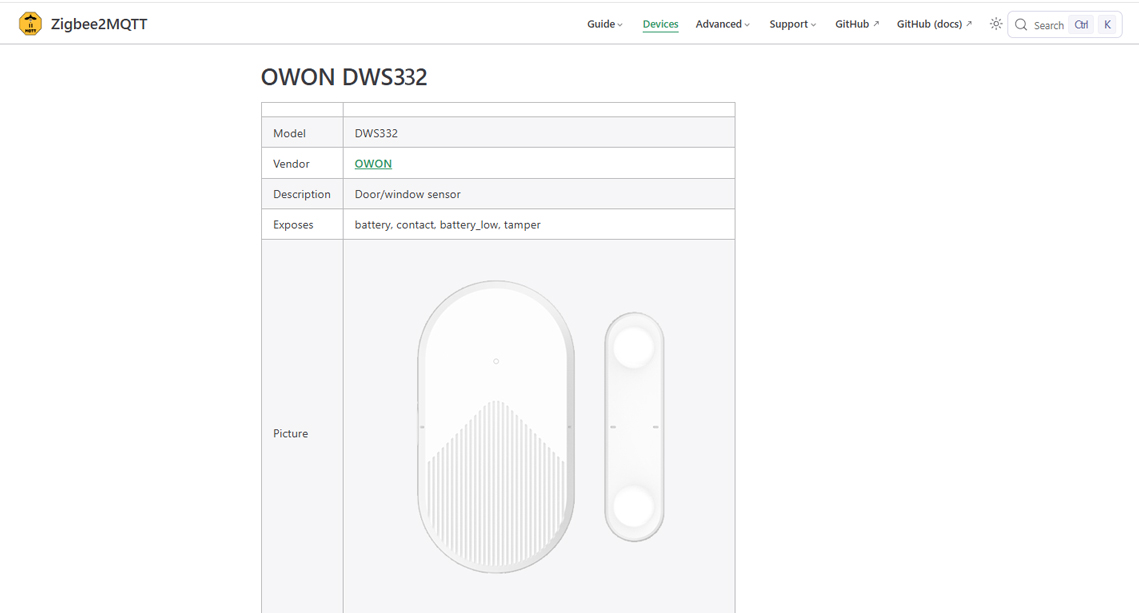
(DWS332 Door/Windows Sensor in ZigBee2MQTT Official List)
Not because it is “special”.
But because it is predictable, OEM-ready, and designed for repeat deployment.
And in this business, predictability is what keeps catalogs alive.
Supplier Evaluation Checklist
Before you make a decision, you can simplify everything into a few checks:
| Area | What You Should Really Care About |
|---|---|
| Product Stability | Will it behave the same next year? |
| OEM Capability | Can you actually build your brand on it? |
| Supply Chain | Can you reorder without surprises? |
| Certification | Can you ship without delays? |
| Ecosystem Behavior | Does it work in real deployments? |
Nothing fancy. But very effective.
Final Thought: You Are Not Choosing a Sensor
If you zoom out a little, something becomes obvious.
You are not really choosing a Zigbee door sensor supplier.
You are choosing how predictable your business will be over the next few years.
Big brands give you trust and market entry.
OEM suppliers give you flexibility and control.
And most experienced distributors do not argue about which one is better.
They simply use both where it makes sense.
Because in the end, the goal is not to find the perfect product.
It is to avoid unpleasant surprises.
And if your supplier helps you do that, you are already ahead of most people in this market.
Post time: Jun-15-2026