If you work in elderly care, you already know that safety is rarely just about technology.
It is about people.
It is about helping older adults maintain independence for as long as possible, while ensuring caregivers can respond quickly when assistance is needed.
Technology simply plays a supporting role.
And in recent years, one area has received increasing attention from care providers, assisted living operators, and elderly care solution companies: non-contact fall detection.
The reason is straightforward. As populations age and care resources become more stretched, organizations are looking for practical ways to improve resident safety without creating additional burden for either residents or care teams.
Why Falls Continue to Be a Major Concern in Elderly Care
Falls remain one of the most common safety risks in elderly care environments.
Whether in an assisted living community, a nursing home, or an independent senior living apartment, a fall can have consequences that extend far beyond the initial incident.
For care providers, the challenge is not only preventing falls where possible. It is also ensuring that when a fall does occur, help can arrive quickly.
The difficulty is that falls often happen when nobody is present in the room.
A resident may be resting, moving between rooms, or using a bathroom independently. In many cases, staff members simply cannot be everywhere at once.
This is why improving visibility without reducing independence has become such an important goal across the care industry.
The Limitations of Traditional Monitoring Approaches
For many years, elderly care providers have relied on a combination of staff observation, emergency call systems, and wearable devices.
These solutions continue to play an important role, but each comes with limitations.
Wearable Emergency Buttons
Panic buttons and wearable alarms can be highly effective when used correctly.
However, they depend on one important factor:
The resident must be wearing the device and be able to activate it.
In real-world environments, that is not always guaranteed.
Devices may be forgotten, misplaced, or removed during daily activities.
Camera-Based Monitoring
Some facilities have explored video monitoring systems.
While cameras can provide visibility, they often introduce concerns around privacy, particularly in bedrooms, bathrooms, and personal living spaces.
For many care providers and families, maintaining dignity is just as important as maintaining safety.
Manual Safety Checks
Routine checks remain a cornerstone of quality care.
However, increasing staff workloads and growing resident populations make continuous monitoring difficult.
Even the most dedicated care teams cannot be everywhere at the same time.
Why Non-Contact Fall Detection Is Gaining Attention
This is where non-contact fall detection sensors are attracting interest.
Rather than relying on a wearable device or continuous visual monitoring, these systems are designed to automatically detect potential fall events within a room.
The concept is simple:
Residents continue their normal daily routines.
Caregivers receive additional awareness when something unusual occurs.
In many ways, the best monitoring technology is the technology residents barely notice.
There are no buttons to press.
No devices to remember.
No changes to daily habits.
For elderly care providers, that balance between safety and independence is often the most valuable benefit.
How Fall Detection Sensors Support Assisted Living Environments
If you manage an assisted living facility or support independent senior living projects, fall detection technology can fit naturally into existing care workflows.
Common deployment areas include:
- Private resident apartments
- Assisted living communities
- Nursing homes
- Independent senior housing
- Retirement residences
Rather than replacing caregivers, these systems provide an additional layer of awareness.
When a potential fall event is detected, staff can verify the situation and respond more quickly if assistance is needed.
The objective is not constant monitoring.
The objective is faster response when it matters most.
What Care Providers Should Look for in a Fall Detection Solution
Not all fall detection technologies are designed for the same environments.
When evaluating a solution, several factors are particularly important.
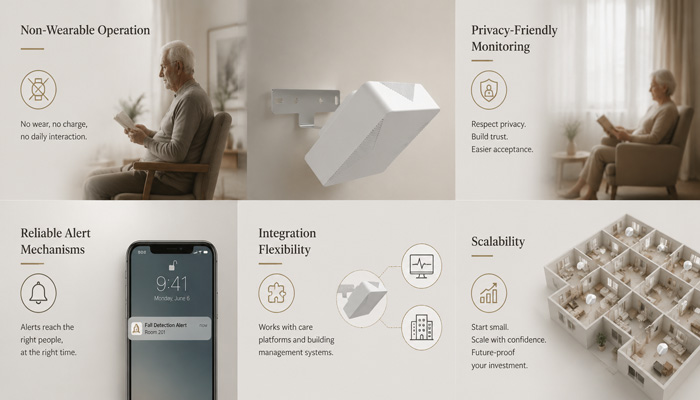
Non-Wearable Operation
Many older adults prefer technology that does not require daily interaction.
A non-contact approach removes the need for charging, wearing, or remembering a device.
Privacy-Friendly Monitoring
Solutions that support resident privacy are often easier to deploy and gain acceptance from both residents and families.
Reliable Alert Mechanisms
A monitoring system is only useful if notifications reach the right people at the right time.
Reliable alert delivery should be a key consideration.
Integration Flexibility
Many elderly care providers work with broader care platforms and building management systems.
Devices that support integration can simplify future expansion and system management.
Scalability
A pilot project may begin with a few rooms.
A successful project often grows much larger.
Choosing solutions that can scale across multiple apartments or facilities can help protect future investments.
An Example of Non-Contact Fall Detection in Practice
Many care technology providers today are exploring solutions such as the OWON FDS315 Zigbee Fall Detection Sensor as part of broader elderly care monitoring systems.
The device is designed to support:
- Non-contact fall detection
- Privacy-conscious monitoring
- Zigbee-based deployment
- Integration into larger care ecosystems
In practical deployments, it is often combined with other devices such as:
- Emergency panic buttons
- Motion sensors
- Door and window sensors
- Care management platforms
The goal is not to create a more complicated environment.
The goal is to help care teams gain better visibility while allowing residents to maintain independence.
A Broader Shift in Elderly Care Technology
What makes fall detection particularly interesting is that it reflects a larger trend within the care industry.
Historically, many technologies focused primarily on emergency response.
Today, there is growing interest in technologies that support proactive care.
Care providers are increasingly looking for solutions that help them:
- Improve resident safety
- Reduce unnecessary workload
- Respect resident privacy
- Support independent living
Non-contact fall detection aligns closely with all four objectives.
Conclusion
If you are responsible for resident safety, you already understand that there is no single technology that solves every challenge in elderly care.
Good care will always depend on people.
However, the right technology can help those people work more effectively.
As elderly care providers continue to balance safety, independence, and operational efficiency, fall detection sensors are becoming an increasingly valuable part of modern care environments.
Not because they replace caregivers.
But because they help caregivers focus their attention where it is needed most.
Related reading:
[Radar Fall Detection vs PIR Motion Sensors: Which Is Better for Elderly Care?]
Post time: Jun-16-2026