As commercial buildings become increasingly connected, energy monitoring is no longer limited to reading monthly utility bills. Modern energy management projects require real-time visibility into electricity consumption, equipment performance, solar generation, and operational efficiency.
One important design consideration is how energy meters communicate with monitoring platforms. Today, Ethernet and WiFi are two of the most common connectivity options used in smart energy monitoring systems.
Rather than asking which technology is better, project designers, system integrators, and energy management professionals should focus on which communication method is best suited for the specific deployment environment.
Why Connectivity Matters in Energy Monitoring Systems
The value of an energy monitoring system depends not only on measurement accuracy but also on reliable data delivery.
Energy data is often used for:
- Building energy optimization
- HVAC performance monitoring
- Solar energy management
- Tenant energy allocation
- Utility reporting
- Energy management systems (EMS)
When communication interruptions occur, operators may lose visibility into energy usage patterns, reducing the effectiveness of monitoring programs.
For this reason, communication architecture is an important consideration during project planning.
Understanding WiFi Energy Meters
WiFi energy meters connect directly to local wireless networks and transmit data to cloud platforms or monitoring applications.
Typical advantages include:
- Simplified installation
- No network cable requirements
- Faster deployment
- Lower installation cost
- Flexible retrofit capability
WiFi-based monitoring is widely used in:
- Residential projects
- Small commercial buildings
- Retail locations
- Light commercial facilities
For many applications, a WiFi energy meter provides an effective balance between installation simplicity and remote monitoring capability.
Understanding Ethernet Energy Meters
Ethernet energy meters use wired network connections to communicate with monitoring platforms and management systems.
Typical advantages include:
- Stable network connectivity
- Reduced wireless interference
- Predictable network performance
- Easier integration with existing IT infrastructure
- Suitable for long-term monitoring deployments
Ethernet-based monitoring is commonly used in:
- Commercial buildings
- Office complexes
- Industrial facilities
- Energy management systems
- Solar and energy storage projects
In environments where network reliability is a key project requirement, Ethernet communication is often selected as part of the overall system design.
Ethernet vs WiFi Energy Meter Comparison
| Consideration | WiFi Energy Meter | Ethernet Energy Meter |
|---|---|---|
| Installation | Easier | Requires network cable |
| Deployment Speed | Fast | Moderate |
| Retrofit Projects | Excellent | Good |
| Network Stability | Depends on wireless environment | Consistent |
| Large Buildings | Good | Excellent |
| EMS Integration | Good | Excellent |
| IT Infrastructure Compatibility | Moderate | High |
The best choice depends on project objectives, building infrastructure, and communication requirements.
Typical Commercial Energy Monitoring Scenarios
Small Commercial Projects
Retail stores, restaurants, and small offices often prefer WiFi-based monitoring due to easier installation and lower deployment costs.
Multi-Tenant Buildings
Office buildings and mixed-use developments may benefit from Ethernet connectivity where centralized network infrastructure already exists.
Solar Energy Monitoring
Many solar and energy storage projects require continuous monitoring of energy consumption and production.
In these applications, both WiFi and Ethernet solutions can support bidirectional energy monitoring depending on project requirements.
Energy Management Systems
Large-scale EMS deployments often prioritize communication stability and integration flexibility when selecting monitoring devices.
Example: Ethernet Energy Meter for Commercial Projects
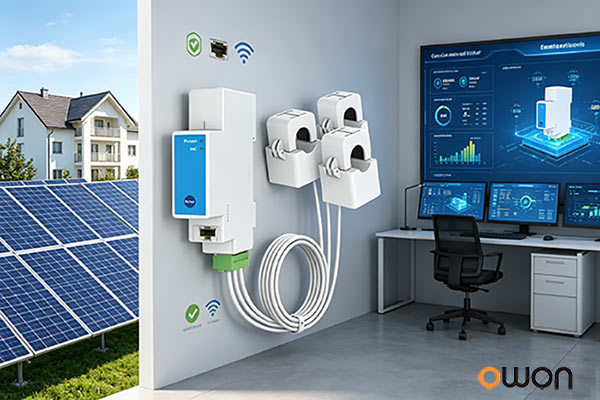
The OWON PC4713 Smart Energy Meter combines energy monitoring with both Ethernet and WiFi connectivity, allowing project designers to select the communication method that best fits their deployment environment.
The meter supports:
- Ethernet connectivity
- WiFi connectivity
- Single-phase monitoring
- Split-phase monitoring
- Three-phase monitoring
- Bidirectional energy measurement
- Real-time energy visibility
- Historical energy analytics
It is suitable for smart building energy monitoring, solar energy systems, and commercial energy management projects. Based on project requirements, users can deploy the meter using either wired Ethernet infrastructure or wireless connectivity.
How to Choose the Right Connectivity Option
When selecting an energy meter, consider the following questions:
- Does the building already have Ethernet infrastructure?
- Is wireless coverage reliable in the installation area?
- Will the project connect to an energy management system?
- Is remote monitoring required?
- Are solar monitoring functions needed?
- How important is network redundancy?
The answers often help determine whether WiFi, Ethernet, or a device supporting both technologies is the most suitable solution.
FAQ
Is Ethernet better than WiFi for energy monitoring?
Not necessarily. Both technologies have advantages. The best choice depends on building infrastructure, deployment requirements, and project objectives.
Can Ethernet energy meters support solar monitoring?
Yes. Many modern Ethernet energy meters support bidirectional energy monitoring for solar generation and electricity consumption tracking.
Are WiFi energy meters suitable for commercial buildings?
Yes. WiFi energy meters are widely used in commercial facilities, especially where fast deployment and installation flexibility are important.
Can one energy meter support both Ethernet and WiFi?
Yes. Some models, such as the OWON PC4713, support both communication methods, providing greater deployment flexibility.
Conclusion
Choosing between Ethernet and WiFi energy meters is not about selecting a universally better technology. Instead, it is about matching communication architecture to project requirements.
For commercial energy monitoring, smart building projects, solar installations, and energy management systems, understanding connectivity options can help improve system performance, simplify deployment, and support long-term energy visibility.
Related reading:
[Bidirectional Energy Meter for Solar and Grid Monitoring (WiFi-Enabled Solutions)]
Post time: Jun-15-2026