A Matter thermostat is a smart thermostat designed to work with the Matter smart home standard, allowing compatible devices and platforms to communicate through a common application layer.
For homeowners, HVAC professionals, smart home brands, and system integrators, the growing interest in Matter is important because thermostat connectivity has traditionally depended heavily on individual ecosystems, proprietary apps, or cloud platforms.
Matter aims to make smart devices easier to connect across compatible ecosystems while supporting local IP-based communication.
However, choosing a Matter thermostat involves more than looking for a Matter logo. Buyers should understand how Matter works, the difference between Matter over WiFi and Matter over Thread, HVAC compatibility, controller requirements, C-wire considerations, and the capabilities actually exposed through Matter.
This guide explains what a Matter thermostat is, how it works, and what to evaluate before choosing one.
What Is a Matter Thermostat?
A Matter thermostat is a connected thermostat that implements the Matter standard for supported thermostat functions.
Matter is an IP-based interoperability standard developed by the Connectivity Standards Alliance (CSA). Instead of requiring every smart device and ecosystem to use a completely proprietary communication model, Matter defines standardized ways for supported device types to communicate.
For thermostats, this can make it easier for a compatible device to participate in multiple smart home ecosystems.
Depending on the thermostat and Matter implementation, supported functions may include basic capabilities such as:
- Reading current temperature
- Viewing thermostat status
- Changing temperature setpoints
- Selecting heating or cooling modes
- Reporting supported thermostat attributes
The exact functions available depend on the thermostat, its Matter implementation, the Matter specification version, and the controlling platform.
Matter compatibility does not mean every thermostat feature will automatically be available through every Matter platform.
That distinction is important when evaluating products.
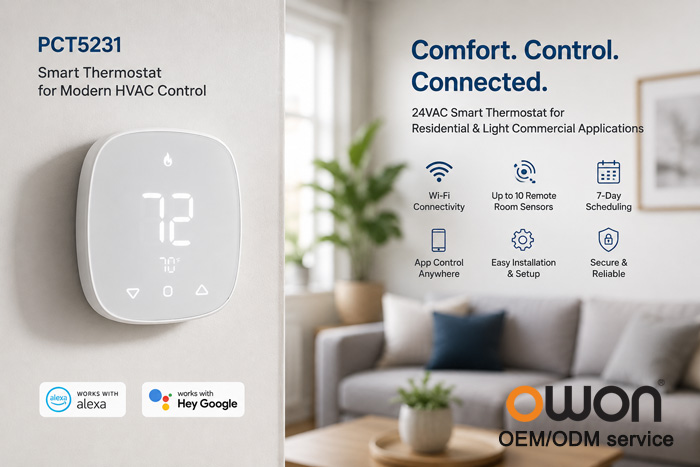
How Does a Matter Thermostat Work?
A Matter thermostat typically involves several layers:
Matter Thermostat → IP Network → Matter Controller → App or Smart Home Platform
The thermostat communicates using IP networking, while a Matter controller commissions and manages the device within the Matter ecosystem.
Depending on the product architecture, Matter communication may operate over technologies such as:
- WiFi
- Thread
- Ethernet in some Matter device architectures
For thermostats, WiFi and Thread are particularly relevant.
The important distinction is that Matter is not itself the radio technology.
Matter defines the application and interoperability layer, while technologies such as WiFi and Thread provide network connectivity.
This is why terms such as Matter over Thread thermostat and Matter over WiFi are commonly encountered when researching Matter-enabled HVAC devices.
Matter over WiFi vs. Matter over Thread Thermostats
Understanding the network architecture is important before selecting a thermostat.
Matter over WiFi
A Matter thermostat using WiFi connects through the building’s WiFi/IP network.
Potential advantages include:
- Existing WiFi infrastructure
- Direct IP connectivity
- Familiar deployment architecture
- No Thread Border Router required solely for WiFi connectivity
For powered devices such as thermostats, WiFi can be practical because power consumption is generally less restrictive than for battery-operated sensors.
Matter over Thread
Thread is a low-power IPv6-based mesh networking technology designed for connected devices.
A Matter over Thread thermostat communicates through a Thread network and typically requires a compatible Thread Border Router to connect that Thread network with the broader IP network.
Thread can offer advantages such as:
- Mesh networking
- Local IP-based communication
- Reduced dependence on WiFi coverage
- An architecture designed for IoT devices
Neither approach is automatically better for every thermostat project. The appropriate choice depends on product architecture, infrastructure, deployment scale, power availability, and the surrounding smart home ecosystem.
Does a Matter Thermostat Need an App?
This is a common source of confusion.
Matter can reduce dependence on a single proprietary ecosystem, but that does not necessarily mean a Matter thermostat app is unnecessary.
A thermostat manufacturer may still provide its own app for:
- Initial configuration
- Advanced HVAC settings
- Scheduling
- Energy reports
- Firmware updates
- Installer configuration
- Diagnostics
- Manufacturer-specific features
At the same time, supported Matter functions may be accessible through compatible third-party Matter ecosystems.
Therefore, buyers should distinguish between:
Matter control
and
the thermostat manufacturer’s complete feature set.
A Matter controller may expose standardized thermostat functions without necessarily replacing every advanced function available through the manufacturer’s own software.
Can a Matter Thermostat Work with Home Assistant?
Matter and Home Assistant are related but separate concepts.
A Matter thermostat with Home Assistant support can potentially be commissioned and controlled through a compatible Matter setup, provided that the thermostat, Matter controller, network architecture, and supported Matter features are compatible.
For users interested in local smart home control, this is one of the attractions of Matter.
However:
Matter support should not be assumed simply because a thermostat works with Home Assistant.
A thermostat can integrate with Home Assistant through other technologies or protocols without being a Matter-certified device.
Likewise, support for technologies such as Zigbee, MQTT, APIs, or cloud integrations does not automatically make a thermostat a Matter thermostat.
When evaluating compatibility, always check the specific integration method.
Does a Matter Thermostat Need a C-Wire?
This depends primarily on the thermostat’s power architecture and HVAC system, not on Matter itself.
The C-wire, or common wire, is commonly used in North American 24VAC HVAC systems to provide continuous power to smart thermostats.
Because connected thermostats may need continuous power for displays, WiFi or Thread communication, sensing, and other electronics, many models use a C-wire.
However:
Matter does not inherently require a C-wire.
Whether a particular Matter thermostat needs one depends on how that thermostat is designed.
Before installation, check:
- HVAC voltage
- Existing thermostat wiring
- R and C terminals
- Heating and cooling stages
- Heat pump configuration
- Auxiliary or emergency heat
- Manufacturer installation requirements
If an existing HVAC system does not have a C-wire, a compatible power adapter or other manufacturer-approved solution may be required.
What HVAC Systems Can a Matter Thermostat Control?
Matter compatibility and HVAC compatibility should be evaluated separately.
A thermostat may support Matter but still not be suitable for a particular HVAC system.
For North American HVAC projects, important compatibility factors may include:
- 24VAC power
- Conventional furnace and air conditioning systems
- Single-stage or multi-stage HVAC
- Heat pumps
- O/B reversing valve control
- Auxiliary heat
- Emergency heat
- Dual fuel or hybrid heating
- Fan control
This is particularly important for HVAC professionals and system integrators.
A thermostat’s communication standard does not determine which HVAC equipment it can control.
Always verify the HVAC control specifications independently from Matter connectivity.
What Are the Benefits of a Matter Thermostat?
The main potential advantage of a Matter-enabled smart thermostat is interoperability.
Multi-Ecosystem Compatibility
Matter is designed to reduce barriers between compatible smart home ecosystems.
This can give users and device manufacturers more flexibility when building connected environments.
Local Communication
Matter supports local IP-based device communication, which can reduce reliance on cloud-to-cloud communication for supported functions.
Simplified Device Commissioning
Matter provides standardized commissioning mechanisms intended to make adding compatible devices easier.
Reduced Ecosystem Lock-In
For smart home brands and device manufacturers, supporting an industry interoperability standard can reduce dependence on a single proprietary ecosystem.
Future Smart Home Integration
As the Matter ecosystem expands, thermostats can participate in broader automation scenarios involving other supported smart devices.
These benefits depend on the actual Matter implementation and the capabilities supported by the participating platforms.
What Are the Limitations of Matter Thermostats?
Matter also has limitations that buyers should understand.
Not Every Feature Is Standardized
Advanced thermostat functions may extend beyond the features exposed through Matter.
Examples can include:
- Detailed HVAC configuration
- Advanced scheduling
- Energy reports
- Remote sensor management
- Installer settings
- Maintenance functions
- Proprietary optimization algorithms
These may still require the manufacturer’s app, cloud service, or API.
Matter Does Not Guarantee HVAC Compatibility
A Matter logo does not tell you whether the thermostat supports your heat pump, multi-stage system, dual fuel configuration, or other HVAC equipment.
Infrastructure Requirements Vary
Matter over Thread devices may require appropriate Thread infrastructure, while Matter over WiFi devices depend on the local WiFi/IP environment.
Platform Features Can Differ
Different Matter ecosystems may expose thermostat capabilities differently.
For this reason, buyers should evaluate the complete thermostat architecture, not Matter compatibility alone.
How to Choose a Matter Thermostat
When comparing Matter thermostat options, start with the HVAC system rather than the connectivity logo.
Consider these six questions:
- Is the thermostat compatible with the HVAC system?
Verify voltage, stages, heat pump requirements, auxiliary heat, and wiring. - Which Matter transport does it use?
Determine whether the thermostat uses WiFi or Thread and what infrastructure is required. - Which thermostat functions are exposed through Matter?
Do not assume every advanced feature is available. - Does it require a manufacturer app or cloud service?
Determine which functions operate locally and which depend on additional services. - Does it work with the intended smart home platform?
Verify the actual Matter integration and controller requirements. - Are APIs or other integration methods required?
For OEM, property technology, or commercial projects, Matter may be only one part of the overall integration architecture.
For professional projects, these questions are usually more important than simply asking whether a thermostat “supports Matter.”
Matter Thermostats for HVAC and IoT Product Development
For HVAC manufacturers, smart home brands, and IoT solution providers, Matter creates new opportunities for developing connected thermostat products that can work across compatible smart home ecosystems.
However, developing a Matter thermostat involves much more than adding Matter connectivity. A complete thermostat platform may require:
- HVAC control hardware
- Embedded firmware
- Matter connectivity and device integration
- WiFi or Thread network architecture
- Mobile applications
- Cloud services
- Remote sensors
- APIs and third-party integration
- Device management
- OEM branding and customization
At OWON, we develop and manufacture connected thermostat solutions for HVAC and IoT projects. Our engineering capabilities cover thermostat hardware, embedded firmware, North American 24VAC HVAC control, wireless connectivity, remote sensing, cloud platforms, APIs, and system integration.
For customers planning a Matter thermostat project, OWON can evaluate the solution based on the required HVAC architecture, Matter connectivity, hardware and firmware requirements, smart home integration, user interface, remote sensors, and OEM/ODM customization.
Our existing 24VAC thermostat platforms also provide engineering experience across conventional HVAC systems, multi-stage heating and cooling, heat pumps, auxiliary and emergency heat, dual fuel systems, remote room sensors, scheduling, and connected HVAC management.
Rather than treating Matter as a standalone feature, a Matter thermostat should be developed as a complete connected HVAC product in which HVAC control, Matter interoperability, hardware, firmware, software integration, and manufacturing work together.
Frequently Asked Questions
What thermostats work with Matter?
Thermostats specifically designed to implement the Matter standard can work within compatible Matter ecosystems. Buyers should verify the product’s Matter support, network transport, Matter controller requirements, supported thermostat features, and HVAC compatibility rather than relying only on general smart-home compatibility.
What is a Matter-enabled smart thermostat?
A Matter-enabled smart thermostat is a connected thermostat that implements Matter for supported device functions, allowing it to communicate with compatible Matter controllers and ecosystems.
Is Matter the same as Thread?
No. Matter is an application-layer interoperability standard, while Thread is an IP-based mesh networking technology. Matter can operate over Thread, but Matter and Thread are not interchangeable terms.
Can a Matter thermostat work with Home Assistant?
It can if the thermostat’s Matter implementation and the Home Assistant Matter environment are compatible. Home Assistant compatibility by itself, however, does not mean a thermostat supports Matter.
Does a Matter thermostat need a C-wire?
Matter itself does not require a C-wire. C-wire requirements depend on the thermostat’s power design and the HVAC system. Many North American connected thermostats use a C-wire for continuous 24VAC power.
Is a Matter thermostat better than a WiFi thermostat?
They describe different aspects of a product and are not necessarily alternatives. Matter defines an interoperability standard, while WiFi is a networking technology. A thermostat can potentially use both Matter and WiFi. The better choice depends on HVAC compatibility, ecosystem requirements, networking architecture, and required features.
Is a Matter Thermostat Right for Your HVAC Project?
A Matter thermostat can provide greater interoperability for connected HVAC applications, but Matter support should not be the only selection criterion.
Start by verifying HVAC compatibility, wiring, power requirements, heating and cooling stages, and heat pump configuration. Then evaluate Matter transport, controller requirements, app functionality, platform compatibility, local control, and advanced integration capabilities.
For homeowners, this approach helps avoid buying a thermostat that works with the preferred smart home ecosystem but not the HVAC equipment.
For HVAC manufacturers, smart home brands, and system integrators, the same principle applies at a larger scale: Matter should be considered one layer of the connected thermostat architecture, not the entire solution.
Post time: Sep-01-2026


