As energy management becomes increasingly digitalized, utilities and commercial building operators are looking for smarter ways to monitor, analyze, and optimize electricity usage. An IoT smart energy metering solution enables real-time energy monitoring, cloud connectivity, and seamless integration with modern energy management platforms.
Compared with traditional metering systems, IoT-enabled smart meters provide remote access, automated data collection, MQTT/API integration, and scalable deployment for commercial and industrial environments.
What Is an IoT Smart Energy Metering Solution?
An IoT smart energy metering solution combines intelligent energy meters, wireless communication technologies, cloud platforms, and monitoring dashboards into a complete energy management system.
These systems are widely used in:
- Utilities and power distribution projects
- Commercial buildings
- Smart factories
- Solar energy systems
- Smart home energy monitoring
- Building energy management systems (BMS)
By collecting real-time electrical data, smart meters help users improve energy efficiency, reduce operational costs, and support data-driven decision-making.
Key Components of a Smart Energy Monitoring System
A complete smart energy monitoring system usually includes the following components:
| Component | Function |
|---|---|
| Smart Energy Meter | Measures voltage, current, power, and energy |
| CT Clamp Sensors | Enable non-invasive current monitoring |
| WiFi / Zigbee Communication | Wireless data transmission |
| MQTT / API Integration | Connects devices to cloud platforms |
| Cloud Platform | Stores and processes energy data |
| Dashboard / Mobile App | Visualizes real-time energy consumption |
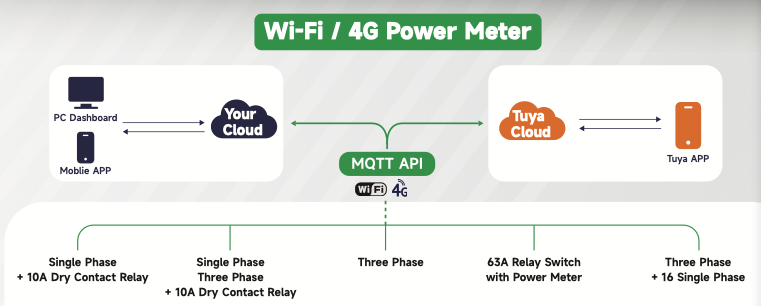
IoT Architecture for Smart Energy Metering Systems
A modern IoT energy monitoring system allows energy data to flow from smart meters to cloud platforms and visualization software in real time.
Typical architecture:
Energy Meter → MQTT/API → Cloud Platform → Dashboard / Mobile AppWiFi and Zigbee energy meters can transmit real-time electrical data through MQTT or API protocols, enabling utilities and commercial buildings to remotely monitor energy consumption and equipment status.
This architecture supports scalable deployment across commercial facilities, industrial plants, and distributed energy systems.
Why MQTT Is Important for IoT Energy Monitoring
MQTT is one of the most widely used communication protocols in IoT energy monitoring systems because of its lightweight architecture and efficient real-time communication capabilities.
Compared with traditional communication methods, MQTT offers several advantages:
- Real-time data transmission
- Lower bandwidth consumption
- Easy cloud integration
- Scalable deployment for large projects
- Reliable communication for distributed systems
For utilities and commercial buildings, MQTT-based energy meters simplify integration with EMS, BMS, SCADA, and third-party IoT platforms.
WiFi vs Zigbee Energy Meter: Which Is Better?
Both WiFi and Zigbee smart energy meters are widely used in IoT energy monitoring systems, but they are designed for different applications.
| Protocol | Best For |
|---|---|
| WiFi | Direct cloud connection and remote monitoring |
| Zigbee | Local wireless mesh networks and gateway systems |
| MQTT | Cloud-based IoT communication |
| Modbus RS485 | Industrial BMS and EMS integration |
WiFi energy meters are often preferred for direct Internet connectivity, while Zigbee meters are commonly used in smart building and gateway-based deployments.
Applications of IoT Smart Energy Metering
IoT-enabled smart energy meters can be used in a wide range of applications.
| Application | Recommended Solution |
| Commercial Buildings | WiFi DIN Rail Energy Meter |
| Utility Projects | 3 Phase Smart Energy Meter |
| Solar Monitoring | Bidirectional Energy Meter |
| Smart Buildings | MQTT Energy Monitoring System |
| Whole Home Monitoring | CT Clamp Energy Meter |
These systems allow facility managers and energy service providers to monitor consumption, optimize loads, and improve operational efficiency.

Smart Energy Monitoring for Solar and Grid Systems
Modern solar installations require bidirectional energy monitoring to measure both imported and exported electricity.
A bidirectional energy meter can monitor:
- Solar power generation
- Grid import energy
- Exported surplus energy
- Real-time load consumption
Combined with MQTT and cloud connectivity, these systems provide complete visibility into solar energy performance and grid interaction.
Benefits of IoT Smart Energy Metering Solutions
Compared with traditional metering infrastructure, IoT-enabled systems provide several key benefits:
- Real-time energy visibility
- Remote monitoring and management
- Easy system integration
- Lower maintenance costs
- Scalable cloud architecture
- Improved energy efficiency
For utilities and commercial buildings, these capabilities help reduce operational costs while supporting smart energy transformation initiatives.
Integration with EMS, BMS, and IoT Platforms
One of the biggest advantages of IoT smart energy metering systems is integration flexibility.
Smart meters can integrate with:
- Energy Management Systems (EMS)
- Building Management Systems (BMS)
- SCADA platforms
- Home Assistant
- Custom cloud dashboards
- Third-party IoT platforms
Through MQTT APIs and cloud communication, system integrators can build scalable and customized energy monitoring solutions.
FAQ
What is an IoT smart energy metering system?
An IoT smart energy metering system uses connected smart meters, wireless communication, and cloud software to monitor and analyze energy usage in real time.
Why use MQTT for energy monitoring?
MQTT provides lightweight, real-time communication for IoT systems, making it ideal for scalable energy monitoring applications.
Can smart energy meters integrate with BMS platforms?
Yes. Many smart energy meters support MQTT, Modbus, RS485, or API integration for BMS and EMS platforms.
What is the difference between WiFi and Zigbee energy meters?
WiFi meters connect directly to cloud platforms, while Zigbee meters typically require a gateway and are commonly used in mesh network deployments.
How do bidirectional energy meters work in solar systems?
Bidirectional energy meters measure both imported electricity from the grid and exported solar energy sent back to the utility network.
Conclusion
An IoT smart energy metering solution enables utilities and commercial buildings to achieve real-time energy visibility, cloud-based monitoring, and intelligent energy management.
By combining smart meters, MQTT communication, cloud platforms, and scalable IoT architecture, organizations can build efficient and future-ready energy monitoring systems for commercial, industrial, and renewable energy applications.
Related reading:
[How to Set Up an MQTT Energy Meter for IoT Integration (Step-by-Step Guide)]
Post time: Feb-12-2026