As solar installations and distributed energy systems continue to grow, energy flows are no longer one-directional. Power is not only consumed from the grid — it is also generated locally and exported back. This shift has made the bidirectional energy meter a critical component for modern energy monitoring, solar self-consumption analysis, and grid interaction management.
At OWON, we design and manufacture WiFi-enabled bidirectional energy meters that help users clearly understand how much energy is consumed, produced, and returned to the grid — in real time and over long-term operation. In this article, we explain how bidirectional energy meters work, when they are needed, and how to select the right solution for solar and multi-phase power systems.
What Is a Bidirectional Energy Meter?
A bidirectional energy meter is a power metering device capable of measuring energy flow in two directions:
-
Import energy: electricity drawn from the grid
-
Export energy: electricity generated locally (such as solar PV) and fed back into the grid
Unlike conventional meters that only track consumption, a bi directional power meter provides a complete picture of energy behavior, making it essential for solar-connected homes, commercial buildings, and energy-aware facilities.
Do You Need a Bidirectional Energy Meter for Solar?
If your system includes:
-
Rooftop or ground-mounted solar panels
-
Net metering or feed-in tariff programs
-
Self-consumption optimization
-
Energy storage or hybrid inverter systems
Then yes, a bidirectional energy meter is required to accurately distinguish produced vs consumed vs exported energy.
Without bidirectional measurement, users and system operators cannot verify solar ROI, grid export performance, or real usage patterns.

How Does a Bidirectional Energy Meter Work?
A bidirectional energy meter continuously measures voltage and current across the monitored electrical system. Using these values, the meter calculates the direction of power flow and records energy separately for import and export.
In a typical solar installation:
- When the building consumes more electricity than the solar system produces, power flows from the utility grid to the load. The meter records this as imported energy.
- When the solar system generates more electricity than the building consumes, excess power flows back to the grid. The meter records this as exported energy.
Modern bidirectional energy meters automatically distinguish between these two operating conditions and maintain separate energy registers for:
- Energy consumption (import)
- Energy production or grid export (export)
Advanced smart meters can also measure:
- Voltage
- Current
- Frequency
- Power factor
- Active power
- Reactive power
- Apparent power
This allows users, solar installers, and energy management platforms to gain a complete view of energy generation, consumption, and grid interaction.
Unlike traditional meters, no manual switching or polarity changes are required during normal operation. The meter continuously identifies the direction of power flow and updates energy data in real time.
Single-Phase vs 3-Phase Bidirectional Energy Meter
Choosing the correct meter depends on the electrical system:
| Application | Recommended Meter Type |
|---|---|
| Residential solar | Single / Split-phase |
| Commercial solar | 3 phase bidirectional energy meter |
| Industrial loads | 3-phase with high-current CTs |
OWON’s bidirectional meters support single-phase, split-phase (120/240V), and 3-phase systems, allowing consistent deployment across regions.
Bidirectional Meter vs Net Meter: What’s the Difference?
Although the terms are often used interchangeably, a bidirectional meter and a net meter are not exactly the same.
A bidirectional energy meter measures energy flowing in two directions:
- Import energy (electricity consumed from the grid)
- Export energy (electricity sent back to the grid)
A net meter is typically a utility-installed meter used for net metering programs. It records the net difference between imported and exported electricity for billing or settlement purposes.
| Feature | Bidirectional Energy Meter | Net Meter |
|---|---|---|
| Measures import energy | Yes | Yes |
| Measures export energy | Yes | Yes |
| Real-time monitoring | Usually Yes | Usually No |
| Historical energy analysis | Yes | Limited |
| Mobile App access | Often available | Rare |
| Used for EMS and solar monitoring | Yes | No |
| Utility billing | Not primary purpose | Primary purpose |
For solar monitoring, energy management systems, and self-consumption analysis, a bidirectional energy meter typically provides far more operational data than a standard net meter.
Many modern solar projects use both devices simultaneously: a utility net meter for billing and a bidirectional energy meter for performance monitoring and energy optimization.
WiFi-Enabled & Secure Energy Monitoring
A bidirectional energy meter WiFi solution allows users to access real-time and historical energy data remotely. OWON meters support:
-
WiFi 2.4GHz connectivity
-
Cloud-based visualization (Tuya ecosystem)
-
Encrypted data transmission
-
Stable reporting intervals for automation and analytics
Security and reliability are built into both hardware and firmware layers, ensuring the meter operates safely in residential and commercial environments.
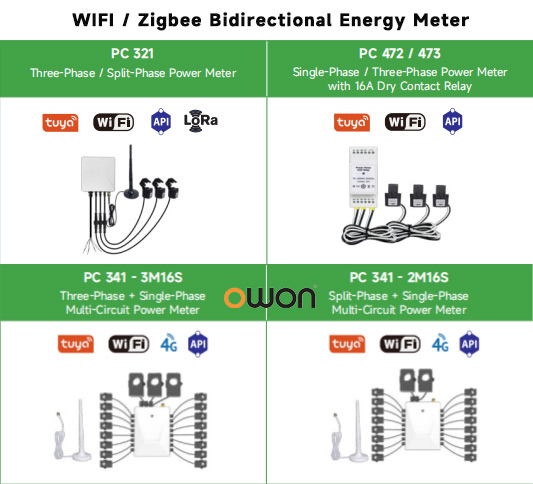
OWON Bidirectional Energy Meter Solutions
PC321 – Power Clamp Energy Meter
PC321 is a compact WiFi power clamp meter designed for single-phase and 3-phase energy monitoring, suitable for both residential and light commercial use.
Key highlights:
• WiFi connectivity (Tuya compatible)
• Real-time voltage, current, power factor, active power
• Optional 80A / 120A / 200A / 300A current clamps
• Lightweight, non-intrusive installation
This makes PC321 ideal for retrofit energy monitoring and distributed measurement scenarios.
PC341 – Multi-Circuit Bidirectional Energy Meter
PC341 is specifically designed for bidirectional energy measurement, making it ideal for solar and grid-connected systems.
Key capabilities:
Measures energy consumed, energy produced, and energy exported
• Supports single-phase, split-phase, and 3-phase (up to 480Y/277VAC)
• Monitors whole-site energy plus sub-circuits (e.g. solar inverter)
• External antenna for reliable WiFi communication
• Historical data analysis (day / month / year)
PC341 is a powerful choice for advanced solar monitoring and multi-circuit energy analysis.
PC4713 – Bidirectional Energy Meter for Solar and Grid Monitoring
PC4713 is a smart bidirectional energy meter designed to monitor both electricity consumption and solar energy production in modern energy systems. With support for single-phase, split-phase, three-phase, and 3-phase 3-wire installations, it is well suited for solar PV, battery storage, and grid-connected energy monitoring projects.
Key highlights:
• Measures imported energy and exported solar energy separately
• Supports bidirectional monitoring for self-consumption and grid export analysis
• Compatible with Single-Phase, Split-Phase, 3-Phase, and 3-Phase 3-Wire systems
• Real-time monitoring of voltage, current, power factor, frequency, active power, reactive power, and apparent power
• WiFi, Ethernet, and RS485 communication options available
• Supports integration with EMS, solar inverters, and smart energy platforms
• Historical energy data available for performance analysis and optimization
This makes PC4713 a powerful choice for solar monitoring, battery energy storage systems (BESS), commercial energy management, and smart building projects.
How to Know If You Already Have a Bidirectional Meter?
You likely have a bidirectional meter if:
-
Your solar system reports exported energy values
-
The meter dashboard shows both positive and negative energy flow
-
Grid export data is available in reports
If not, an external bidirectional energy meter like PC341 can be added without replacing the utility meter.
Deployment & Integration Considerations
For system integrators, solution providers, and energy project planners, bidirectional energy meters must offer:
-
Stable long-term measurement accuracy
-
Flexible CT options for different current ranges
-
Remote configuration and data access
-
Compatibility with solar inverters and EMS platforms
At OWON, we support customized configurations and scalable deployments for energy monitoring projects, including private-label and system-level integration support.
Talk to OWON About Your Energy Monitoring Project
Whether you are building a solar monitoring solution or upgrading an existing energy management system, our bidirectional energy meters are designed to support real-world deployment and long-term operation.
Contact OWON to discuss product selection, system compatibility, or evaluation samples.
Related reading:
[Smart 3-Phase WiFi Power Meter for Real-Time Energy Monitoring]
Post time: Feb-01-2026