Custom thermostats give HVAC, smart home, IoT, and connected building brands a faster way to add climate control products without developing an entire thermostat platform from the ground up.
Depending on the project, customization can range from custom branding and private-label packaging to UI changes, firmware configuration, HVAC control functions, wireless modules, cloud integration, and Matter connectivity.
For North American applications, however, developing a custom thermostat involves more than changing a logo or enclosure. The underlying platform must also work reliably with 24VAC HVAC systems, including conventional heating and cooling, multi-stage equipment, heat pumps, auxiliary heat, emergency heat, and dual-fuel systems.
OWON provides established thermostat platforms that can serve as a starting point for custom and private-label thermostat projects, helping brands reduce development time while adapting the product to their own market and ecosystem requirements.
What Are Custom Thermostats?
Custom thermostats are thermostat platforms adapted to the requirements of a specific brand, HVAC product, connected ecosystem, or project.
Customization can take place at several levels:
- Logo, colors, UI graphics, and packaging
- Hardware and interface configuration
- HVAC control functions
- Firmware and user experience
- Wireless communication modules
- Mobile app and cloud integration
- Communication protocols and APIs
- Smart home ecosystem integration
A custom thermostat does not necessarily need to be developed completely from scratch. For many projects, starting with an existing HVAC thermostat platform can reduce engineering work and shorten time to market.
The degree of customization depends on the product strategy, technical requirements, order volume, and integration scope.
Custom Thermostats vs. Private Label Thermostats
Although the terms are sometimes used interchangeably, custom thermostats and private label thermostats can represent different levels of product development.
A private-label project typically starts with an existing thermostat platform and focuses on faster commercialization through customer branding, packaging, UI, and selected software configurations.
A custom thermostat project can go further.
| Customization | Private Label | Custom Thermostat |
|---|---|---|
| Customer logo and branding | Yes | Yes |
| Custom packaging | Yes | Yes |
| UI customization | Optional | Yes |
| Firmware changes | Limited / Optional | Yes |
| HVAC control adaptation | Limited | Available |
| Wireless module integration | Optional | Available |
| Cloud/platform integration | Optional | Available |
| Hardware adaptation | Limited | Available |
For brands that already have an app, cloud platform, or proprietary communication architecture, deeper customization may be more appropriate than a standard private-label program.
What Can Be Customized in a Smart Thermostat?
The right customization strategy depends on what makes the final thermostat different from a standard off-the-shelf product.
Branding and Product Design
For custom branded thermostats, customization may include:
- Customer logo
- White or black front-panel options
- UI graphics
- Localized icons and interface elements
- Private-label packaging
This allows the thermostat to better match an existing smart home, HVAC, or connected product portfolio.
HVAC Control and Functions
For North American 24VAC applications, customization should begin with HVAC compatibility.
Depending on the selected thermostat platform, functions can include:
- Conventional heating and cooling
- Multi-stage HVAC control
- Heat pump control
- Auxiliary and emergency heat
- Dual-fuel and hybrid heat
- Remote room sensors
- Temperature limits and scheduling
- Occupancy-based control
- Humidity monitoring and control
- Energy usage monitoring
This is particularly important for HVAC manufacturers and system integrators because a thermostat must match the actual equipment configuration—not simply the customer’s branding requirements.
Firmware and User Experience
Firmware customization can help adapt the thermostat to different applications and product strategies.
Depending on project requirements, this may involve control logic, interface behavior, device configuration, communication protocols, and integration with customer-specific software environments.
For deeper projects, hardware interfaces and PCB configurations can also be evaluated.
Wireless, App and Cloud Integration
Many established smart home brands want the thermostat to operate inside their existing connected ecosystem rather than through a separate third-party application.
OWON’s thermostat platform can support different integration approaches, including Tuya-based solutions and customer-specific wireless modules.
For projects using proprietary WiFi modules designed around compatible module dimensions, pin definitions, and communication interfaces, the customer’s module can potentially be integrated with the thermostat hardware platform.
For other module architectures, customization may involve:
- PCB adaptation
- Firmware modification
- Communication protocol adaptation
- Hardware interface redesign
This allows brands to connect the thermostat with their own mobile app, cloud infrastructure, device management platform, and data environment.
Custom Branded Thermostats: More Than Adding a Logo
For consumer-facing HVAC and smart home brands, visual consistency can be nearly as important as technical integration.
A custom branded thermostat can be adapted through Color, Material, and Finish (CMF) options, UI graphics, branding, and packaging.
For example, a thermostat can be configured around a clean white appearance for one product family or a black glass design for another.
The objective is to make the thermostat feel like a natural extension of the customer’s existing product ecosystem rather than a separately sourced device with a different visual identity.
Matter Integration for Custom Smart Thermostats
Matter is becoming increasingly relevant for brands developing multi-platform smart home ecosystems.
For projects requiring Matter connectivity, compatible thermostat hardware architectures can support development paths such as:
- Matter over WiFi
- Matter over Thread
- Multi-platform smart home interoperability
Matter requirements should be evaluated at the beginning of a custom thermostat project because connectivity architecture, wireless modules, firmware, certification, and ecosystem requirements can influence the overall development approach.
Example Custom Thermostat Platforms
Rather than starting every custom thermostat project with a completely new hardware design, brands can often begin with an established thermostat platform and customize the areas that differentiate their final product.
PCT5231 – Flexible 24VAC HVAC Platform
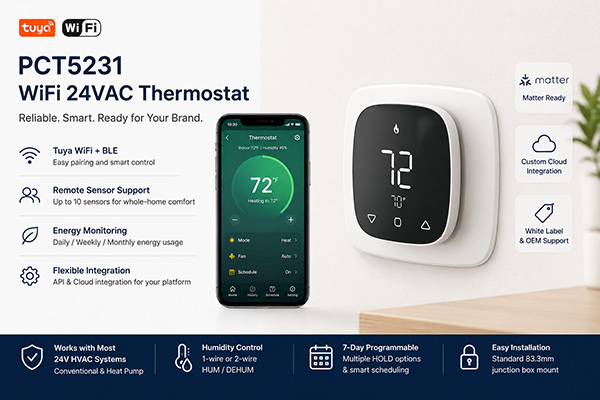
For example, the OWON PCT5231 can serve as a starting platform for North American smart HVAC projects requiring broad 24VAC system compatibility.
The platform supports multi-stage HVAC and heat pump applications, including up to 4H/2C heat pump configurations, dual-fuel/hybrid heating, auxiliary and emergency heat, and up to 10 remote room sensors.
It is particularly suitable for projects where HVAC compatibility, connected control, remote sensing, scheduling, and system integration are priorities.
PCT533 – Advanced Sensing and Comfort Control Platform
For projects requiring more advanced room sensing and environmental control, the OWON PCT533 provides another platform option.
Its capabilities include a 4.3-inch color touchscreen, occupancy sensing, humidity monitoring and control, remote sensor support, and compatibility with multi-stage and heat pump HVAC applications.
This makes it suitable as a starting point for projects requiring a more advanced user interface and integrated room comfort functions.
The appropriate platform should ultimately be selected according to the target HVAC equipment, required functions, industrial design, connectivity architecture, and customization scope.
How Does a Custom Thermostat Project Work?
A successful custom thermostat program normally begins with technical requirements rather than appearance.
A typical development process includes:
1. Define HVAC requirements
Identify the target HVAC systems, heating and cooling stages, heat pump requirements, auxiliary heat, dual-fuel control, and other equipment-specific functions.
2. Select a suitable thermostat platform
Determine whether an existing hardware platform can meet the core requirements or whether deeper hardware development is necessary.
3. Define the customization scope
Confirm branding, UI, firmware, wireless connectivity, cloud integration, protocols, and hardware changes.
4. Prototype and integrate
Develop and test the required customization and system integration.
5. Validate HVAC compatibility
Verify thermostat operation with the intended HVAC equipment and control configurations.
6. Move toward production
After technical validation, the project can proceed to pilot production and volume manufacturing.
Starting from a mature HVAC platform can significantly reduce unnecessary redevelopment while allowing engineering resources to focus on the features that differentiate the final product.
Who Needs Custom Thermostats?
Custom thermostat programs are particularly relevant for companies that want to add HVAC control to an existing product or connected ecosystem.
Typical customers include:
- HVAC equipment manufacturers
- Smart home and IoT brands
- Home automation companies
- System integrators
- Connected building solution providers
- Property technology companies
- Distributors developing private-label product lines
For these customers, the decision is often not simply which thermostat to buy, but how to integrate thermostat hardware, HVAC control, branding, software, and connectivity into a scalable product strategy.
Frequently Asked Questions
What is a custom thermostat?
A custom thermostat is a thermostat platform adapted to specific branding, HVAC, hardware, firmware, connectivity, or system integration requirements. Customization can range from private labeling to deeper hardware and software development.
What is a private label thermostat?
A private label thermostat typically uses an established thermostat platform that is sold under another company’s brand. Customization may include the logo, UI, packaging, and selected product configurations.
What is the difference between private label and custom thermostats?
Private label programs generally focus on faster market entry using an existing product platform. Custom thermostat projects can involve deeper changes to firmware, HVAC functions, hardware, wireless modules, and cloud or platform integration.
Can a thermostat be customized for different HVAC systems?
Yes, but compatibility depends on the underlying thermostat platform. Important factors include 24VAC control, heating and cooling stages, heat pump configuration, auxiliary and emergency heat, dual-fuel systems, wiring, and equipment-specific requirements.
Can I replace an HVAC thermostat with a different brand?
Often yes for standard 24VAC HVAC systems, provided the replacement thermostat supports the equipment type, control voltage, heating and cooling stages, heat pump configuration, wiring, and power requirements. Proprietary communicating HVAC systems may require specific compatible controls.
Building a Custom Thermostat Around the Right Platform
A successful custom thermostat project requires more than adding a brand logo to an existing device.
The best starting point is a thermostat platform that already supports the target HVAC systems and can then be adapted through branding, firmware, hardware, connectivity, and platform integration.
For smart home brands, HVAC manufacturers, and system integrators, this approach can shorten development cycles while maintaining greater control over product identity and connected ecosystem strategy.
OWON Technology provides smart thermostat OEM/ODM development and manufacturing services for companies requiring private-label products, custom hardware and firmware, wireless module integration, and connected HVAC solutions.
Related reading:
[ Lockable Thermostat Guide: Password, PIN Lock and Temperature Limits Explained ]
Post time: Jun-09-2026


