A Tuya thermostat is a connected thermostat that uses the Tuya IoT ecosystem to enable app-based HVAC control, scheduling, automation, and integration with compatible smart devices. Depending on the product, a Tuya thermostat may use WiFi or Zigbee and may be designed for different HVAC systems, including central 24VAC HVAC, heat pumps, boilers, and fan coil units.
However, Tuya compatibility does not automatically mean HVAC compatibility. Wiring, power requirements, heating and cooling stages, pairing procedures, and available smart features depend on the specific thermostat.
Understanding these differences is essential when selecting a Tuya thermostat for a home, HVAC project, apartment building, or connected building platform.
What Is a Tuya Thermostat?
A Tuya thermostat combines thermostat-level HVAC control with the connectivity and smart device capabilities of the Tuya ecosystem.
Depending on the model and system architecture, supported features may include remote temperature control, scheduling, HVAC mode selection, automation, temperature and humidity monitoring, OTA updates, and integration with compatible smart devices.
An important distinction is that Tuya provides the IoT ecosystem, while the thermostat manufacturer determines the actual HVAC control capabilities.
For example, two thermostats may both connect to a Tuya-compatible platform but support completely different HVAC equipment. One may be designed for a North American 24VAC heat pump, while another may control a boiler or fan coil unit.
For this reason, buyers should evaluate both smart connectivity and HVAC compatibility.
Tuya WiFi Thermostat vs Tuya Zigbee Thermostat
Tuya-compatible thermostats can use different wireless technologies. WiFi and Zigbee are two common approaches.
| Feature | Tuya WiFi Thermostat | Tuya Zigbee Thermostat |
|---|---|---|
| Connectivity | WiFi | Zigbee |
| Gateway | Usually connects directly to WiFi | Typically requires a compatible gateway |
| Architecture | Thermostat → WiFi → App/Cloud | Thermostat → Gateway → Platform/App |
| Typical Applications | Central HVAC, heat pumps, connected residential HVAC | Boiler, fan coil, multi-device building applications |
| Key Benefit | Direct network connectivity | Gateway-based device networking and automation |
A Tuya WiFi thermostat can be suitable when direct network connectivity and app-based remote HVAC control are priorities.
A Tuya Zigbee thermostat can be useful when thermostats need to operate alongside sensors, gateways, and other connected devices within a broader smart home or building network.
Neither option is universally better. The correct architecture depends on the HVAC equipment, building application, number of devices, and integration requirements.
Tuya Thermostat App, Pairing & Connectivity
Depending on how a thermostat is configured by its manufacturer or solution provider, Tuya-compatible products may work with applications such as Tuya Smart, Smart Life, or a customized/white-label app.
Supported app functions may include temperature adjustment, HVAC mode selection, scheduling, device status, and automation. Available controls vary by thermostat model.
How Does Tuya Thermostat Pairing Work?
There is no universal pairing procedure for every Tuya thermostat. A typical process includes:
- Install and power the thermostat correctly.
- Install the app specified by the manufacturer.
- Put the thermostat into pairing mode.
- Add the device through the app.
- Configure the required network connection.
- Verify thermostat and HVAC operation.
The exact pairing mode and WiFi reset procedure are model-specific. If pairing fails, users should check the thermostat manual, network requirements, and device status rather than following instructions written for a different thermostat model.
What to Check Before Installing a Tuya Thermostat
Connectivity should never be the only consideration when choosing a smart thermostat. The thermostat must first be compatible with the HVAC equipment.
Important factors include:
Control voltage: Determine whether the system uses 24VAC low-voltage thermostat control, line voltage, or another architecture.
HVAC type: Identify whether the thermostat will control conventional heating and cooling, a heat pump, dual-fuel system, boiler, or fan coil unit.
Heating and cooling stages: Multi-stage HVAC systems require a thermostat that supports the correct number of equipment stages.
Heat pump control: Heat pump applications may require O/B reversing-valve control, auxiliary heat, emergency heat, and specific staging logic.
Power and C-wire: Connected thermostats may require continuous power. For 24VAC HVAC installations, check the thermostat’s C-wire requirements and available power options.
Wiring terminals: Always compare the existing HVAC wiring and equipment requirements with the thermostat terminal definitions before installation.
This is why a thermostat should not be selected simply because it carries Tuya connectivity.
Tuya Thermostats for North American 24VAC HVAC
HVAC compatibility becomes especially important in North America, where central HVAC systems may include furnaces, air conditioners, multi-stage heat pumps, auxiliary heat, emergency heat, and dual-fuel configurations.
OWON develops Tuya WiFi thermostats specifically for these applications.
The PCT5231 WiFi thermostat supports conventional HVAC and heat pump systems, including multi-stage heat pump control, auxiliary and emergency heat, and dual-fuel applications. It can also connect with up to 10 wireless remote room sensors for multi-room temperature monitoring.
The PCT533 WiFi thermostat provides a 4.3-inch color touchscreen together with temperature, humidity and occupancy-related capabilities. It supports conventional and multi-stage heat pump applications, auxiliary and emergency heat, dual fuel, remote sensors, and humidity-related HVAC control.
These products demonstrate an important principle when evaluating a Tuya thermostat:
The IoT platform provides connectivity, but the thermostat hardware and firmware determine HVAC compatibility.
Tuya Thermostats for OEM & Smart HVAC Projects
Tuya thermostat platforms can also provide advantages beyond individual residential installations.
For HVAC manufacturers, smart home brands, property technology companies and system integrators, an established IoT ecosystem can reduce the need to independently develop every layer of connected-device infrastructure.
Depending on the project, this may include:
- OEM and private-label thermostat development
- Firmware customization
- App and cloud integration
- API integration
- Connected sensor automation
- Remote device management
- Multi-property deployment
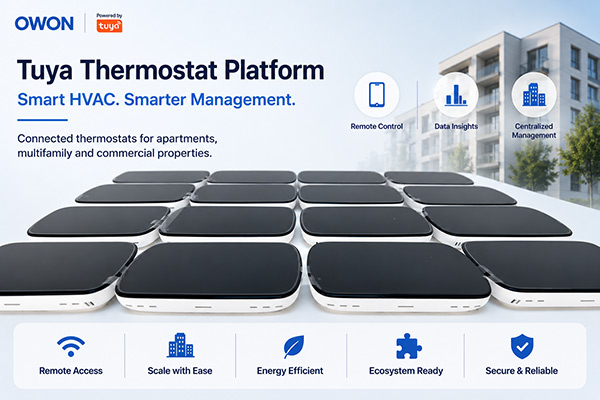
For apartments and other managed properties, connected thermostats can also support remote HVAC access and centralized device management across multiple units.
OWON combines Tuya-compatible thermostats with sensors, gateways, energy devices, OEM/ODM development and IoT integration capabilities for broader connected building projects. Your existing article similarly positions the platform for HVAC brands, property technology companies, system integrators and smart building developers.
How to Choose the Right Tuya Thermostat
Before choosing a Tuya thermostat, start with the HVAC system rather than the app.
Check these factors in order:
- HVAC system – Heat pump, conventional HVAC, boiler, fan coil, or another system?
- Control voltage – Is the thermostat electrically compatible?
- Stages and functions – What heating, cooling, auxiliary, or emergency functions are required?
- Wiring and power – Are the necessary terminals and power connections available?
- Connectivity – Is WiFi or Zigbee more suitable?
- Integration – Do you need app control, automation, API, or third-party integration?
- Application – Is the thermostat for a home, property portfolio, OEM product, or connected building project?
This approach helps prevent one of the most common selection mistakes: choosing a smart thermostat based on connectivity before confirming HVAC compatibility.
Frequently Asked Questions
Is there a universal Tuya thermostat manual?
No. “Tuya thermostat” refers to many thermostat products using the Tuya ecosystem, not one standardized model. If you are searching for a Tuya thermostat manual PDF, identify the manufacturer and exact model first and use its model-specific documentation.
Is a Tuya thermostat WiFi or Zigbee?
It can be either. WiFi thermostats can connect directly to a compatible WiFi network, while Zigbee thermostats typically communicate through a compatible Zigbee gateway.
How do I put a Tuya thermostat into pairing mode?
Pairing procedures vary by model. Follow the manual or quick-start guide for the exact thermostat rather than using a generic button sequence.
Can a Tuya thermostat work with Home Assistant?
Some Tuya-based thermostats can be integrated with Home Assistant, but compatibility and available thermostat functions depend on the specific device, communication method, integration, and exposed entities.
Can a Tuya thermostat control a heat pump?
Some models can. A compatible heat pump thermostat may need to support O/B control, multiple stages, auxiliary heat, and emergency heat. Always verify the thermostat specifications against the HVAC system.
Choosing a Tuya Thermostat for Your HVAC Project
A Tuya thermostat should be selected based on more than app connectivity. The right thermostat must match the HVAC system, electrical architecture, required control functions, wireless technology, and integration requirements.
For individual users, this means identifying the exact thermostat model before installation, pairing, reset, or downloading a manual. For HVAC manufacturers and system integrators, it also means evaluating how the thermostat fits into the wider connected HVAC architecture.
OWON develops Tuya-compatible thermostat platforms for North American 24VAC HVAC and connected building applications, with OEM/ODM and integration capabilities for B2B smart HVAC projects.
Contact OWON to discuss HVAC compatibility, thermostat customization, platform integration, or your OEM/ODM project requirements.
Post time: May-26-2026


