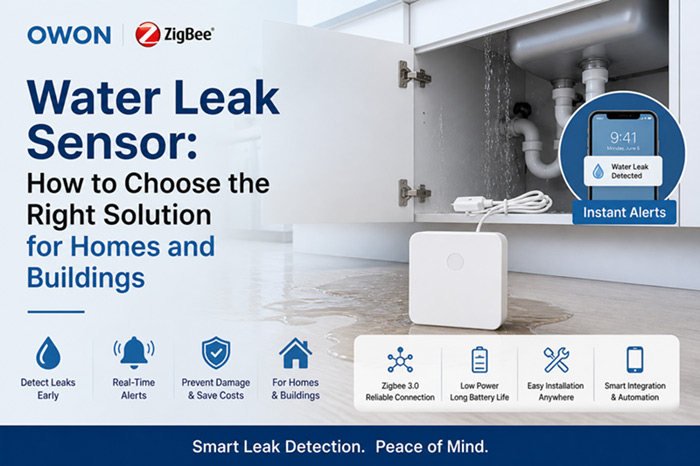
A water leak sensor can detect unwanted water before a small plumbing problem becomes serious property damage. These devices are commonly installed under sinks, near water heaters, around HVAC equipment, in basements, and in other areas where leaks may go unnoticed.
However, not every leak detector works in the same way. Some provide only a local alarm, while smart water leak sensors can send remote notifications or become part of a larger automation system.
This guide explains how water leak sensors work, the main types available, and what to consider when choosing one for a home, apartment, hotel, or commercial building.
What Is a Water Leak Sensor and What Does It Do?
A water leak sensor, also called a water leak detector, is designed to detect the presence of unwanted water in a specific area.
A typical sensor is placed close to a potential leak source. When its sensing contacts or probe detect water, the device generates an alert. Depending on the system, this may be a local audible alarm, a mobile notification, or an automation event sent through a smart home or building platform.
Water leak sensors are commonly used:
- Under kitchen and bathroom sinks
- Near water heaters and boilers
- Behind washing machines and dishwashers
- In basements and utility rooms
- Around HVAC condensate drains
- In mechanical and equipment rooms
It is important to distinguish leak detection from leak prevention. A basic sensor detects water and provides an alert. Automatic water shut-off normally requires an additional compatible valve or building automation system.
What Are the Main Types of Water Leak Sensors?
Understanding the detection method is one of the first steps in choosing the right solution.
Point Water Leak Sensors
Point sensors detect water in a small, specific area, usually through conductive contacts located on or near the bottom of the device.
They are simple and suitable for locations where water is likely to collect, such as underneath a sink, next to a washing machine, or near a water heater.
Remote Probe Water Leak Sensors
A remote probe separates the sensing point from the main sensor body. This provides more flexibility when the potential leak point is difficult to reach or when the main electronics should be mounted in a more convenient location.
For example, the OWON WLS316 Zigbee water leak sensor uses a standard 1-meter remote probe. The probe can be positioned near a potential leak point while the main sensor can be wall-mounted or placed nearby. The device reports immediately when triggered. Datasheet-WLS-316-Water-Leakage…
This design can be useful around plumbing, water heaters, equipment cabinets, and other confined areas.
Water Leak Sensor Cables
A water leak sensor cable is different from a remote probe.
A sensing cable is designed to detect water along part or all of its sensing length, making it useful for monitoring larger areas such as equipment rooms, pipelines, raised floors, or perimeter zones.
When comparing a water leak sensor cable with a remote-probe sensor, consider whether you need to monitor one specific leak point or a longer area.
Flow-Based Leak Detection
Another approach is to monitor water flow within the plumbing system.
Instead of waiting for water to reach a floor-mounted sensor, these systems identify unusual flow patterns that may indicate a leak. Some advanced systems can work with automatic shut-off valves.
Flow monitoring can provide broader plumbing protection, while point and probe sensors are useful for detecting water at specific high-risk locations.
Water Leak Sensor Alarm: Local vs Remote Alerts
The term water leak sensor alarm can describe several different types of alerts, so it is important to check exactly what a product provides.
A local audible alarm produces a sound at the installation location when water is detected. This is simple and useful when someone is nearby.
A smart water leak sensor can communicate through a gateway or network and allow a connected platform to provide remote notifications. This is useful when a property is vacant or managed remotely.
More advanced systems can use a detected leak as an automation trigger. Depending on the gateway and platform, the event may activate a compatible siren, send a notification, or trigger a water shut-off device.
For commercial projects, understanding the difference between local alarm, remote notification, and automated response is especially important.
Wi-Fi vs Zigbee Water Leak Sensors
Connectivity is another important factor when choosing a smart water leak detector. Wi-Fi and Zigbee are both commonly used for wireless leak monitoring, but they suit different deployment needs.
| Feature | Wi-Fi Water Leak Sensor | Zigbee Water Leak Sensor |
|---|---|---|
| Connection | Connects through a Wi-Fi network | Requires a compatible Zigbee gateway |
| Power Consumption | Depends on device design and Wi-Fi usage | Well suited to low-power sensor applications |
| Network Type | Wi-Fi network | Zigbee mesh network |
| Multi-Sensor Deployment | Suitable for individual or small-scale installations | Well suited to multiple sensors across homes or buildings |
| Typical Applications | Homes and standalone monitoring | Smart homes, apartments, hotels and smart buildings |
| System Integration | Depends on the device and platform | Can support gateway-based automation and centralized monitoring |
For example, the OWON WLS316 uses Zigbee 3.0 at 2.4 GHz and is powered by two AAA batteries. Its specified outdoor communication range is up to 100 meters under open-area conditions. Datasheet-WLS-316-Water-Leakage…
The better choice depends on the existing network infrastructure, gateway compatibility, number of sensors, and integration requirements.

7 Features to Consider When Choosing a Water Leak Sensor
1. Detection Method
First determine what needs to be monitored.
A point sensor may be sufficient under a sink, while a remote probe can provide more installation flexibility in difficult-to-access locations. Cable-based detection may be more appropriate when a longer area needs to be monitored.
2. Alarm and Notification Method
Ask how you want to be notified.
Do you need:
- A local audible alarm?
- A mobile notification?
- Centralized monitoring?
- Automatic valve shut-off?
Do not assume every smart water leak sensor provides all four functions.
3. Connectivity
For smart devices, consider whether the sensor uses Wi-Fi, Zigbee, or another communication technology.
The right choice depends on the existing smart home or building infrastructure. For Zigbee devices, also check gateway and platform compatibility before deployment.
4. Installation Flexibility
The physical design matters.
If the leak source is behind equipment, underneath cabinetry, or in another narrow space, a water leak sensor with a remote probe may be easier to position than a sensor whose sensing contacts are integrated directly into its main body.
5. Battery and Power Consumption
Leak sensors often remain in place for long periods, so low power consumption can reduce maintenance requirements.
For multi-unit properties, battery replacement across dozens or hundreds of sensors can become an important operational consideration.
6. Automation and System Integration
A residential user may only need a phone notification. A hotel, apartment operator, or building manager may require centralized monitoring and automation.
For these projects, evaluate how the sensor communicates with gateways and whether leak events can be used by the wider automation platform.
7. Scalability
A solution for one kitchen is different from a solution for a 200-room hotel.
For larger deployments, consider gateway capacity, wireless coverage, device management, alert handling, and integration with the existing building infrastructure.
Choosing Water Leak Sensors for Homes and Buildings
Homes
For residential use, prioritize simple installation and fast notification.
Common monitoring locations include kitchens, bathrooms, washing machines, basements, and water heaters. A smart water leak sensor can be particularly useful when homeowners want to receive alerts while away from home.
Apartments and Multi-Family Properties
Property managers may need to monitor many kitchens, bathrooms, mechanical spaces, and utility areas.
In these environments, individual sensor cost is only one consideration. Centralized monitoring, battery maintenance, network coverage, and multi-device management can become equally important.
Hotels
A hidden leak in a guest room, bathroom, kitchen, or service area can affect more than one room.
Wireless leak detection allows sensors to be installed at high-risk locations without extensive new wiring. A gateway-based system can also help facility teams manage multiple detection points.
Commercial and Smart Buildings
Commercial facilities may need leak monitoring around HVAC systems, mechanical rooms, water treatment equipment, plumbing infrastructure, or other critical areas.
For these applications, look beyond the sensor itself. The gateway, automation platform, notification method, and integration architecture should be evaluated as part of the complete water leak detection system.
Example: Remote-Probe Leak Detection with Zigbee
A remote-probe design can be useful when the most likely leak location is not the best place to install the sensor electronics.
For example, OWON’s WLS316 combines Zigbee 3.0 connectivity with a standard 1 m remote probe. It supports tabletop or wall mounting, uses two AAA batteries, and reports immediately when a leak event is triggered. When no event is detected, it provides a periodic report once per hour. Datasheet-WLS-316-Water-Leakage…
The product also supports linkage with smart devices through a compatible Zigbee system. Datasheet-WLS-316-Water-Leakage…
This type of design can be considered for smart homes, hotels, apartments, utility rooms, and building automation projects where flexible sensor placement and low-power wireless communication are important.
When evaluating any Zigbee sensor, however, always verify gateway and platform compatibility for the specific project rather than assuming that every Zigbee device supports every ecosystem.
Frequently Asked Questions
What does a water leak sensor do?
A water leak sensor detects unwanted water near plumbing, appliances, HVAC equipment, or other leak-prone areas. When water is detected, it generates an alert so action can be taken before the leak causes more serious damage.
Is there a device that detects water leaks?
Yes. Several types of devices can detect water leaks, including point sensors, remote-probe sensors, water-sensing cables, and flow-monitoring systems. The right option depends on the location and the type of leak you need to detect.
What sensor is used for water leak detection?
Many water leak sensors use conductive contacts or probes. When water bridges the sensing contacts, the device detects the change and generates a leak event. Other systems monitor water flow or other plumbing conditions to identify possible leaks.
What are three types of leak detectors?
Three common types are point water leak sensors, remote-probe or cable-based leak sensors, and flow-based leak detection systems. More advanced solutions may combine leak detection with automatic water shut-off.
Where should water leak sensors be installed in a home?
Common locations include under sinks, near water heaters, behind washing machines and dishwashers, around toilets, in basements, and near HVAC condensate drains. Sensors should be positioned where leaking water is likely to appear first.
Is a smart water leak sensor better than a basic water alarm?
It depends on the application. A basic alarm can provide effective local warning, while a smart water leak sensor may provide remote notifications and automation when connected to a compatible platform. Remote monitoring is particularly useful for vacant properties, multi-unit buildings, and locations that are not continuously occupied.
Do Zigbee water leak sensors require a gateway?
Generally, yes. A Zigbee water leak sensor communicates through a compatible Zigbee gateway or coordinator. The gateway can then connect the sensor to a smart home or building platform for monitoring, notifications, or automation.
Conclusion
Choosing the right water leak sensor starts with understanding where leaks may occur and how quickly you need to know about them.
For a simple residential application, a point sensor or smart water leak detector may be enough. Hard-to-reach locations may benefit from a remote probe, while larger areas may require sensing cables or more comprehensive leak detection systems. Commercial buildings and multi-unit properties should also consider connectivity, centralized monitoring, maintenance, and scalability.
The most effective solution is not necessarily the device with the longest feature list. It is the one that matches the detection location, alert requirements, network infrastructure, and automation needs of the property.
Related reading:
[How to Deploy ZigBee Fall Detection Sensors in Care Homes: A Room-by-Room Installation Guide]
Post time: May-02-2026