If you’ve spent time in the Home Assistant or Zigbee2MQTT community, you’ve probably noticed a common pattern.
Most users begin with simple automation devices such as door sensors, motion sensors, smart plugs, and standard temperature sensors. As their smart home or IoT system grows, however, they start monitoring more than just room conditions.
Questions like these soon appear:
- Is my freezer maintaining a safe temperature?
- What’s the actual temperature inside a water tank?
- Is my floor heating loop operating correctly?
- Can I monitor pipe temperature without running cables?
These applications require more than a standard room sensor. They require a probe temperature sensor.
Unlike conventional temperature sensors that only measure ambient air, a probe temperature sensor places the sensing element exactly where temperature matters most—inside equipment, pipes, liquids, refrigerators, or other enclosed environments.
For Zigbee2MQTT users, adding a Zigbee probe temperature sensor is often the next logical step when expanding from basic smart home automation to professional monitoring applications.
What Is a Probe Temperature Sensor?
A probe temperature sensor uses an external sensing probe connected by a cable to the wireless sensor body. Instead of measuring only surrounding air temperature, the probe can directly contact surfaces, liquids, or enclosed spaces for more accurate readings.
This design makes it suitable for applications where a standard temperature sensor cannot provide reliable data.
Typical applications include:
- HVAC pipe monitoring
- Floor heating systems
- Refrigerators and freezers
- Cold chain storage
- Water tanks
- Industrial equipment
- Environmental monitoring cabinets
Compared with a conventional room sensor, a probe sensor delivers temperature measurements exactly where they are needed, helping improve control accuracy and equipment protection.
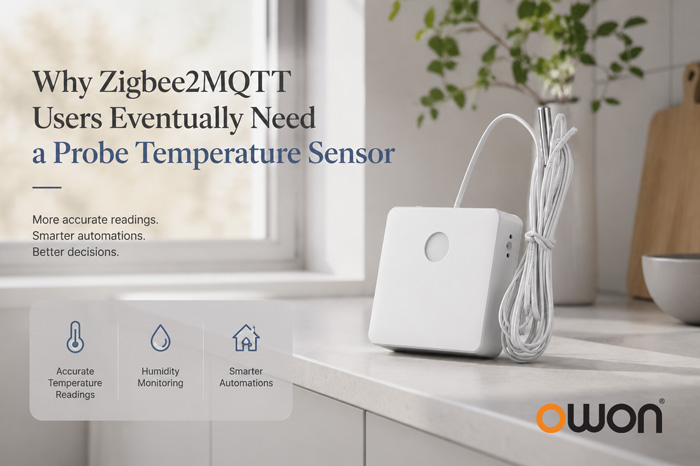
Why Zigbee2MQTT Users Upgrade to Probe Sensors
One reason Zigbee2MQTT has become so popular is its flexibility.
Unlike closed ecosystems, Zigbee2MQTT allows users to integrate a wide range of Zigbee devices into Home Assistant, Node-RED, openHAB, and other automation platforms.
As projects become more advanced, users typically move beyond simple occupancy detection and lighting automation.
Instead, they begin monitoring real-world operating conditions, including:
- Heating system efficiency
- Cold storage temperature
- Equipment overheating
- Water temperature
- Pipe temperature
These scenarios require a wireless probe temperature sensor, not just a standard indoor temperature sensor.
A Zigbee probe sensor enables precise monitoring while keeping installation simple. Battery-powered operation eliminates the need for additional wiring, making it suitable for retrofit projects as well as new smart building installations.
Typical Applications of a Zigbee Probe Temperature Sensor
| Application | Why a Probe Sensor Is Better |
|---|---|
| HVAC Systems | Measures pipe or supply water temperature directly |
| Floor Heating | Monitors floor loop temperature instead of room air |
| Refrigerators & Freezers | Tracks internal storage temperature accurately |
| Cold Chain Monitoring | Helps protect temperature-sensitive products |
| Water Tanks | Measures liquid temperature directly |
| Industrial Equipment | Detects localized overheating in machinery |
These applications are increasingly common in commercial buildings, industrial automation, laboratories, food storage, and energy management systems.
For system integrators, adding probe-based monitoring also creates opportunities for predictive maintenance and remote diagnostics.
How Owon’s THS317-ET Fits These Applications
An example of this type of solution is the Owon THS317-ET Zigbee Temperature Sensor with Probe.
Unlike a conventional ambient sensor, the THS317-ET combines Zigbee wireless communication with a 2.5-meter external temperature probe, allowing temperature measurement inside pipelines, liquid containers, refrigeration equipment, or other enclosed spaces while keeping the Zigbee module in an optimal wireless location.
Key capabilities include:
- Zigbee 3.0 connectivity
- External 2.5 m temperature probe
- Wide temperature measurement range (-40°C to +200°C)
- Battery-powered operation
- Zigbee2MQTT compatibility
- Home Assistant integration
Because installation requires no communication wiring, the sensor is well suited for HVAC retrofits, cold chain monitoring, equipment monitoring, and smart building projects.
Why It Matters for System Integrators and Distributors
For distributors, OEM brands, and system integrators, a Zigbee probe temperature sensor is more than just another sensor—it expands the range of projects they can support.
Instead of monitoring only room conditions, customers can now monitor equipment, refrigeration systems, water circulation, heating loops, and other temperature-critical assets.
Typical commercial applications include:
- Smart HVAC systems
- Building automation
- Cold storage facilities
- Food and beverage refrigeration
- Laboratory monitoring
- Industrial IoT projects
- Energy management systems
Because the sensor communicates through Zigbee, it can easily become part of a larger monitoring network connected to gateways, cloud platforms, or building management systems.
For companies developing their own smart building or IoT solutions, selecting devices that support open ecosystems such as Zigbee2MQTT and Home Assistant also helps reduce integration effort and improve long-term compatibility.
Choosing the Right Zigbee Probe Temperature Sensor
Not all probe temperature sensors are designed for the same applications.
When selecting a Zigbee probe temperature sensor, consider the following factors:
- Probe type and cable length for your installation
- Temperature measurement range
- Battery life and maintenance requirements
- Wireless communication stability
- Compatibility with Zigbee2MQTT or Home Assistant
- Support for commercial or OEM deployments
For professional projects, choosing a sensor with proven interoperability and reliable long-term performance can significantly reduce installation and maintenance costs.
Conclusion
As Zigbee2MQTT projects evolve, monitoring room temperature alone is often no longer enough.
Many real-world applications require accurate temperature measurements inside pipelines, refrigeration equipment, water tanks, floor heating systems, or industrial machinery. In these situations, a probe temperature sensor provides a practical and reliable solution.
A Zigbee probe temperature sensor combines wireless deployment with precise temperature measurement, making it suitable for both smart home enthusiasts and commercial IoT projects.
For distributors, OEM brands, and system integrators, it also opens opportunities in HVAC, cold chain, industrial monitoring, and smart building automation—applications where standard ambient sensors simply cannot deliver the required accuracy.
If your Zigbee2MQTT network is expanding beyond basic room monitoring, adding a probe temperature sensor may be the next upgrade worth considering.
Frequently Asked Questions
What is a probe temperature sensor?
A probe temperature sensor measures temperature using an external sensing probe rather than relying only on the surrounding air. This allows accurate monitoring inside pipes, liquids, refrigeration equipment, and other enclosed environments.
What is the difference between a probe temperature sensor and a standard temperature sensor?
A standard temperature sensor measures ambient air temperature around the device.
A probe temperature sensor places the sensing element at the actual measurement point, making it more suitable for HVAC systems, water tanks, refrigeration equipment, floor heating, and industrial monitoring.
Can a Zigbee probe temperature sensor work with Zigbee2MQTT?
Yes. Many Zigbee probe temperature sensors are compatible with Zigbee2MQTT, allowing users to integrate temperature data into Home Assistant and other open automation platforms for monitoring, alerts, and automation.
Where are Zigbee probe temperature sensors commonly used?
Common applications include:
- HVAC systems
- Floor heating
- Refrigerators and freezers
- Cold chain monitoring
- Water tanks
- Industrial equipment
- Building automation
- Smart energy management
How do I choose the right Zigbee probe temperature sensor?
When comparing products, consider:
- Temperature measurement range
- Probe length and installation flexibility
- Zigbee 3.0 compatibility
- Zigbee2MQTT and Home Assistant support
- Battery life
- Suitability for commercial or industrial applications
Choosing a sensor designed for your deployment environment helps improve long-term reliability and simplifies system integration.
Related reading:
[ ZigBee Temperature Sensor for Freezers – Unlocking Reliable Cold Chain Monitoring for B2B Markets ]
Post time: Jul-16-2026