A ZigBee air conditioner controller is a smart device designed to connect traditional air conditioning systems to a wireless automation network. It enables centralized control, remote access, and system-level HVAC management without replacing existing split air conditioners.
In many buildings today, air conditioners are still operated using handheld remotes. While this method works for individual use, it does not meet the needs of modern smart HVAC control. A connected control device allows system integrators and facility managers to manage multiple units more efficiently through a unified platform.
What Is a ZigBee Air Conditioner Controller?
A ZigBee air conditioner controller is a type of air conditioning control solution that communicates with a gateway using ZigBee protocol and sends commands to the air conditioner through infrared signals.
This approach is widely used in retrofit scenarios where existing split AC units need to be integrated into a smart HVAC system. Instead of replacing hardware, installers can deploy a controller that acts as a bridge between the air conditioner and the automation platform.
This type of system supports:
- centralized HVAC management
- remote control via software platforms
- scheduling and automation
- integration with smart building environments
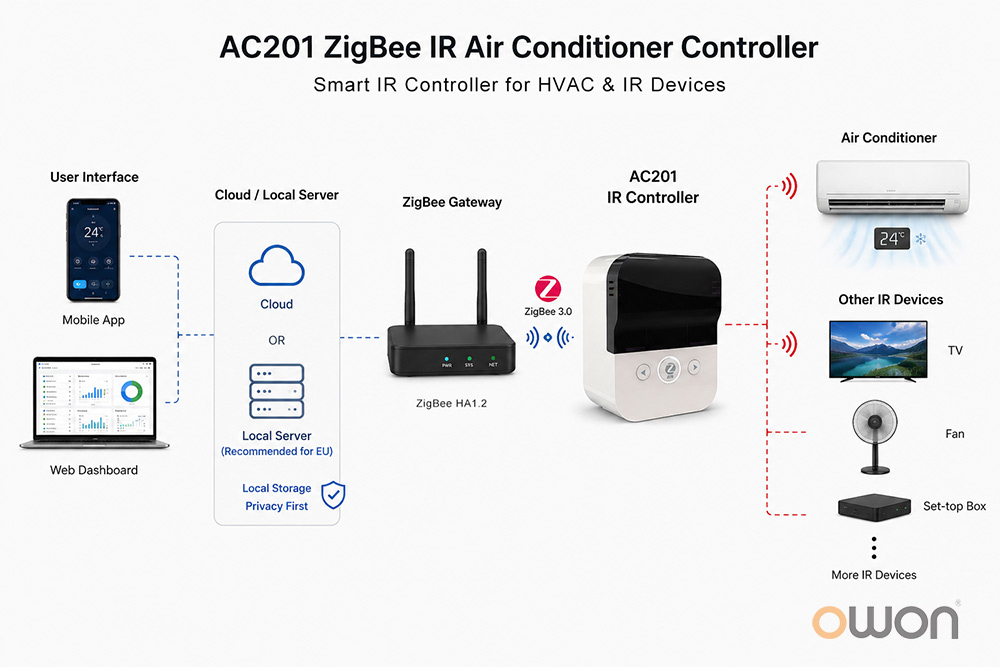
How a ZigBee-Based AC Control System Works
A typical smart HVAC setup includes several key components working together:
- a ZigBee gateway for communication
- one or more AC control devices
- a cloud platform or local server
- a mobile or web-based control interface
When a command is issued, the gateway transmits it to the control unit, which then converts the signal into infrared instructions. These instructions are received by the air conditioner and executed accordingly.
This design allows traditional air conditioning systems to be upgraded using a ZigBee IR air conditioner controller for centralized and automated HVAC control.
Why Traditional Air Conditioner Control Is Limited
Standard remote controls are designed for manual, single-room operation. In commercial or multi-room environments, this creates several challenges:
- no centralized management
- no automation capabilities
- inefficient energy usage
- lack of system visibility
A smart control solution addresses these limitations by enabling coordinated operation across multiple devices.
Key Benefits of Smart Air Conditioner Control
1. Centralized Management
Instead of managing each unit separately, users can control multiple air conditioners through a single interface. This improves operational efficiency in hotels, offices, and residential complexes.
2. Remote Access and Automation
With a connected system, users can control HVAC settings remotely. Schedules and automation rules can be applied to reduce unnecessary energy consumption and improve comfort.
3. Easy Retrofit for Existing Systems
One of the biggest advantages of this type of solution is that it does not require replacing existing air conditioning units. This makes it ideal for retrofit projects where cost and installation time are critical factors.
4. Integration with Smart Building Systems
These controllers can be integrated with other ZigBee devices such as motion sensors, door/window sensors, and thermostats. This allows the creation of a complete smart HVAC ecosystem.
5. Scalability for Commercial Deployment
ZigBee mesh networking supports stable communication across multiple devices, making it suitable for large-scale installations such as hotels and office buildings.

Control vs Monitoring: The Evolution of HVAC Systems
In advanced HVAC projects, basic control is often not enough. Modern systems increasingly require data feedback and performance visibility.
Some advanced solutions, such as a ZigBee air conditioner controller with energy monitoring, provide deeper insights into HVAC performance:
- temperature sensing
- humidity monitoring
- energy consumption tracking
- system status feedback
These features allow operators to make more informed decisions and optimize system performance over time.
Typical Application Scenarios
This type of HVAC control solution is widely used in:
Smart Hotels
Enable centralized room control, improve guest comfort, and reduce energy waste.
Office Buildings
Support scheduled operation and zone-based control for better efficiency.
Residential Projects
Add smart HVAC functionality without changing existing AC units.
Retrofit Projects
Upgrade legacy systems into connected environments quickly and cost-effectively.
Energy Management Systems
Integrate HVAC control into broader building energy optimization strategies.
How to Choose the Right AC Control Solution
When selecting a control system, B2B buyers should evaluate:
- compatibility with AC brands
- support for IR code libraries and learning
- integration capability with existing platforms
- need for monitoring features
- scalability of deployment
Basic models focus on reliable control, while advanced solutions provide deeper system insights.
Conclusion
A ZigBee air conditioner controller plays a key role in transforming traditional air conditioning systems into connected components of a smart HVAC environment. By enabling centralized control, automation, and integration, it helps improve operational efficiency and supports modern building requirements.
For system integrators and solution providers, adopting this type of technology offers a practical way to deliver scalable and future-ready HVAC solutions.
FAQ
What is a ZigBee air conditioner controller?
It is a device that connects air conditioners to a ZigBee network, allowing centralized and automated control.
How does it work?
It receives commands from a gateway and converts them into infrared signals that control the air conditioner.
Is it suitable for retrofit projects?
Yes, it is commonly used to upgrade existing split air conditioners without replacing them.
Can it support smart HVAC systems?
Yes, it integrates with sensors, gateways, and platforms to enable full smart HVAC control.
Related reading:
[ Zigbee IR Blaster for Split AC | Smart Retrofit AC Controller with Zigbee2MQTT ]
Post time: Apr-12-2026