As smart buildings continue to expand across Europe, HVAC control systems are becoming more intelligent, connected, and energy-focused. In commercial buildings, hotels, apartments, and office environments, traditional thermostats are no longer sufficient for modern building management requirements.
Today, a Zigbee fan coil thermostat is increasingly used as part of integrated smart HVAC systems, helping building operators improve energy efficiency, simplify deployment, and achieve centralized climate control.
Compared with conventional standalone thermostats, Zigbee-based HVAC control solutions provide better scalability, flexible wireless communication, and easier integration with smart building ecosystems.
Why Smart Buildings Need Smarter HVAC Control
Heating and cooling account for a significant portion of energy consumption in European buildings. As energy prices rise and EU efficiency regulations become stricter, property owners and facility managers are under increasing pressure to optimize HVAC performance.
Traditional fan coil thermostats often operate independently without centralized visibility or intelligent automation. This creates several challenges:
- Inconsistent room temperatures
- Inefficient energy usage
- Limited remote management capability
- Higher maintenance complexity
- Difficult retrofitting in older buildings
Modern smart buildings require HVAC systems that can support automation, occupancy-based control, and centralized management across multiple zones.
This is where Zigbee-based fan coil thermostat solutions provide clear advantages.

What Is a Zigbee Fan Coil Thermostat?
A Zigbee fan coil thermostat is a smart HVAC controller designed for fan coil unit (FCU) systems. It manages room temperature, fan speed, heating, and cooling functions while communicating wirelessly with gateways or building automation platforms through the Zigbee protocol.
Unlike traditional thermostats that rely mainly on standalone local control, Zigbee-enabled devices can become part of a larger connected HVAC ecosystem.
Typical functions include:
- Heating and cooling mode control
- Multi-speed fan control
- Weekly scheduling
- Remote temperature adjustment
- Occupancy-based automation
- Centralized device management
- Integration with smart building platforms
These capabilities make Zigbee thermostats particularly suitable for large-scale HVAC projects where flexibility and scalability are essential.
Benefits of Zigbee in Smart Building HVAC Systems
One of the key reasons Zigbee is widely used in building automation is its mesh networking capability.
In Zigbee networks, devices can relay communication signals between one another, helping improve network stability throughout the building. This is especially important in hotels, apartment complexes, and office buildings where HVAC devices may be distributed across multiple floors and rooms.
Comparison of Traditional HVAC Control vs Zigbee Smart HVAC Control
| Feature | Traditional HVAC Control | Zigbee Smart HVAC Control |
|---|---|---|
| Communication | Wired or standalone | Wireless mesh networking |
| Installation | Complex wiring required | Easier retrofit deployment |
| Scalability | Limited | Flexible multi-room expansion |
| Remote Management | Limited | Centralized cloud-based control |
| Energy Optimization | Basic | Intelligent automation & scheduling |
| Integration Capability | Low | Compatible with smart building systems |
Key advantages of Zigbee HVAC control include:
Stable Wireless Communication
Zigbee supports reliable short-range communication with low latency, making it suitable for real-time HVAC control.
Reduced Installation Complexity
Wireless deployment reduces the need for additional communication wiring, which is especially valuable in retrofit projects.
Scalable System Expansion
Additional thermostats, sensors, and control devices can be added without major infrastructure changes.
Low Power Consumption
Zigbee devices are designed for energy-efficient operation, supporting long-term smart building deployment.
Easier Integration with IoT Platforms
Zigbee fan coil thermostats can integrate with gateways, occupancy sensors, smart meters, and building management systems for more advanced automation strategies.
Smart HVAC Control for Hotels and Apartments
Hotels and residential apartment projects are among the most common applications for Zigbee fan coil thermostat systems in Europe.
In hotel environments, HVAC automation helps improve guest comfort while reducing unnecessary energy consumption in unoccupied rooms.
Common automation strategies include:
- Automatic temperature setback when rooms are vacant
- Occupancy-triggered HVAC activation
- Centralized room management
- Remote maintenance diagnostics
- Integration with hotel management systems
In apartment buildings, smart thermostats help property owners improve energy efficiency while offering residents better temperature control and mobile access.
Because many European buildings are retrofit projects, wireless Zigbee deployment also helps reduce installation complexity and renovation cost.
Integration with Building Management Systems
Modern smart buildings increasingly rely on centralized building management systems (BMS) to coordinate HVAC, lighting, energy monitoring, and security functions.
A Zigbee fan coil thermostat can function as part of this broader automation architecture.
When integrated with gateways and cloud platforms, HVAC operators can achieve:
- Centralized monitoring of multiple rooms
- Remote HVAC scheduling
- Energy usage optimization
- Data-driven maintenance management
- Cross-device automation with sensors and meters
This level of integration is becoming increasingly important in European commercial buildings seeking higher operational efficiency and sustainability compliance.
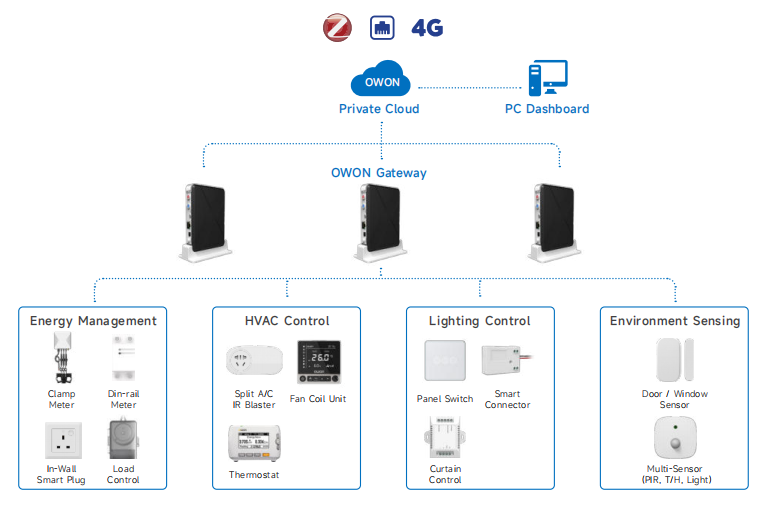
Example: OWON PCT504 Zigbee Fan Coil Thermostat
For smart HVAC projects requiring flexible deployment and reliable wireless communication, solutions such as the OWON PCT504 Zigbee fan coil thermostat provide a practical option for European markets.
The PCT504 supports fan coil unit control with multiple HVAC modes, fan speed adjustment, programmable scheduling, and Zigbee-based connectivity. It can be integrated into broader smart building systems alongside gateways, sensors, and other IoT devices.
Such solutions are suitable for hotels, apartments, office buildings, and retrofit HVAC projects where centralized control and scalability are important.
Why Zigbee HVAC Systems Are Growing in Europe
Several market trends are accelerating the adoption of Zigbee HVAC control systems across Europe:
- Growing demand for energy-efficient buildings
- Expansion of smart hotel and smart apartment projects
- Increasing retrofit renovation activity
- EU carbon reduction initiatives
- Rising interest in wireless building automation
As these trends continue, connected HVAC control systems are expected to play a larger role in both residential and commercial building infrastructure.
Frequently Asked Questions About Zigbee Fan Coil Thermostats
What is a Zigbee fan coil thermostat?
A Zigbee fan coil thermostat is a wireless HVAC controller designed for fan coil unit systems. It supports heating, cooling, fan speed control, and integration with smart building automation platforms.
Why are Zigbee thermostats suitable for hotels and apartments?
Zigbee thermostats support centralized management, wireless deployment, occupancy-based automation, and scalable HVAC control, making them suitable for hotels and multi-room residential buildings.
Can Zigbee fan coil thermostats work in retrofit projects?
Yes. Wireless Zigbee communication reduces installation complexity and minimizes additional wiring requirements, making these systems ideal for retrofit HVAC projects.
What are the benefits of smart HVAC automation?
Smart HVAC automation helps improve energy efficiency, enables remote management, reduces operational costs, and enhances occupant comfort across modern buildings.
Conclusion
A Zigbee fan coil thermostat is no longer simply a temperature controller. In modern smart buildings, it functions as part of a connected HVAC ecosystem that supports energy optimization, centralized management, and scalable automation.
For European building projects, especially hotels, apartments, and retrofit applications, Zigbee-based HVAC systems offer a practical balance of flexibility, reliability, and smart building integration.
As smart building adoption continues to grow, wireless HVAC automation technologies such as Zigbee are becoming an increasingly important part of future-ready building design.
Related reading:
[Zigbee IR Blaster for Split AC | Smart Retrofit AC Controller with Zigbee2MQTT]
Post time: Aug-29-2025