Introduction
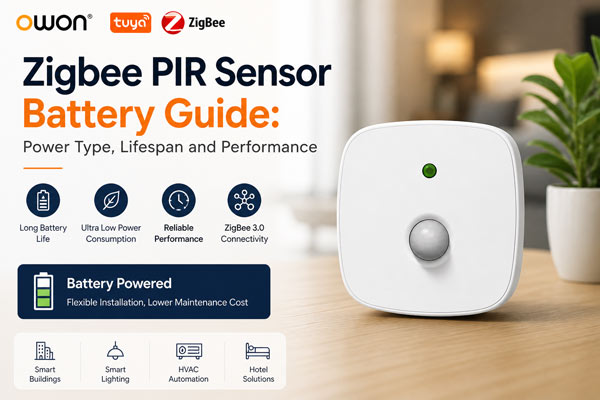
Battery-powered Zigbee PIR sensors are becoming increasingly popular in smart buildings, hotels, offices, and energy management systems.
Unlike traditional wired motion detectors, Zigbee PIR sensors are designed for low-power wireless deployment, making installation faster and more flexible for modern IoT projects.
When users search for topics related to Zigbee PIR sensor batteries, they are usually not only interested in battery lifespan. They also want to understand:
- why Zigbee PIR sensors use batteries
- how battery-powered sensors compare with wired solutions
- what affects battery performance
- whether wireless PIR sensors are reliable for commercial projects
This article explains how battery-powered Zigbee PIR sensors work, why they are widely used in smart buildings, and what factors influence long-term performance.
Why Most Zigbee PIR Sensors Are Battery-Powered
The main advantage of battery-powered Zigbee PIR sensors is deployment flexibility.
In traditional wired systems, every motion detector requires power wiring. In hotels, offices, and retrofit projects, this can significantly increase:
- installation cost
- labor requirements
- deployment complexity
- maintenance difficulty
Wireless Zigbee PIR sensors eliminate much of this infrastructure work.
Because Zigbee is a low-power wireless communication protocol based on IEEE 802.15.4, devices can remain in sleep mode most of the time and only transmit data when needed. This allows many sensors to operate efficiently using compact batteries.
Battery-powered Zigbee PIR sensors are therefore widely used in:
- smart office occupancy sensing
- hotel room automation
- HVAC control systems
- energy-saving building projects
- residential retrofit applications
Battery-Powered vs Wired PIR Sensors
Battery-powered Zigbee PIR sensors and wired PIR sensors are designed for different deployment needs.
| Feature | Battery-Powered Zigbee PIR Sensor | Wired PIR Sensor |
|---|---|---|
| Installation | Wireless & flexible | Requires wiring |
| Retrofit projects | Easy deployment | More difficult |
| Deployment speed | Fast | Slower |
| Placement flexibility | High | Limited |
| Maintenance | Battery replacement required | Less battery maintenance |
| Scalability | Easier for large projects | More infrastructure needed |
| IoT integration | Excellent | Depends on architecture |
For modern smart building projects, wireless deployment often provides better scalability and lower installation cost.
How Battery-Powered Zigbee PIR Sensors Reduce Power Consumption
Low power consumption is the foundation of battery-powered Zigbee sensors.
Several technologies help optimize battery performance.
Sleep Mode Operation
Most Zigbee PIR sensors remain in ultra-low-power standby mode until motion or environmental changes are detected.
This significantly reduces unnecessary energy consumption.
For example, Owon’s Zigbee multi sensor PIR313 is designed with standby current ≤40uA for long battery life optimization.
Event-Based Communication
Battery-powered Zigbee sensors usually transmit data only when:
- motion is detected
- environmental values change
- reporting intervals are reached
Compared with continuously active wired systems, this event-driven communication improves energy efficiency.
Zigbee Mesh Networking
Zigbee networks are optimized for low-bandwidth IoT communication.
Compared with Wi-Fi devices, Zigbee PIR sensors typically consume less power because they transmit lightweight data packets and remain in sleep mode most of the time.
Common Battery Types Used in Zigbee PIR Sensors
Most Zigbee PIR sensors use compact batteries to balance size, installation flexibility, and operating time.
AAA Batteries
AAA batteries are commonly used in compact Zigbee PIR sensors because they offer:
- small form factor
- easy replacement
- stable availability worldwide
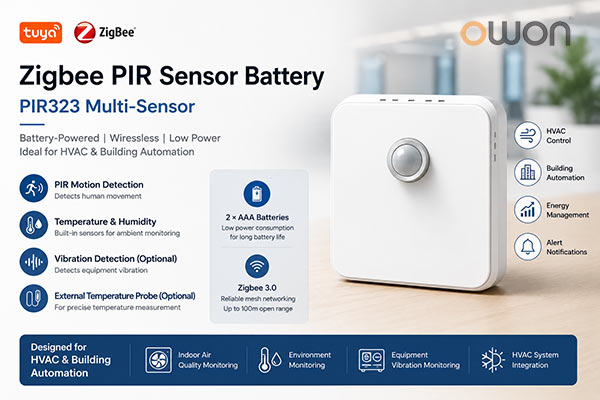
For example, PIR323 uses two AAA batteries and supports low-power Zigbee 3.0 operation.
AA Batteries
Some Zigbee multi-sensors use AA batteries to provide higher battery capacity and longer operating time.
PIR313 uses two AA batteries and supports long battery life optimization for low-power sensing applications.
Coin Cell Batteries
Compact wireless sensors may also use coin cell batteries such as CR2477.
For example, Zigbee door sensor DWS332 uses a CR2477 battery and supports long-term wireless operation for door/window monitoring applications.
What Affects Battery Performance in Zigbee PIR Sensors
Battery life depends on multiple factors, not just battery size.
Motion Detection Frequency
Sensors installed in busy corridors or public spaces trigger more frequently, increasing power consumption.
Reporting Interval
Some Zigbee multi-sensors periodically report:
- temperature
- humidity
- motion status
- vibration
- illuminance
More frequent reporting usually increases battery usage.
Owon’s PIR323 sensor, for example, supports configurable reporting cycles for temperature and humidity data.
Additional Sensor Functions
Modern Zigbee multi-sensors may integrate:
- PIR motion detection
- temperature & humidity sensing
- illuminance sensing
- vibration detection
- external temperature probes
Additional functions improve automation capability but may also increase energy consumption depending on system configuration.
Network Stability
Poor Zigbee signal quality may increase communication retries, which can reduce battery efficiency.
A stable Zigbee mesh network is important for long-term sensor performance.
Why Battery-Powered Zigbee PIR Sensors Are Popular in Smart Buildings
Battery-powered Zigbee PIR sensors are widely adopted because they simplify deployment in distributed IoT environments.
Typical applications include:
- smart hotel room management
- office occupancy sensing
- HVAC automation
- wireless building management systems
- energy-saving lighting control
- retrofit building upgrades
OWON’s wireless BMS architecture, for example, integrates Zigbee field sensors for room sensing, HVAC control, and energy management applications.
Different Types of Zigbee Multi-Sensor Applications
Modern Zigbee PIR sensors are no longer limited to motion detection only.
Smart Lighting & Energy Saving
Some multi-sensors combine:
- motion detection
- illuminance sensing
This allows systems to avoid unnecessary lighting activation when daylight is sufficient.
PIR313 is an example of this type of Zigbee multi-sensor design with integrated illuminance measurement.
HVAC & Environmental Monitoring
Other Zigbee multi-sensors focus more on environmental sensing by combining:
- motion detection
- temperature & humidity monitoring
- optional vibration detection
- optional external temperature probes
PIR323 is designed around this type of smart building and HVAC sensing application.
Conclusion
Battery-powered Zigbee PIR sensors have become an important part of modern smart building systems because they offer:
- wireless deployment flexibility
- lower installation cost
- scalable IoT integration
- low-power operation
Compared with traditional wired motion detectors, Zigbee PIR sensors are better suited for modern smart lighting, HVAC, and building automation projects where flexible deployment and energy efficiency are priorities.
Understanding how battery-powered Zigbee PIR sensors work helps system integrators, engineers, and facility managers select more suitable sensing solutions for commercial and residential automation systems.
Post time: May-05-2026