A Zigbee2MQTT temperature sensor provides a flexible way to monitor temperature and humidity without relying on a closed cloud ecosystem. By connecting compatible Zigbee sensors to Zigbee2MQTT, users can bring environmental data into platforms such as Home Assistant or integrate it with customized IoT and building automation systems.
For system integrators, OEM partners, HVAC solution providers, and IoT developers, choosing the right sensor involves more than measurement accuracy. Compatibility, battery operation, sensing method, network reliability, and integration flexibility can all affect long-term performance.
This guide explains what to consider when selecting a Zigbee2MQTT temperature sensor, when an external probe is useful, and how these sensors can support HVAC, cold chain, smart building, and industrial monitoring applications.
What Is a Zigbee2MQTT Temperature Sensor?
A Zigbee2MQTT temperature sensor is a Zigbee-based sensing device that can communicate through the open-source Zigbee2MQTT platform.
Instead of requiring a proprietary Zigbee cloud or app, Zigbee2MQTT enables compatible Zigbee devices to communicate with MQTT-based systems and popular platforms such as Home Assistant.
Depending on the device, a sensor may measure:
- Ambient temperature
- Relative humidity
- Contact or localized temperature through an external probe
- Battery status
This makes Zigbee2MQTT particularly useful for projects where local control, system flexibility, or integration with third-party platforms is important.
Why Use Temperature Sensors with Zigbee2MQTT?
Zigbee is designed for low-power wireless communication and supports networks containing multiple connected devices. Zigbee2MQTT adds an open integration layer that can make those devices easier to use within customized automation systems.
Key advantages include:
- Local control: Environmental data can be processed locally without depending entirely on cloud services.
- Home Assistant integration: Compatible sensors can provide temperature and humidity data for dashboards and automations.
- Multi-device integration: Different supported Zigbee devices can operate within the same Zigbee2MQTT environment.
- MQTT connectivity: Sensor data can be integrated with other MQTT-based applications and platforms.
- Flexible system development: Useful for smart home developers, system integrators, and customized IoT projects.
For professional deployments, however, protocol compatibility should not be the only selection criterion. Hardware design, measurement method, battery maintenance, installation environment, and long-term product availability should also be considered.
How to Choose the Best Zigbee2MQTT Temperature Sensor
There is no single “best” Zigbee2MQTT temperature sensor for every application. The right choice depends on what needs to be measured and where the sensor will be installed.
Temperature and Humidity Measurement
For rooms, offices, hotels, warehouses, and general environmental monitoring, a standard Zigbee temperature and humidity sensor with built-in sensing is usually sufficient.
These sensors measure the ambient conditions around the device and are suitable for applications such as:
- Room comfort monitoring
- HVAC automation
- Warehouse environmental monitoring
- Smart home automation
- Building management
External Temperature Measurement
Ambient sensing is not suitable for every project.
If temperature needs to be measured inside a freezer, on HVAC equipment, around a pipeline, or at another specific measurement point, an external probe may provide greater installation flexibility.
In these cases, a Zigbee temperature sensor with probe can be a better option.
Battery Operation
Battery-powered sensors simplify installation because communication and power wiring are not required at every measurement point.
For larger deployments, consider battery type, reporting frequency, accessibility for maintenance, and Zigbee network conditions rather than evaluating battery life from a single advertised number.
Integration Compatibility
Before selecting a device, verify that the specific model is supported by the intended Zigbee environment.
For projects based on Zigbee2MQTT, also consider whether integration with Home Assistant, MQTT applications, gateways, or other automation platforms is required.
Zigbee2MQTT External Temperature Sensor: When Is a Probe Needed?
An important distinction when choosing a temperature sensor is whether the application requires ambient sensing or localized temperature measurement.
A standard sensor measures the air temperature around its enclosure. This works well for rooms, offices, warehouses, and general indoor environmental monitoring.
An external temperature sensor places the sensing point away from the main Zigbee device.
This can be useful for:
- HVAC pipes and equipment
- Refrigerators and freezers
- Cold storage environments
- Underfloor heating systems
- Water systems
- Industrial equipment
- Enclosed measurement locations
The main Zigbee module can remain in a convenient wireless location while the external probe is positioned at the required measurement point.
This design is particularly useful when the temperature at the target location differs significantly from the surrounding room temperature.
Built-In Sensor vs External Probe
| Feature | Built-In Temperature Sensor | External Probe Temperature Sensor |
|---|---|---|
| Main measurement | Ambient environment | Localized/contact temperature |
| Typical location | Rooms and open spaces | Pipes, equipment, freezers |
| Installation | Sensor placed at measurement location | Probe separated from wireless module |
| Temperature & humidity monitoring | Suitable | Depends on sensor design |
| HVAC applications | Room monitoring | Equipment and pipe monitoring |
| Cold chain applications | General environment | Freezer or localized monitoring |
Neither design is universally better. The correct choice depends on the measurement objective.
For example, an office HVAC automation system may primarily need room temperature and humidity, while a refrigeration project may require an external probe placed inside the monitored area.
Using a Zigbee2MQTT Temperature Sensor with Home Assistant
Home Assistant is one of the common reasons users look for Zigbee2MQTT-compatible temperature sensors.
A typical system architecture includes:
Temperature Sensor → Zigbee Network → Zigbee Coordinator → Zigbee2MQTT → Home Assistant
Once a supported sensor is integrated, temperature and humidity data can be used for dashboards, alerts, and automation.
Typical applications include:
- Turning HVAC equipment on or off according to temperature
- Generating high- or low-temperature alerts
- Monitoring humidity conditions
- Recording environmental trends
- Creating room-based automation
- Combining temperature data with other Zigbee devices
For B2B projects, the same concept can also be applied to customized MQTT-based IoT platforms and building automation solutions.
Battery Life and Maintenance Considerations
One of the common questions about Zigbee temperature sensors is how long the battery will last.
There is no universal answer because battery life can depend on several factors:
- Battery type and capacity
- Temperature and humidity reporting frequency
- Zigbee network quality
- Operating temperature
- Frequency of device communication
- Installation environment
A sensor that reports very frequently may consume more power than one configured for less frequent environmental updates.
For commercial projects involving dozens or hundreds of sensors, maintenance accessibility is therefore an important consideration. Battery status reporting can also help facility operators plan replacement before a device goes offline.
Applications for Zigbee2MQTT Temperature Sensors
HVAC and Building Automation
Temperature and humidity data can support HVAC control, room monitoring, energy management, and building automation.
External probe sensors can extend monitoring to specific HVAC components or temperature points where ambient room sensing is insufficient.
Cold Chain and Refrigeration
Cold rooms, refrigerators, freezers, and storage facilities require reliable temperature monitoring.
An external probe allows the temperature sensing point to be positioned where monitoring is required while the Zigbee module remains in a suitable location for wireless communication.
Hotels and Commercial Buildings
Battery-powered Zigbee sensors can simplify deployment across guest rooms, offices, meeting rooms, and other commercial spaces.
Environmental data can then be used as part of centralized monitoring or automation systems.
Industrial and IoT Monitoring
For customized IoT projects, Zigbee2MQTT provides a flexible way to connect supported sensors with MQTT-based platforms.
Applications may include equipment monitoring, environmental monitoring, facility management, and customized automation systems.
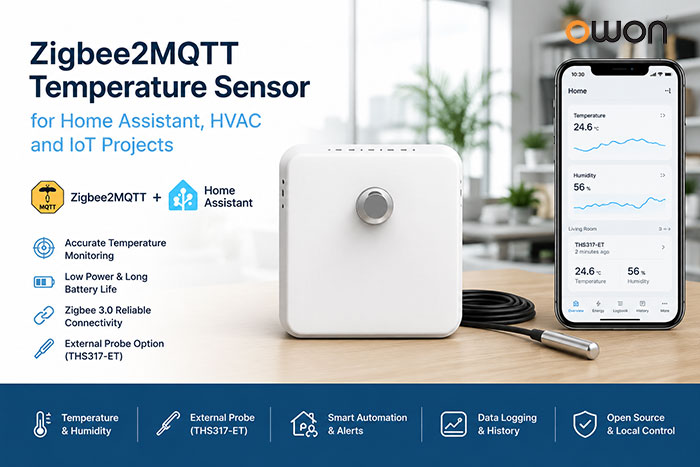
Example: OWON THS317 Series
For example, the OWON THS317 series provides two sensing configurations for different temperature monitoring requirements.
THS317
The standard THS317 uses built-in sensing for ambient temperature and humidity monitoring, making it suitable for rooms, buildings, HVAC environments, and general IoT monitoring.
THS317-ET
The THS317-ET adds an external temperature probe, allowing the sensing point to be positioned away from the main Zigbee module.
This configuration is particularly useful for applications such as HVAC equipment, refrigeration, cold chain, pipelines, and other locations requiring localized temperature measurement.
The THS317 series supports Zigbee2MQTT integration and can be used with Home Assistant, providing flexibility for open-platform projects.
For B2B customers, OWON also supports OEM/ODM requirements for Zigbee sensing and IoT projects.
Frequently Asked Questions
What temperature sensors work with Zigbee2MQTT?
Zigbee2MQTT supports many Zigbee temperature and humidity sensors from different manufacturers. Compatibility depends on the specific device model rather than Zigbee support alone, so the supported-device information should be checked before deployment.
Can I use a Zigbee2MQTT temperature sensor with Home Assistant?
Yes. Compatible Zigbee temperature sensors can be connected through Zigbee2MQTT and integrated with Home Assistant for dashboards, alerts, historical data, and automation.
When should I use a Zigbee2MQTT external temperature sensor?
An external sensor or probe is useful when temperature must be measured at a specific location rather than from the surrounding air. Typical examples include HVAC pipes, refrigeration equipment, freezers, underfloor heating systems, and industrial equipment.
How long does the battery last in a Zigbee temperature sensor?
Battery life varies according to battery capacity, reporting frequency, Zigbee network conditions, operating environment, and device configuration. For commercial deployments, battery status monitoring and maintenance accessibility should be considered during system design.
How do I pair a temperature sensor with Zigbee2MQTT?
The general process is to enable joining in Zigbee2MQTT and then place the temperature sensor into pairing mode. The exact reset or pairing procedure depends on the device model, so the manufacturer’s instructions should be followed.
Conclusion: Choosing the Right Zigbee2MQTT Temperature Sensor
A Zigbee2MQTT temperature sensor can provide a flexible foundation for environmental monitoring without locking a project into a single proprietary ecosystem.
For general room monitoring, a built-in temperature and humidity sensor may be the most practical choice. For HVAC equipment, refrigeration, cold chain, or other localized measurement points, a Zigbee temperature sensor with an external probe may provide greater flexibility.
Before selecting a device, consider measurement requirements, Zigbee2MQTT compatibility, Home Assistant integration, battery maintenance, installation environment, and long-term project needs.
OWON Technology provides Zigbee temperature and humidity sensing solutions for smart buildings, HVAC, cold chain, and industrial IoT applications. The THS317 series offers both built-in sensing and external probe options, together with Zigbee2MQTT and Home Assistant compatibility. For OEM/ODM projects or customized Zigbee sensing requirements, OWON can also support device and system integration needs.
Related reading:
[ Zigbee2MQTT Door Sensor: Integration Guide for Home Assistant and Smart Automation ]
Post time: Oct-01-2025


