Introduction
As the global population continues to age, healthcare providers face increasing challenges in protecting elderly residents from falls, especially during nighttime hours when supervision is more difficult. Falls remain one of the leading causes of injury among older adults in nursing homes, assisted living facilities, rehabilitation centers, and long-term care environments.
Many of these incidents occur when residents attempt to leave their beds without assistance. Traditional safety measures often rely on routine caregiver rounds or manual nurse call systems, which may delay intervention when immediate assistance is needed.
For this reason, healthcare organizations are increasingly deploying bed presence monitoring solutions that automatically detect occupancy changes and notify caregivers in real time. These intelligent systems help reduce fall risks, improve caregiver efficiency, and form the foundation of modern bed exit monitoring strategies.
Why Bed Exit Monitoring Matters in Elderly Care
Unexpected bed exits are one of the most common causes of nighttime falls among elderly residents.
Without continuous monitoring, caregivers may not know that a resident has left the bed until routine inspections or emergency calls occur. Even a short delay in response can increase the likelihood of injuries and hospitalization.
A modern bed exit monitoring system provides continuous occupancy awareness and immediately alerts caregivers when predefined events occur, enabling faster intervention while reducing unnecessary manual room checks.
Compared with conventional alarm systems, automated monitoring also improves staff efficiency and allows caregivers to focus their attention where it is most needed.
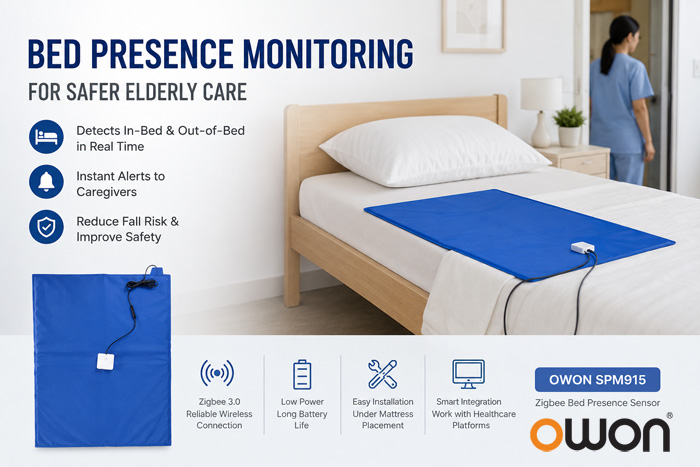
What Is a Bed Presence Sensor?
A bed presence sensor is a monitoring device designed to determine whether a person is currently occupying a bed or has left it.
Installed beneath or inside the mattress, the sensor continuously monitors bed occupancy without requiring the resident to wear any device or interact with the system.
Typical functions include:
- Real-time in-bed detection
- Out-of-bed detection
- Bed occupancy monitoring
- Automatic caregiver notifications
- Event history recording
Because monitoring is completely passive, bed presence sensors are particularly suitable for elderly residents, patients with limited mobility, rehabilitation patients, and long-term healthcare monitoring.
Bed Presence Sensor vs. Bed Occupancy Sensor
The terms bed presence sensor and bed occupancy sensor are often used interchangeably in elderly care and healthcare applications. In most cases, they refer to the same type of monitoring device that detects whether a bed is occupied and provides real-time occupancy status to caregivers.
Different manufacturers and healthcare providers may prefer one term over the other depending on their application or industry terminology. Regardless of the name, the primary purpose remains the same: helping caregivers know whether a resident is in bed or has left the bed, so they can respond quickly when assistance is needed.
For this reason, many modern monitoring solutions—including Zigbee-based systems—combine bed presence monitoring, bed occupancy monitoring, and bed exit detection within a single device and integrated monitoring platform.
How a Bed Exit Monitoring System Works
A complete bed exit monitoring system consists of more than just a sensing device. It combines intelligent sensors, wireless communication, and centralized monitoring software to deliver timely notifications and support efficient care management.
A typical solution includes:
- Bed presence sensor
- Zigbee wireless communication
- Zigbee gateway
- Central monitoring platform
- Mobile notifications
- Event logging and reporting
When a resident enters or leaves the bed, the sensor immediately detects the occupancy change and transmits status information through the Zigbee network. Caregivers receive real-time notifications on monitoring platforms or mobile devices, allowing faster response without disturbing residents during normal sleep.
Benefits of Smart Bed Presence Monitoring
Healthcare providers are increasingly adopting intelligent occupancy monitoring because it offers advantages beyond simple alarm functions.
Improved Resident Safety
Real-time occupancy monitoring enables caregivers to respond quickly when residents leave the bed unexpectedly.
Reduced Fall Risks
Immediate bed exit notifications help reduce unattended movement and improve nighttime supervision.
Better Caregiver Efficiency
Automatic monitoring minimizes routine manual inspections, allowing staff to focus on residents who require assistance.
Non-Intrusive Monitoring
Residents do not need to wear pendants, wristbands, or other tracking devices.
Scalable Wireless Deployment
Wireless Zigbee networking supports large-scale deployments across multiple rooms, wards, or healthcare facilities.
Common Applications
Bed presence monitoring solutions are widely used across various healthcare environments.
Typical applications include:
Nursing Homes
Improve nighttime supervision while reducing caregiver workload.
Assisted Living Facilities
Support resident independence while maintaining continuous safety monitoring.
Hospitals
Assist patient monitoring and fall prevention during recovery.
Rehabilitation Centers
Monitor patient movement throughout rehabilitation programs.
Home Healthcare
Provide family caregivers with occupancy notifications for aging-in-place scenarios.
Building a Complete Zigbee Bed Exit Monitoring Solution
Modern healthcare facilities increasingly prefer integrated monitoring solutions rather than standalone alarm devices.
A complete Zigbee-based solution typically combines:
- Bed Presence Sensors
- Zigbee Gateways
- Central Monitoring Software
- Mobile Caregiver Notifications
- Device Management
- Historical Event Records
- API Integration
Centralized monitoring enables caregivers to supervise multiple rooms simultaneously while supporting future expansion as facilities grow.
Example Solution from OWON
For example, OWON provides Zigbee-based elderly care monitoring solutions designed for nursing homes, assisted living facilities, hospitals, rehabilitation centers, and healthcare system integrators.
Instead of supplying only individual sensors, OWON offers a complete monitoring ecosystem that may include:
- SPM915 Bed Presence Sensor for real-time in-bed and out-of-bed detection
- Zigbee gateways for reliable wireless networking
- Wireless BMS 8000 centralized monitoring platform
- Real-time caregiver notifications
- Device management and event history
- API integration for healthcare and IoT platforms
This solution enables caregivers to monitor multiple residents from a unified interface while supporting scalable deployments across healthcare facilities.
Choosing the Right Bed Presence Monitoring Solution
When evaluating monitoring technologies, healthcare providers should consider:
- Detection accuracy
- Wireless communication reliability
- Ease of installation
- Platform integration capabilities
- Scalability
- Long-term product availability
- Technical support
- OEM & ODM customization
A professional monitoring solution should not only improve resident safety but also integrate seamlessly into existing healthcare workflows.
FAQ
What is a bed presence sensor?
A bed presence sensor detects whether a person is currently in bed or has left the bed, providing real-time occupancy information for caregiver monitoring.
What is the difference between a bed presence sensor and a bed occupancy sensor?
In most healthcare and elderly care applications, the terms “bed presence sensor” and “bed occupancy sensor” are used interchangeably. Both describe a device that detects whether a person is in bed or has left the bed, providing real-time occupancy information for caregivers. Different manufacturers may use different terminology, but the primary function remains the same.
What is a bed exit monitoring system?
A bed exit monitoring system combines occupancy sensors, wireless communication, gateways, and monitoring software to automatically notify caregivers when residents leave the bed.
Does a bed presence sensor monitor heart rate or respiration?
No. Bed presence sensors are designed for occupancy detection only. If non-contact heart rate or respiration monitoring is required, solutions such as the OWON SPM912 or SPM913 are more appropriate.
Why is Zigbee suitable for bed monitoring?
Zigbee provides low power consumption, stable mesh networking, and reliable wireless communication, making it ideal for healthcare facilities deploying multiple monitoring devices.
Who uses bed presence monitoring solutions?
Typical users include nursing homes, assisted living facilities, hospitals, rehabilitation centers, healthcare platform providers, and smart healthcare system integrators.
Conclusion
As elderly care becomes increasingly digital, bed presence monitoring solutions are evolving from simple alarm devices into intelligent components of connected healthcare ecosystems. By combining accurate bed presence sensors, reliable bed exit monitoring systems, wireless Zigbee networking, and centralized management platforms, healthcare providers can enhance resident safety while improving caregiver efficiency.
For organizations planning smart elderly care projects, choosing a scalable solution is essential. For example, OWON’s Zigbee-based monitoring ecosystem—including the SPM915 Bed Presence Sensor, Zigbee gateways, and the WBMS 8000 centralized monitoring platform—provides a flexible foundation for building safer, more connected, and future-ready elderly care environments.
Related reading:
[Why Vital Signs Monitoring Devices Are Transforming Elderly Healthcare Systems]
Post time: Jul-01-2026