If you manage apartments or hotels, you have probably experienced a slightly frustrating truth about HVAC systems:
The equipment is usually not the problem.
The energy bill is.
Walk through almost any property and you will find familiar situations.
A guest leaves the room, but the air conditioning keeps running.
A vacant apartment is still being cooled.
Maintenance teams discover temperature issues only after complaints arrive.
The HVAC system is working exactly as designed.
Unfortunately, that is sometimes the problem.
Modern properties are no longer looking only for larger HVAC equipment. They are looking for smarter HVAC control.
Because saving energy is important.
But saving energy without annoying guests or tenants is where things get interesting.
Why Smart HVAC Control Is Becoming Essential for Apartments and Hotels
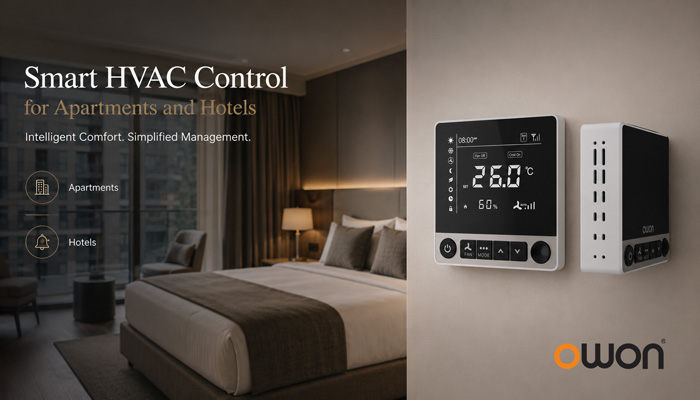
Smart HVAC control is becoming increasingly important in apartments, hotels, serviced residences, and light commercial buildings because these properties face the same challenge every day:
How can indoor comfort be maintained while reducing unnecessary HVAC operation?
In hotels, comfort directly affects guest experience. A room should feel comfortable when a guest arrives, even if the room was unoccupied for hours.
In apartments, property managers need reliable temperature control across multiple units while keeping operating costs predictable.
In both cases, traditional standalone thermostats often provide limited visibility. They control temperature locally, but they do not always help property operators understand occupancy, energy waste, room conditions, or maintenance needs.
That is why more property operators are moving toward connected HVAC control systems that combine thermostats, sensors, gateways, and centralized management.
Why HVAC Energy Waste Happens So Easily
Most energy waste in hotels and apartment buildings does not come from equipment failure.
It comes from a lack of visibility and control.
A thermostat cannot know that a guest left for dinner.
A fan coil unit cannot tell whether a room has been vacant for six hours.
And unless someone manually adjusts settings, the system simply keeps doing what it was told to do.
Rather like an enthusiastic employee who follows instructions perfectly but never asks whether they still make sense.
The result is familiar:
- HVAC systems running in empty rooms
- Heating and cooling operating longer than necessary
- Different rooms using completely different settings
- Higher energy costs without noticeable comfort benefits
- Maintenance teams responding only after complaints happen
The challenge is not generating comfort.
The challenge is managing comfort efficiently.
What Smart HVAC Control Actually Means
When people hear the term smart HVAC control, they often think about controlling a thermostat from a mobile app.
That is certainly part of it.
But the real value goes much further.
A smart HVAC system is not simply connected.
It is informed.
Instead of treating every room the same way, it adjusts based on real-world conditions such as occupancy, schedules, room status, and operating requirements.
In practical terms, smart HVAC control often includes:
- Automated scheduling
- Remote monitoring
- Centralized management
- Occupancy-based temperature adjustment
- Door and window status integration
- Real-time room visibility
- Gateway-based system control
- Integration with property or building management platforms
In other words, the goal is not to give property managers more buttons to press.
The goal is to reduce the number of times they need to press them.
Smart HVAC Control vs Traditional Thermostat Control
| Traditional Thermostat Control | Smart HVAC Control |
|---|---|
| Controls one room independently | Connects rooms into a managed system |
| Requires manual adjustment | Supports automation and schedules |
| Limited visibility | Provides room-level status awareness |
| No occupancy context | Can respond to occupancy or vacancy |
| Hard to scale across properties | Easier to manage across many rooms |
| Mainly comfort-focused | Balances comfort, energy, and operations |
This difference matters especially in hotels and apartment buildings, where many rooms or units must be managed at the same time.
Key Components of a Smart HVAC Control System
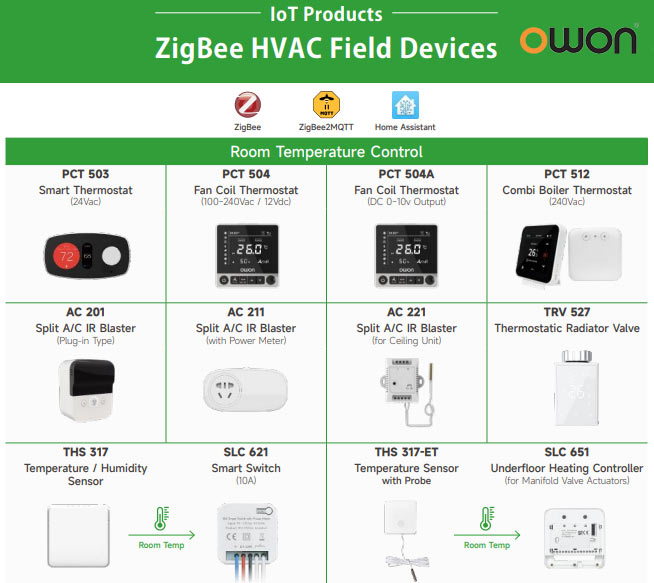
A smart HVAC control system usually includes more than one device.
For apartments and hotels, a practical system may include:
Smart Thermostats
Thermostats remain the main control interface for room temperature, HVAC modes, fan speed, and user interaction.
In fan coil projects, a Zigbee fan coil thermostat can control heating, cooling, and fan operation while communicating with other smart devices.
Occupancy Sensors
Occupancy sensors help determine whether a room is currently being used.
This enables energy-saving logic when rooms are vacant.
Door and Window Sensors
Door or window sensors can help identify conditions that may waste energy, such as cooling a room while a balcony door is open.
Gateways
A gateway connects thermostats and sensors to a central platform, cloud server, or local control system.
Management Platform
The management platform allows property operators to monitor room conditions, apply schedules, and manage HVAC strategies across multiple rooms.
Together, these components turn basic HVAC control into a smart HVAC control system.
Apartments and Hotels Face Different HVAC Challenges
Although apartments and hotels may use similar HVAC technologies, their priorities are often different.
Hotels focus heavily on guest comfort.
A room should feel comfortable when a guest arrives, regardless of whether the room was occupied five minutes ago or five days ago.
Apartment operators tend to focus more on long-term efficiency and tenant satisfaction.
Residents expect comfort, but property managers also need predictable operating costs across dozens or hundreds of units.
Different buildings.
Different business models.
The same underlying question:
How do you maintain comfort without wasting energy?
Why More Properties Are Moving Beyond Standalone Thermostats
Traditional thermostats work independently.
Each room becomes its own little island.
That approach worked reasonably well for many years.
But modern property management increasingly requires a broader view.
Today, many operators want to understand:
- Which rooms are consuming energy?
- Which units are vacant?
- Which areas require maintenance attention?
- Where can energy use be optimized?
- Which rooms need temperature adjustment before check-in?
This is where connected HVAC systems begin to make a difference.
Instead of controlling individual rooms, property managers gain the ability to manage an entire property more intelligently.
The thermostat stops being just a wall-mounted device.
It becomes part of an operational strategy.
Why Zigbee Is Popular in HVAC Retrofit Projects
One reason many property upgrades use Zigbee-based HVAC control is simple:
Most buildings would prefer not to tear open walls.
Retrofitting existing hotels or apartment buildings is rarely glamorous work.
Guests dislike construction noise.
Property managers dislike construction invoices.
Zigbee helps reduce both.
Because it uses wireless communication, it is often easier to deploy in existing properties without extensive rewiring.
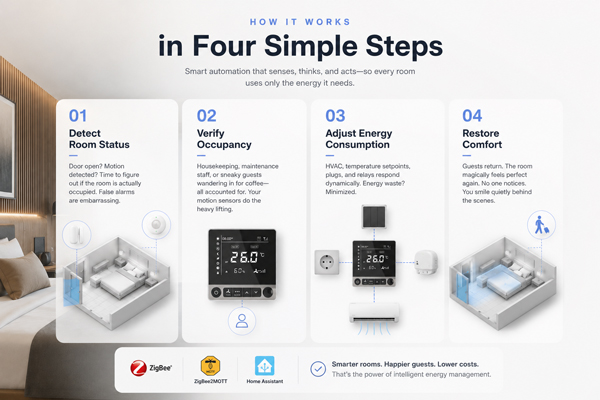
It also allows thermostats, occupancy sensors, door sensors, and gateways to work together as part of a larger control system.
And when multiple devices can share information, smarter decisions become possible.
Which is really the whole point.
Real Devices Behind Smart HVAC Control
A smart HVAC controller is only valuable when it can match the real equipment used in the building.
In many European hotels, apartments, and commercial properties, fan coil units are widely used for room-level heating and cooling.
That is why Zigbee fan coil thermostats are often selected for smart HVAC control projects.
For example, the OWON PCT504 Zigbee Fan Coil Thermostat is designed for fan coil HVAC applications and can be used as part of broader hotel room automation and apartment energy management systems.
In a typical deployment, the thermostat does not work alone. It can operate together with occupancy sensors, door sensors, and gateways to support room-level automation, centralized control, and energy-saving strategies.
This makes the thermostat one practical component inside a larger smart HVAC control system.
A Real Example: Hotel Energy Management Upgrade
Consider a hotel retrofit project completed by a European system integrator.
The property wanted to reduce unnecessary HVAC operation while preserving guest comfort.
There was one important condition:
The existing HVAC infrastructure needed to remain in place.
Replacing everything would have been expensive, disruptive, and difficult to justify.
Instead, the project combined:
- Zigbee thermostats
- Door sensors
- Occupancy sensors
- A centralized gateway
This allowed room conditions and occupancy status to work together.
When guests were present, comfort remained the priority.
When rooms became vacant, energy-saving logic could take over automatically.
The result was not a futuristic smart building.
It was something far more useful:
A building that wasted less energy while remaining comfortable for guests.
What Property Managers Should Look for in Smart HVAC Devices
When evaluating smart HVAC solutions, technical specifications matter.
But they are rarely the only consideration.
Experienced property managers often focus on questions such as:
Can the system scale?
A pilot project is easy.
Deploying across hundreds of rooms is where things become interesting.
Can it integrate with other devices?
Thermostats rarely work alone.
Occupancy sensors, door sensors, and gateways often play important supporting roles.
Is the wireless communication reliable?
Because nobody enjoys troubleshooting room temperatures at 11 PM.
Does it support the existing HVAC equipment?
A smart control system must match the real HVAC infrastructure, whether the building uses fan coil units, split air conditioning, or other room-level systems.
Will the product still be available in the future?
Long-term support and supply stability are often more important than saving a few dollars upfront.
Better HVAC Control Starts With Better Visibility
Many HVAC upgrades begin with a simple realization:
You cannot optimize what you cannot see.
Connected thermostats provide more than temperature control.
They provide visibility.
And visibility creates opportunities for better decisions.
Solutions such as OWON’s PCT504 Zigbee Fan Coil Thermostat are often used as part of broader room automation and energy management projects, helping operators balance comfort, efficiency, and operational control without major infrastructure changes.
The thermostat itself is only one piece of the puzzle.
But it is often the piece that allows everything else to work together.
Conclusion
For hotels and apartment buildings, the future of HVAC management is not about installing larger systems.
It is about operating existing systems more intelligently.
The buildings that perform best are not always the ones with the newest equipment.
They are often the ones with the best control strategies.
Because in the end, guests care about comfort.
Property managers care about costs.
And smart HVAC control is one of the few solutions that helps both sides win.
For system integrators, hotel solution providers, and apartment technology partners, OWON provides Zigbee HVAC control devices, gateways, and integration-ready solutions that can support smart room automation, energy management, and retrofit projects.
If you are planning a hotel, apartment, or smart building HVAC control project, OWON can help evaluate suitable thermostat and sensor configurations for your deployment.
FAQ
What is smart HVAC control?
Smart HVAC control uses connected thermostats, sensors, gateways, automation, and centralized management to improve comfort while reducing unnecessary energy consumption.
What is a smart HVAC control system?
A smart HVAC control system is a connected system that may include thermostats, occupancy sensors, door sensors, gateways, and management software. It allows property operators to monitor and manage HVAC operation more intelligently.
How can hotels reduce HVAC energy waste?
Hotels can reduce HVAC energy waste through occupancy-based control, automated scheduling, remote monitoring, door sensor integration, and centralized thermostat management.
What is occupancy-based HVAC control?
Occupancy-based HVAC control adjusts heating and cooling settings based on whether a room is occupied or vacant, helping reduce energy waste without affecting comfort.
Why do hotels use Zigbee thermostats?
Many hotels use Zigbee thermostats because they support wireless deployment, centralized control, and integration with occupancy sensors, door sensors, gateways, and room automation systems.
Can I turn an existing HVAC system into a smart HVAC system?
In many cases, yes. Existing HVAC systems can often be upgraded with smart thermostats, sensors, and gateways, especially in retrofit projects where full HVAC replacement is not practical.
Are smart thermostats suitable for apartment buildings?
Yes. Smart thermostats help apartment operators improve energy efficiency, simplify property management, and provide better temperature control across multiple units.
Related reading:
[Zigbee Fan Coil Thermostat for Smart Building HVAC Automation in Europe]
Post time: Jul-02-2026