A WiFi thermostat for heat pump systems can provide remote temperature control, scheduling, connected HVAC management, and other smart features. However, not every WiFi thermostat is compatible with every heat pump.
Heat pump systems can require different thermostat control logic than conventional furnace and air-conditioning systems. Before selecting a thermostat, it is important to check the HVAC voltage, heating and cooling stages, O/B reversing valve, auxiliary and emergency heat requirements, dual-fuel configuration, and thermostat power supply.
For homeowners, HVAC contractors, distributors, and system integrators, understanding these requirements is the first step toward choosing the right WiFi thermostat for a heat pump.
Can a WiFi Thermostat Work with a Heat Pump?
Yes. A WiFi thermostat can work with a heat pump as long as the thermostat supports the specific HVAC configuration.
In many North American residential and light-commercial applications, heat pumps use 24VAC thermostat control. Depending on the system, the thermostat may need to manage:
- Compressor heating and cooling
- Multiple heating or cooling stages
- O/B reversing valve control
- Auxiliary heat
- Emergency heat
- Indoor fan operation
- Dual-fuel or hybrid heating
WiFi connectivity does not determine HVAC compatibility. WiFi provides the communication layer for features such as app-based control and remote management, while the thermostat’s HVAC hardware and control logic determine whether it can properly operate the heat pump.
This is why checking compatibility should come before comparing apps, displays, voice control, or other connected features.

Do You Need a Special Thermostat for a Heat Pump?
A heat pump requires a thermostat that specifically supports its control configuration.
A conventional thermostat used with a furnace and central air conditioner may control separate heating and cooling equipment. A heat pump, by contrast, uses the refrigeration cycle for both heating and cooling and typically requires an O/B reversing valve signal to switch operating modes.
More advanced heat pump systems may also require the thermostat to coordinate multiple compressor stages and backup heating.
For example, a heat pump thermostat may need to support configurations such as:
- 2H/2C
- 3H/2C
- 4H/2C
- Heat pump + auxiliary heat
- Heat pump + emergency heat
- Dual-fuel heat pump + furnace
Therefore, simply finding a thermostat with WiFi does not mean it will work correctly with a particular heat pump.
How Does a WiFi Thermostat Control a Heat Pump?
In a typical connected 24VAC HVAC installation, the control path can be simplified as:
Mobile App → Internet / WiFi → Thermostat → 24VAC HVAC Control → Heat Pump
When a user changes a temperature setting remotely, the command reaches the WiFi thermostat through the connected platform. The thermostat then applies its HVAC control logic and activates the appropriate terminals based on the operating mode and system configuration.
Common heat pump thermostat terminals can include:
- R – 24VAC power
- C – Common
- Y / Y2 – Compressor stages
- G – Indoor fan
- O/B – Reversing valve
- AUX / W – Auxiliary heat
- E – Emergency heat
The exact terminal configuration varies by HVAC system and thermostat.
This also explains why “connecting a heat pump to WiFi” often means installing a compatible WiFi thermostat or using the HVAC manufacturer’s connected control system—not simply adding WiFi directly to the heat pump.
7 Things to Check Before Choosing a WiFi Thermostat for a Heat Pump
The following compatibility checks are more important than choosing a thermostat based only on its smart features.
1. HVAC Control Voltage
Determine whether the heat pump uses standard 24VAC thermostat control or a proprietary communicating control system.
Many North American central heat pump systems use 24VAC controls, but this should never be assumed solely from the HVAC brand.
2. Heating and Cooling Stages
Check how many compressor and heating stages the system requires.
A thermostat designed for a basic single-stage HVAC system may not provide enough outputs for a multi-stage heat pump.
For more advanced systems, support such as 4H/2C may be required.
3. O/B Reversing Valve
Heat pumps commonly use an O/B terminal to control the reversing valve that changes the refrigeration cycle between heating and cooling.
The thermostat must support the appropriate O/B configuration for the HVAC system.
4. Auxiliary Heat
Some heat pump installations include an auxiliary heating source that can supplement the heat pump when additional heating capacity is required.
A compatible thermostat must support the required auxiliary heat stages and control strategy.
For a more detailed explanation of this configuration, see our guide to WiFi thermostat for heat pump with auxiliary heat.
5. Emergency Heat
Emergency heat is related to backup heating but should not be treated as simply another name for normal auxiliary heat operation.
If the HVAC system provides an emergency heat mode, make sure the thermostat supports the required control configuration.
For more information about how this mode works, see Emergency Heat on a Thermostat.
6. Dual-Fuel or Hybrid Heating
A dual-fuel system typically combines a heat pump with another heating source, such as a gas furnace.
The thermostat must be capable of coordinating the two heating sources according to the system’s control strategy.
This is particularly important in regions where heat pumps operate alongside backup heating during colder outdoor conditions.
7. C-Wire and Thermostat Power
WiFi connectivity, displays, sensors, and other electronics require continuous power.
Many 24VAC WiFi thermostats use R and C to provide this power. Before replacing an existing thermostat, check whether a C-wire is available and whether the thermostat requires one.
If a dedicated C-wire is unavailable, check whether an appropriate manufacturer-supported adapter or wiring solution can be used.
WiFi Thermostat for Heat Pump with Auxiliary Heat
Users often specifically look for a WiFi thermostat for heat pump with auxiliary heat because backup heating is an important compatibility issue.
Auxiliary heat supplements the heat pump when the system requires additional heating capacity. Depending on the HVAC design, this may involve electric resistance heat or another backup heating source.
The thermostat therefore needs to understand when and how the additional heat source should be activated.
However, the presence of an AUX terminal alone is not enough to confirm compatibility. The number of heating stages, heat pump configuration, HVAC equipment, and thermostat control logic should all be checked.
For detailed information about this specific application, our dedicated auxiliary heat guide explains the topic separately.
Auxiliary Heat vs. Emergency Heat
Although the two terms are related, auxiliary heat and emergency heat are not the same operating concept.
Auxiliary heat can be used as part of normal heat pump operation when additional heating is required.
Emergency heat is generally a manually selected backup operating mode intended for situations where the normal heat pump heating operation cannot be used.
The exact implementation varies by HVAC equipment, so users and installers should follow the equipment manufacturer’s requirements rather than assuming all heat pump systems operate identically.
Will Any WiFi Thermostat Work with Any Heat Pump?
No.
This is particularly important when searching for a thermostat by HVAC brand.
Two heat pumps from different manufacturers—or even different product families from the same manufacturer—may use different control architectures.
A central heat pump may use conventional 24VAC thermostat terminals, while another system may use a proprietary communicating controller.
Ductless and mini-split heat pumps can also use control architectures that differ substantially from traditional North American 24VAC central HVAC systems.
Therefore, compatibility should be determined from:
- HVAC system type
- Control voltage
- Existing thermostat wiring
- Number of heating and cooling stages
- O/B configuration
- Auxiliary and emergency heat requirements
- Manufacturer documentation
Do not assume that a thermostat is compatible with every model from a particular HVAC brand unless that compatibility has been verified.
WiFi Thermostat Features Worth Considering
After HVAC compatibility has been confirmed, connected features can become part of the selection process.
Depending on the project, useful capabilities may include:
Remote App Control
WiFi connectivity can allow users to adjust temperature, operating mode, schedules, and other supported settings remotely.
Scheduling
Programmable schedules can automatically adjust HVAC settings according to occupancy patterns and daily routines.
Remote Room Sensors
A single wall thermostat does not always represent temperatures throughout a home or building.
Compatible remote sensors can provide additional room-level temperature information for monitoring or thermostat control strategies.
Energy Information
Some connected thermostats provide HVAC runtime or energy-related reports that can help users understand system operation.
Alerts and Maintenance Reminders
Connected platforms may provide temperature alerts, filter reminders, system notifications, or other maintenance information.
For professional and B2B applications, additional considerations can include API availability, device management, firmware updates, and integration with third-party platforms.
Example: A 24VAC WiFi Thermostat for Heat Pump Systems
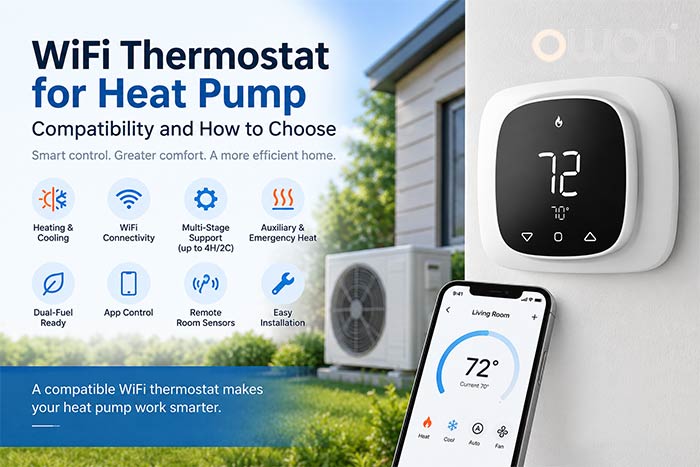
For example, the OWON PCT5231 WiFi thermostat is designed for North American 24VAC HVAC systems and supports conventional and heat pump configurations.
For heat pump applications, the platform supports up to 4H/2C, along with auxiliary heat, emergency heat, and dual-fuel or hybrid heating configurations.
It also provides features such as:
- WiFi connectivity
- 7-day scheduling
- Support for up to 10 remote room sensors
- Temperature limits and thermostat locking
- HVAC maintenance reminders
- Energy-related reporting
- API options for system integration
For installations where a suitable C-wire is unavailable, OWON also provides the SWB511 C-wire adapter for compatible installation scenarios.
This type of thermostat illustrates why heat pump compatibility involves more than simply adding WiFi connectivity: the thermostat must combine the appropriate HVAC control hardware, software logic, and connected functions.
WiFi Heat Pump Thermostats for OEM and HVAC Projects
For HVAC manufacturers, distributors, smart home brands, and system integrators, thermostat selection may involve requirements beyond a single residential installation.
OEM and connected HVAC projects can require:
- Private-label branding
- Hardware customization
- Firmware customization
- API integration
- Cloud platform integration
- Mobile app integration
- Device management
- OTA firmware upgrades
- Long-term manufacturing support
OWON develops WiFi thermostat platforms for North American HVAC applications and provides OEM/ODM options for customers that need thermostat products integrated into their own HVAC, smart home, energy management, or connected-building solutions.
For B2B projects, compatibility should therefore be evaluated at two levels: HVAC equipment compatibility and system-level integration requirements.
Frequently Asked Questions
Can you put a WiFi thermostat on a heat pump?
Yes, if the WiFi thermostat supports the heat pump’s voltage, control wiring, heating and cooling stages, reversing valve, and any required backup heating functions.
Do I need a special thermostat for a heat pump?
You need a thermostat specifically compatible with the heat pump configuration. Heat pumps can require O/B reversing valve control, multiple compressor stages, auxiliary heat, emergency heat, or dual-fuel control that a basic conventional thermostat may not support.
Can a WiFi thermostat control auxiliary heat?
Yes, if the thermostat and HVAC configuration support auxiliary heat. Compatibility should be checked based on the required heating stages and control wiring.
Can a WiFi thermostat control emergency heat?
Some heat pump thermostats support emergency heat operation. Verify that the thermostat supports the required emergency heat configuration before installation.
Does a WiFi heat pump thermostat need a C-wire?
Many 24VAC WiFi thermostats use a C-wire for continuous power, although installation requirements vary by model. Check both the thermostat requirements and existing HVAC wiring.
Can I use any WiFi thermostat with a heat pump?
No. WiFi connectivity does not guarantee HVAC compatibility. Check voltage, stages, O/B configuration, auxiliary and emergency heat, C-wire requirements, and whether the HVAC system uses conventional or proprietary controls.
What’s the difference between a WiFi thermostat and a smart thermostat?
WiFi primarily describes network connectivity. A smart thermostat may include additional capabilities such as automation, sensors, energy information, scheduling, occupancy-based functions, or third-party integrations. Many modern thermostats provide both.
Conclusion
Choosing a WiFi thermostat for heat pump systems starts with HVAC compatibility.
Before comparing apps or smart features, verify the control voltage, heating and cooling stages, O/B reversing valve, auxiliary and emergency heat requirements, dual-fuel configuration, and thermostat power supply.
For a standard North American 24VAC heat pump, a properly matched WiFi thermostat can combine reliable HVAC control with remote access, scheduling, room sensors, and connected management.
For OEMs, HVAC manufacturers, distributors, and system integrators, the selection process can also include API access, firmware customization, cloud integration, private labeling, and long-term product support.
The right thermostat is therefore not simply the one with the most connected features—it is the one whose HVAC control architecture matches the heat pump system and the requirements of the application.
Related reading:
[How to Choose a WiFi Thermostat Platform for Residential HVAC Products]
Post time: Sep-22-2025


