If your thermostat displays “Aux Heat” or “Auxiliary Heat,” it usually means the heat pump is receiving help from a supplemental heating source to meet the current heating demand.
Auxiliary heat can be a normal part of heat pump operation, especially during colder conditions. However, frequent or unexpected Aux Heat operation may raise questions about thermostat settings, HVAC performance, and energy use.
A heat pump thermostat with auxiliary heat must do more than switch between heating and cooling. Depending on the HVAC system, it may also need to manage multiple compressor stages, auxiliary heating, emergency heat, and O/B reversing valve control.
This guide explains how Aux Heat works, when it may turn on, and what to check when choosing a compatible thermostat.
What Is Auxiliary Heat on a Heat Pump Thermostat?
Auxiliary heat, often shown as “Aux Heat” on the thermostat, is supplemental heating used when the heat pump needs additional help to meet the heating demand.
Depending on the HVAC configuration, supplemental heating may come from electric resistance heating or another backup heating source. Dual-fuel systems can also combine a heat pump with a furnace as part of the overall heating strategy.
Seeing Aux Heat on the thermostat does not automatically mean something is wrong. It can be part of normal system operation.
When Does Auxiliary Heat Come On?
Auxiliary heat may operate when the heat pump needs additional heating capacity. Common situations can include:
- Low outdoor temperatures
- A large difference between room temperature and the thermostat setpoint
- Recovery after a scheduled temperature setback
- Defrost operation on some heat pump systems
- HVAC control strategies configured to call for supplemental heat
The exact operating logic depends on the heat pump, thermostat, backup heating equipment, and system configuration.
At What Temperature Does Auxiliary Heat Come On?
There is no single outdoor temperature at which Aux Heat must activate for every heat pump.
The activation point can depend on outdoor conditions, heat pump capacity, building heating load, thermostat settings, and the type of backup heat.
Some systems may use configured balance points or other control logic. Always follow the HVAC equipment and thermostat manufacturer’s recommended settings rather than assuming one temperature applies to every system.
Is It Bad If Auxiliary Heat Comes On?
Not necessarily.
Auxiliary heat is designed to provide additional heating when the heat pump alone cannot meet the current demand.
However, if Aux Heat operates unusually often, remains active for long periods during mild weather, or the home is still not warming properly, the thermostat configuration or HVAC system may need to be checked.
Electric resistance auxiliary heat can also consume more electricity than normal heat pump operation, making unnecessary Aux Heat operation an energy concern.
Should I Switch My Heat Pump to Aux Heat?
In normal operation, users generally do not need to manually switch a properly configured heat pump to auxiliary heat. The HVAC control system can call for supplemental heat when additional heating capacity is required.
It is also important not to confuse Auxiliary Heat with Emergency Heat.
Aux Heat normally supplements heat pump operation when needed. Emergency Heat is a separate operating mode on applicable systems and should be used according to the HVAC equipment manufacturer’s instructions.
Can You Reduce Unnecessary Auxiliary Heat Operation?
The goal should not be to disable Aux Heat if the HVAC system is designed to use it. Instead, the goal is to avoid unnecessary operation.
Useful checks may include:
- Avoiding unnecessarily large thermostat setpoint increases
- Reviewing heating schedules and setback recovery
- Confirming thermostat heat pump and auxiliary heat settings
- Checking configured balance-point settings where applicable
- Having the HVAC system inspected if the heat pump cannot maintain temperature normally
If the thermostat shows Aux Heat but no heat is being delivered, the cause may involve thermostat configuration, auxiliary heating equipment, wiring, airflow, or the heat pump itself. A qualified HVAC technician should inspect the system if normal heating is not restored.
What Should a Heat Pump Thermostat with Auxiliary Heat Support?
Before choosing a thermostat, HVAC compatibility should come before WiFi, app control, or other smart features.
Two-Stage Heat Pump Control
For compatible two-stage heat pump systems, the thermostat may need to support Y1 and Y2 compressor stages along with the appropriate O/B reversing valve configuration.
A thermostat described simply as “2-stage” is not automatically compatible with every two-stage heat pump.
Auxiliary and Emergency Heat
A compatible thermostat should support the auxiliary heating configuration required by the HVAC system.
Emergency Heat is different from normal Aux Heat operation and should also be supported when required by the equipment.
O/B Reversing Valve
Heat pumps use a reversing valve to change between heating and cooling operation. The thermostat must support the appropriate O/B configuration for the HVAC equipment.
Auxiliary Heat vs. Emergency Heat: What’s the Difference?
Although the terms are sometimes confused, they serve different purposes.
| Feature | Auxiliary Heat | Emergency Heat |
|---|---|---|
| Typical operation | Automatic supplemental heat | Separate operating mode |
| Purpose | Assist normal heat pump operation | Used when normal heat pump operation is unavailable or as specified by the system |
| Heat pump operation | May continue depending on configuration | May be disabled depending on system design |
| User action | Usually automatic | Typically manually selected where supported |
Understanding this difference is especially important when selecting and configuring a thermostat for a heat pump system.
What About Dual Fuel and Hybrid Heat?
Some North American HVAC systems combine a heat pump with a gas furnace, commonly referred to as Dual Fuel or Hybrid Heat.
Depending on the HVAC configuration and control strategy, a compatible thermostat can manage switching between the heat pump and backup heating source based on configured conditions or system logic.
This makes Dual Fuel support another important compatibility consideration for contractors and HVAC projects.
Smart Thermostat Options for Heat Pump Systems
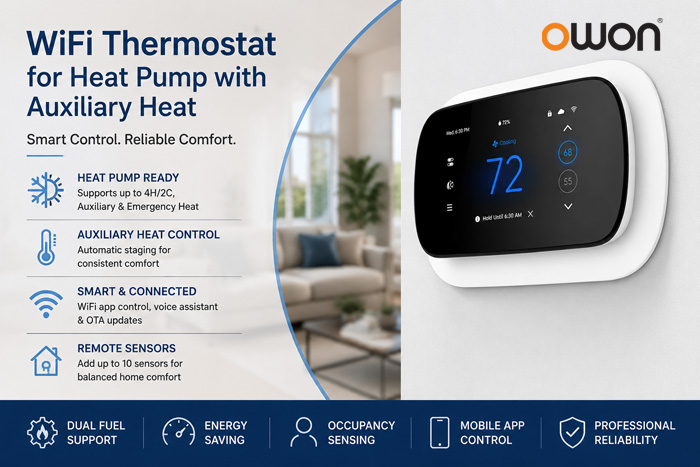
For compatible North American 24VAC heat pump applications, the OWON PCT5231 24VAC WiFi thermostat supports heat pump operation, auxiliary heat, emergency heat, O/B valve control, Dual Fuel/Hybrid Heat, WiFi connectivity, and up to 10 remote room sensors.
The OWON PCT533 provides another option for advanced heat pump applications, adding features such as a 4.3-inch touchscreen, occupancy sensing, humidity control, remote sensing, and connected HVAC management.
For distributors, HVAC contractors, system integrators, and OEM brands, the correct thermostat should always be selected according to the actual HVAC equipment, stages, wiring, and control requirements.
FAQ
What is auxiliary heat on a heat pump thermostat?
Auxiliary heat is supplemental heating used when the heat pump needs additional heating capacity. Depending on the HVAC system, it may use electric resistance heating or another backup heat source.
What temperature should auxiliary heat come on?
There is no universal temperature for every heat pump. Aux Heat operation depends on equipment capacity, outdoor conditions, thermostat configuration, building load, and the system’s control strategy.
Do I need a special thermostat for a two-stage heat pump with auxiliary heat?
The thermostat must support the required heat pump stages and control configuration. For many two-stage applications, this can include Y1/Y2, O/B, auxiliary heat, and emergency heat support.
Is it normal for auxiliary heat to come on?
Yes, Aux Heat can be part of normal heat pump operation. Frequent or prolonged operation under conditions where it is not expected may justify checking thermostat settings and HVAC performance.
Final Thoughts
Choosing a heat pump thermostat with auxiliary heat requires more than checking for WiFi or smart-home features. The thermostat must match the actual HVAC configuration, including heat pump stages, O/B reversing valve control, auxiliary heat, emergency heat, and Dual Fuel requirements where applicable.
For North American 24VAC HVAC projects, OWON provides smart thermostat solutions designed to support a range of heat pump configurations, along with WiFi control, remote sensing, scheduling, and system integration capabilities.
If you are an HVAC distributor, contractor, system integrator, or OEM/ODM brand looking for a compatible thermostat solution, contact OWON to discuss your HVAC specifications, integration requirements, and customization needs.
Related reading:
[ Smart Thermostat White Label OEM: Native Matter Integration and Pin-Compatible Wi-Fi Module Customization ]
Post time: Jun-12-2026


