Upgrading to a WiFi thermostat is one of the easiest ways to improve comfort, energy efficiency, and HVAC control. However, many homeowners and HVAC contractors encounter the same problem during installation: there is no C wire available behind the existing thermostat.
This situation is especially common in homes built before smart thermostats became popular. Traditional mechanical and programmable thermostats often operated without a dedicated common wire, but modern WiFi thermostats require continuous power to support wireless communication, cloud connectivity, touchscreens, and advanced automation features.
Fortunately, the absence of a C wire does not necessarily mean a WiFi thermostat cannot be installed. Today, thermostat manufacturers have developed several reliable solutions that allow modern smart thermostats to operate on older HVAC systems without extensive rewiring.
For homeowners, understanding these solutions can simplify thermostat upgrades. For HVAC contractors, distributors, OEM brands, and retrofit specialists, selecting the right thermostat platform can reduce installation time while expanding compatibility across millions of existing HVAC systems.
Can a WiFi Thermostat Work Without a C Wire?
Yes.
A WiFi thermostat can often operate without a dedicated C wire, depending on its power management design and the HVAC system configuration.
Modern WiFi thermostats generally use one of three approaches:
- Power stealing technology
- Dedicated C-wire adapters or power modules
- Conventional C-wire connections
Each method has different advantages depending on the HVAC equipment, wiring conditions, and installation requirements.
For retrofit projects, choosing the correct solution is more important than simply selecting a thermostat with the longest feature list.

What Happens If Your Thermostat Does Not Have a C Wire?
Many older residential HVAC systems were installed before smart thermostats became common. As a result, the existing thermostat wiring may only include:
- R
- W
- Y
- G
without a dedicated C (Common) wire.
Because WiFi thermostats require continuous electrical power to maintain wireless communication and cloud connectivity, insufficient power can lead to problems such as:
- WiFi disconnects
- Display resets
- Random thermostat reboots
- HVAC control instability
- Firmware update failures
Fortunately, replacing the entire thermostat cable is rarely the only solution.
Depending on the HVAC system, installers can often solve the problem by using a compatible power management design or installing a dedicated C-wire adapter, avoiding expensive wall repairs and electrical rewiring.
Do All WiFi Thermostats Need a C Wire?
No.
Different thermostat manufacturers use different methods to supply operating power.
Some WiFi thermostats require a dedicated C wire for continuous power.
Others use advanced power-stealing technology that temporarily draws operating power through existing HVAC control circuits.
Some thermostat platforms also support optional C-wire adapters or external power modules, providing installers with additional flexibility when upgrading older HVAC systems.
For this reason, HVAC professionals should always verify thermostat compatibility before installation instead of assuming every WiFi thermostat has identical wiring requirements.
Understanding the “No C Wire” Challenge
To understand why this issue exists, it helps to understand the purpose of the C wire.
The R wire delivers 24VAC power from the HVAC transformer.
The C wire provides the return path that allows electronic thermostats to receive continuous power.
Traditional mechanical thermostats functioned as simple switches, so they did not require continuous power.
Modern WiFi thermostats, however, continuously operate internal processors, wireless radios, memory, cloud services, and touchscreen interfaces—even when the HVAC equipment is idle.
Without adequate power, these functions cannot operate reliably.
This is why C-wire compatibility has become one of the most common questions when upgrading to a smart thermostat.
Which WiFi Thermostats Can Work Without a C Wire?
Modern WiFi thermostats generally fall into three categories.
1. Thermostats That Require a Dedicated C Wire
These products rely entirely on continuous 24VAC power supplied through the C terminal.
They often provide the most straightforward installation when modern HVAC wiring is already available.
2. Thermostats Using Power-Stealing Technology
Some manufacturers use electronic power management circuits that temporarily draw small amounts of power through existing HVAC wiring.
This approach works well with many systems but may have limitations depending on HVAC equipment compatibility.
3. Thermostats Supporting Optional C-Wire Adapters
Many professional HVAC installers prefer thermostats that can operate with an optional C-wire adapter or power module.
This solution provides stable power while avoiding complete thermostat cable replacement, making it particularly suitable for retrofit projects.
For older North American HVAC systems, installing a dedicated adapter is often one of the most reliable approaches for long-term operation.
C-Wire Adapter vs. Power-Stealing Technology
Both solutions are designed to solve the same installation problem, but they work differently.
| Feature | C-Wire Adapter | Power-Stealing Technology |
|---|---|---|
| Requires New Thermostat Cable | No | No |
| Stable Continuous Power | Excellent | Depends on HVAC system |
| Installation Complexity | Moderate | Simple |
| HVAC Compatibility | Very High | Varies by equipment |
| Recommended for Retrofit Projects | Yes | Sometimes |
| Suitable for Professional Installers | Yes | Depends on application |
For HVAC contractors managing large retrofit projects, a dedicated C-wire adapter often provides the most predictable installation experience because it minimizes compatibility uncertainty across different furnace and air handler designs.
Engineering Solutions for HVAC Retrofit Projects
Modern thermostat manufacturers have invested significant engineering effort into solving C-wire compatibility challenges.
Typical solutions include:
- Intelligent power management circuits
- Optional power modules
- External C-wire adapters
- Improved HVAC compatibility algorithms
- Flexible installer configuration menus
These technologies allow WiFi thermostats to support a much broader range of residential HVAC systems than earlier generations of smart thermostats.
As HVAC retrofits continue to grow, flexibility has become one of the most important design considerations when selecting thermostat platforms for OEM brands and HVAC professionals.
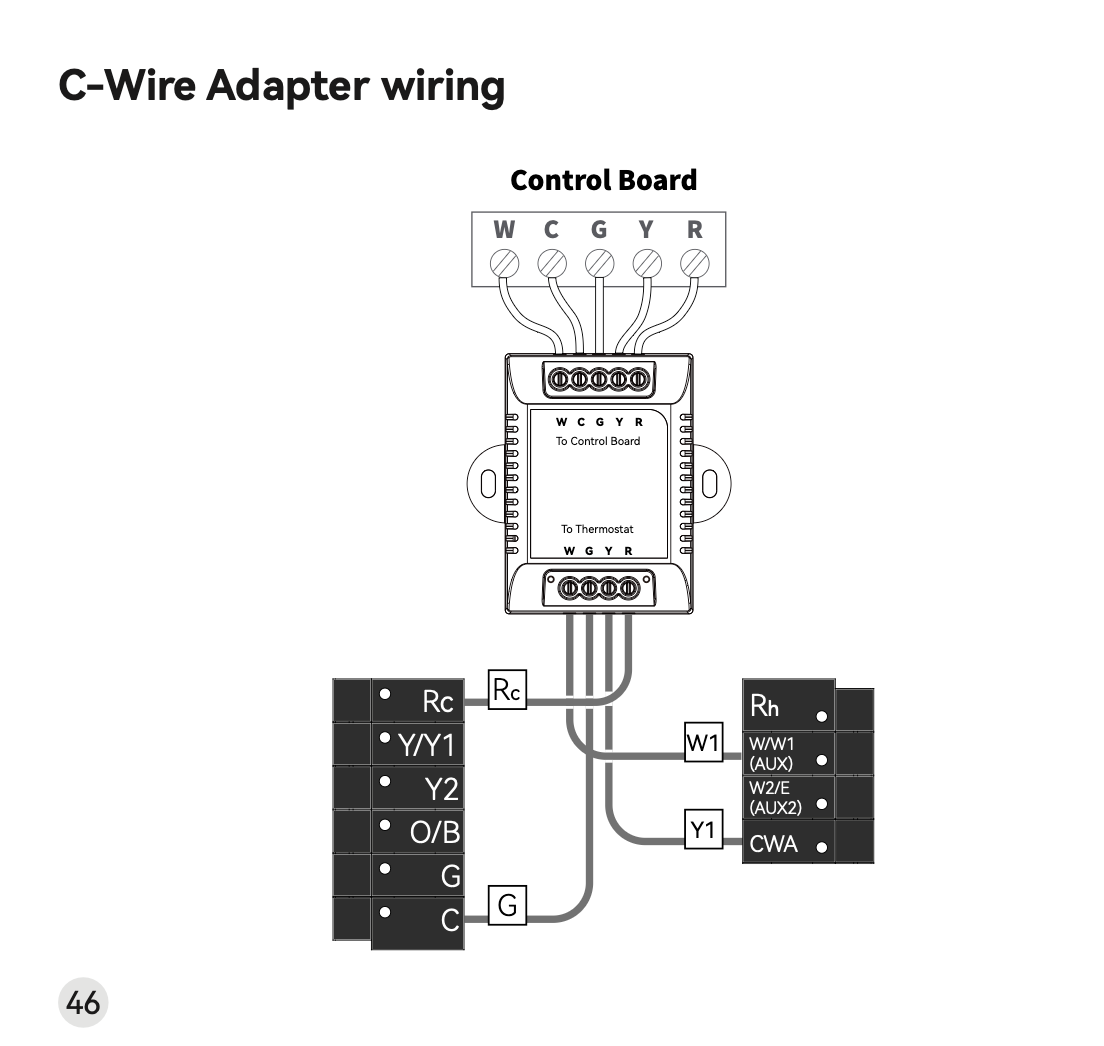
Installing a WiFi Thermostat Without a C Wire
Installing a WiFi thermostat without a C wire does not necessarily require extensive electrical work. In many retrofit projects, professional installers can complete the upgrade using existing HVAC wiring together with an appropriate power solution.
A typical installation process includes:
- Verifying thermostat compatibility with the HVAC system
- Inspecting the existing thermostat wiring
- Checking the furnace or air handler control board
- Determining whether a C-wire adapter or power module is required
- Testing heating, cooling, fan, and WiFi connectivity after installation
Rather than following a one-size-fits-all approach, HVAC professionals evaluate each installation individually. Factors such as HVAC equipment age, transformer capacity, wiring configuration, and thermostat power requirements all influence the best installation method.
Proper installation not only improves reliability but also reduces service callbacks and long-term maintenance issues.
Why C-Wire Compatibility Matters for HVAC Retrofit Projects
Millions of homes across North America still operate older HVAC systems that were installed before smart thermostats became common.
Replacing thermostat wiring throughout an existing home can be expensive and disruptive. In some cases, running new cable requires opening finished walls or ceilings, significantly increasing labor costs.
A thermostat platform that supports flexible power options allows contractors to complete more retrofit projects without major electrical modifications.
For distributors and HVAC brands, this broader compatibility can also reduce inventory complexity by allowing a single thermostat platform to serve both new construction and retrofit applications.
Benefits of WiFi Thermostats Beyond Remote Control
Many homeowners initially upgrade to a WiFi thermostat for the convenience of smartphone control. However, modern WiFi thermostats offer far more than remote temperature adjustment.
Common benefits include:
- Weekly and daily scheduling
- Energy-saving temperature programs
- Vacation mode
- Remote system monitoring
- HVAC usage reports
- Smart home integration
- Multi-room temperature management using remote sensors
- Automatic comfort optimization
These features help improve both comfort and energy efficiency while giving users greater visibility into HVAC operation.
Choosing the Right WiFi Thermostat for Older HVAC Systems
When selecting a WiFi thermostat for an existing HVAC system, compatibility should always take priority over individual features.
Consider the following factors:
HVAC System Compatibility
Verify that the thermostat supports the installed HVAC equipment, including conventional furnaces, air conditioners, heat pumps, or dual fuel systems.
Flexible Power Options
Look for thermostat platforms that support multiple installation methods, including optional C-wire adapters where appropriate.
Future Expansion
Features such as remote room sensors, humidity control, and smart scheduling may become valuable as HVAC systems are upgraded over time.
Professional Installation Support
For contractors and distributors, installer-friendly setup menus, clear wiring documentation, and reliable technical support can significantly simplify deployment.
A Practical Industry Example
As an example of how thermostat manufacturers address C-wire compatibility challenges, some modern thermostat platforms are designed with flexible power solutions to simplify HVAC retrofits.
For example, the OWON PCT5231 is designed for North American 24VAC HVAC systems and supports conventional heating and cooling systems, heat pumps, auxiliary heat, emergency heat, and dual fuel applications. Combined with support for up to ten wireless remote sensors, it offers flexibility for both residential and light commercial projects.
For installations where a dedicated common wire is unavailable, solutions such as the OWON SWB511 C-Wire Adapter can provide continuous power without requiring complete thermostat cable replacement. This approach helps contractors complete retrofit projects more efficiently while maintaining reliable thermostat operation.
These examples illustrate how modern thermostat platforms are evolving to support a wider range of HVAC installations rather than relying on a single wiring approach.
Why HVAC Brands Work with Thermostat Manufacturers
As demand for smart HVAC upgrades continues to grow, many HVAC equipment manufacturers expand their product portfolios by partnering with experienced thermostat manufacturers.
Rather than developing new thermostat hardware from scratch, OEM and private-label programs allow HVAC brands to launch compatible WiFi thermostat products more quickly while focusing on their core heating and cooling equipment.
Manufacturers with experience in North American 24VAC HVAC systems can also provide support for features such as:
- Heat pump compatibility
- Dual fuel control
- Remote sensor integration
- C-wire adapter solutions
- Cloud connectivity
- Mobile app platforms
- OEM and ODM customization
This collaborative approach helps accelerate product development while ensuring compatibility with modern HVAC requirements.
Conclusion
Installing a WiFi thermostat without a C wire is no longer the obstacle it once was.
Thanks to advances in thermostat design, power management technology, and optional C-wire adapters, many existing HVAC systems can now be upgraded without replacing thermostat wiring.
Whether you are a homeowner planning an HVAC upgrade or an HVAC professional managing retrofit projects, selecting a thermostat platform with flexible installation options can simplify deployment while improving long-term system reliability.
As smart HVAC technology continues to evolve, compatibility, installation flexibility, and reliable power management will remain key factors when choosing the right WiFi thermostat for modern heating and cooling systems.
Frequently Asked Questions
Can you run a WiFi thermostat without a C wire?
Yes. Some WiFi thermostats can operate without a dedicated C wire by using advanced power management technology or an optional C-wire adapter, depending on the HVAC system.
Which WiFi thermostats do not require a C wire?
Some thermostat platforms support power-stealing technology or optional C-wire adapters, allowing installation without running a new common wire. Compatibility should always be verified before installation.
What if my thermostat does not have a C wire?
If your existing thermostat wiring does not include a C wire, you may still be able to install a WiFi thermostat by using a compatible power management solution or a dedicated C-wire adapter.
Is a C-wire adapter better than power-stealing technology?
Both approaches have advantages. Power-stealing technology may simplify installation in some systems, while a dedicated C-wire adapter often provides more stable and predictable power for retrofit projects.
Can a heat pump use a WiFi thermostat without a C wire?
Yes, provided the thermostat is compatible with the heat pump system and an appropriate power solution is available. HVAC professionals should always verify wiring and equipment compatibility before installation.
Does OWON provide solutions for HVAC retrofit projects?
Yes. As one example, OWON offers WiFi thermostat platforms for North American HVAC systems together with compatible C-wire adapter solutions that help simplify retrofit installations while supporting modern smart HVAC functionality.
Related reading:
[Key Considerations When Selecting a Smart Heating Thermostat Manufacturer]
Post time: Nov-04-2025