Introduction
Home Assistant has evolved far beyond a smart home platform. Today, it is increasingly adopted in commercial buildings, hotels, energy management systems, and multi-site automation projects where local control, integration flexibility, and long-term scalability are critical.
As Zigbee continues to be one of the most widely deployed wireless technologies for building automation, selecting the right Zigbee gateway has become an important architectural decision. While many discussions focus on device compatibility, experienced system integrators understand that gateway selection directly impacts network stability, maintenance efficiency, system scalability, and future integration possibilities.
This article examines the key considerations for choosing a Zigbee gateway for Home Assistant deployments and explores how different gateway architectures support various project requirements.
Why the Zigbee Gateway Matters More Than Most People Think
In a Home Assistant deployment, the Zigbee gateway is more than a communication bridge.
It acts as the central coordination layer between Zigbee field devices and the automation platform. Every sensor report, thermostat adjustment, energy meter reading, and automation trigger passes through the gateway.
As the number of connected devices increases, the gateway becomes one of the most important components affecting:
- Network reliability
- Automation response time
- Device scalability
- System maintenance
- Integration flexibility
Many automation issues that appear to be device-related are often caused by gateway limitations, network bottlenecks, or poor architectural planning.
For commercial deployments, gateway selection should therefore be treated as a system design decision rather than a hardware purchase.
Key Evaluation Criteria for Zigbee Gateway Selection
1. Connectivity Architecture
One of the first decisions is determining how the gateway will connect to the local network.
Zigbee WiFi gateways provide deployment flexibility and reduce installation complexity. They are commonly used in retrofit projects, residential deployments, and environments where Ethernet infrastructure is limited.
Ethernet-based gateways provide higher communication stability and are often preferred for commercial projects that require continuous operation and centralized management.
For hotels, office buildings, and energy management applications, Ethernet connectivity often provides better long-term operational reliability.
2. Device Capacity and Network Growth
Many Zigbee deployments begin with a small number of devices but expand significantly over time.
A gateway that supports current requirements may become a bottleneck as additional sensors, thermostats, energy meters, occupancy detectors, and control devices are added.
When evaluating gateways, it is important to consider:
- Maximum supported Zigbee devices
- Future expansion plans
- Multi-floor deployment requirements
- Multi-building management requirements
Scalability should be evaluated at the beginning of the project rather than after deployment.
3. Local Control Capability
Cloud connectivity offers convenience, but many commercial deployments require local operation.
Building owners and facility managers increasingly demand:
- Reduced cloud dependency
- Faster response times
- Improved cybersecurity
- Business continuity during internet outages
Gateways that support local control can continue operating critical automations even when external connectivity is unavailable.
This capability is particularly important in hospitality, energy management, and commercial building environments.
4. Open Integration Capability
A Zigbee gateway should not become an isolated component.
Professional deployments often require integration with:
- Building Management Systems (BMS)
- HVAC platforms
- Energy Management Systems (EMS)
- Utility monitoring platforms
- Private cloud environments
- Custom IoT applications
Open APIs and standard communication protocols significantly simplify integration and future system expansion.
WiFi vs Ethernet Zigbee Gateways
Different projects require different deployment strategies.
| Feature | WiFi Zigbee Gateway | Ethernet Zigbee Gateway |
|---|---|---|
| Installation Flexibility | Excellent | Good |
| Network Stability | Good | Excellent |
| Infrastructure Requirements | Minimal | Ethernet Network Required |
| Small Building Projects | Ideal | Suitable |
| Large Commercial Projects | Suitable | Preferred |
| Long-Term Scalability | Good | Excellent |
| Centralized Management | Good | Excellent |
In practice, the decision is often driven by project scale and operational requirements rather than technology preference.
Gateway Selection for Different Project Types
Smart Building Automation
Building automation projects require reliable communication between multiple subsystems, including HVAC, occupancy sensing, energy monitoring, and access control.
Gateway stability and integration capabilities typically become more important than installation convenience.
Hotel Automation Systems
Hotels often deploy hundreds of connected devices across guest rooms and common areas.
Scalability, centralized management, and operational reliability become critical considerations.
Zigbee Ethernet gateway architectures are commonly preferred in these environments.
Energy Management Systems
Energy monitoring projects depend on accurate and continuous data collection.
Communication interruptions can affect reporting accuracy, automation performance, and operational decision-making.
Reliable gateway infrastructure becomes essential.
Multi-Site Deployments
Organizations managing multiple locations must consider standardization, maintenance efficiency, and remote management capabilities.
Selecting a gateway architecture that can scale across locations reduces long-term operational complexity.
Real-World Gateway Examples for Home Assistant Projects
Practical deployment requirements often determine the most suitable gateway architecture.
For projects that prioritize flexible installation and rapid deployment, WiFi-based gateways can simplify implementation while still supporting integration with Home Assistant and third-party platforms.
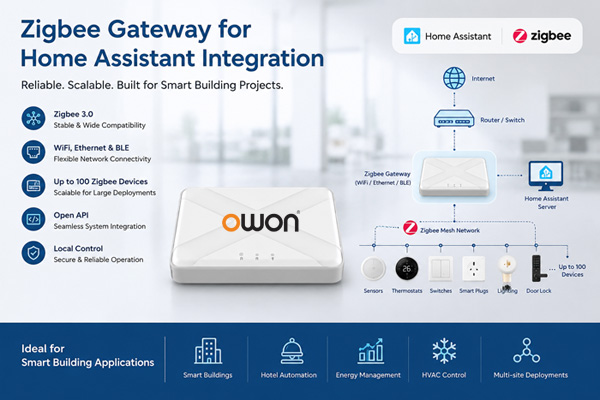
For example, the OWON SEG-X3 Zigbee gateway combines Zigbee connectivity, WiFi networking, and open API support, making it suitable for residential automation, HVAC control systems, apartment projects, and small-to-medium building deployments.
For larger commercial environments, network reliability and device capacity typically become higher priorities.
The OWON SEG-X5 Zigbee gateway is designed for these scenarios, providing Ethernet connectivity, WiFi and BLE onboarding, local control capability, and support for larger Zigbee networks. These characteristics make it suitable for smart buildings, hotel automation systems, and energy management applications where long-term operational stability is essential.
The objective is not to select the most advanced gateway, but to choose the architecture that best aligns with project requirements.
FAQ
Which Zigbee gateway is best for Home Assistant projects?
There is no universal answer. The optimal gateway depends on deployment scale, network infrastructure, integration requirements, and operational expectations.
Is Ethernet always better than WiFi?
Not necessarily. Ethernet generally provides higher stability, while WiFi offers greater installation flexibility. The right choice depends on the project’s operational requirements.
Why is local control important?
Local control improves reliability, reduces cloud dependency, and allows critical automations to continue functioning during internet outages.
What should integrators prioritize when selecting a Zigbee gateway?
Network stability, scalability, local control capability, API support, and long-term maintainability should generally be prioritized over initial hardware cost.
Conclusion
Home Assistant provides a powerful foundation for building automation, but long-term system performance depends heavily on gateway architecture.
Organizations planning Zigbee deployments should evaluate connectivity options, scalability, integration capabilities, and operational requirements before selecting a gateway.
A well-designed Zigbee gateway strategy can improve reliability, simplify maintenance, support future growth, and maximize the long-term value of automation investments.
Related reading:
[Smart Hotel Automation System with Zigbee IoT for Scalable Hospitality Control]
Post time: Nov-09-2025