Introduction
A Zigbee PIR sensor is an important component in modern smart home and building automation systems. By combining Passive Infrared (PIR) motion detection with Zigbee wireless communication, these sensors can detect human movement and trigger automated actions such as lighting control, security alerts, and energy-saving strategies.
Unlike traditional motion detectors that work as standalone devices, a Zigbee PIR sensor becomes part of a connected automation system. Through Zigbee gateways and smart platforms, it can communicate with switches, lighting controllers, HVAC systems, and other IoT devices.
This guide explains how Zigbee PIR sensors work, their common applications, platform compatibility, and how to choose the right solution for smart lighting and automation projects.
What Is a Zigbee PIR Sensor?
A Zigbee PIR sensor uses Passive Infrared (PIR) technology to detect changes in infrared radiation caused by human movement.
When movement is detected, the sensor sends an event signal through a Zigbee network to a connected gateway. The gateway can then execute automation rules, such as turning on lights, adjusting HVAC settings, or sending security notifications.
Compared with traditional wired motion sensors, Zigbee PIR sensors provide several advantages:
- Low-power wireless operation
- Easy installation without additional wiring
- Reliable Zigbee mesh communication
- Flexible integration with smart home and building systems
- Long battery life for battery-powered models
In smart automation applications, a Zigbee PIR sensor is not only a motion detector but also a connected sensing device that enables intelligent control.
Is a PIR Sensor the Same as a Motion Sensor?
A PIR sensor is one type of motion sensor technology.
The term motion sensor describes a device that detects movement, while PIR refers specifically to the sensing technology used to achieve this detection.
Common motion detection technologies include:
| Technology | Description |
|---|---|
| PIR | Detects infrared changes caused by human movement |
| mmWave | Detects continuous human presence and small movements |
| Ultrasonic | Uses sound waves for detection |
For smart lighting and general automation, Zigbee PIR motion sensors are widely used because they offer low power consumption, reliable detection, and simple deployment.

How Zigbee PIR Sensors Enable Smart Lighting
Smart lighting is one of the most common applications for Zigbee PIR sensors.
A typical system works as follows:
Zigbee PIR Sensor → Zigbee Gateway → Smart Switch / Lighting Controller
When motion is detected:
- The sensor sends a Zigbee signal
- The gateway processes automation rules
- Lights are turned on or adjusted automatically
This enables:
- Motion-triggered lighting
- Energy-saving lighting control
- Hands-free operation
- Improved user experience
For example, in hotels, offices, and apartment buildings, Zigbee PIR sensors can automatically control lighting based on room activity.
Zigbee PIR Sensor with Lux Measurement for Energy-Efficient Lighting
Modern smart lighting systems often require more than motion detection.
By combining PIR motion sensing with ambient light measurement, a sensor can determine whether lighting is actually needed.
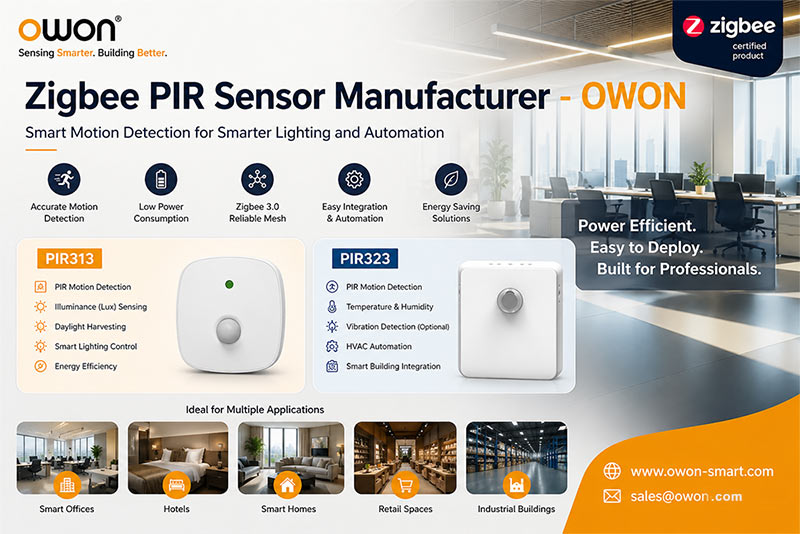
For example, a Zigbee PIR sensor with lux measurement, such as OWON’s PIR313, can detect:
- Human movement
- Ambient light level
This allows automation systems to:
- Turn lights on only when someone enters a space and illumination is insufficient
- Avoid unnecessary lighting during daytime
- Improve energy efficiency
This type of solution is commonly used in:
- Offices
- Hotels
- Apartments
- Commercial buildings
Zigbee PIR Sensor Compatibility: Tuya, Home Assistant, and Zigbee2MQTT
Platform compatibility is an important factor when selecting a Zigbee PIR sensor.
Depending on firmware configuration and gateway support, Zigbee PIR sensors can be integrated with platforms such as:
- Tuya Zigbee ecosystems
- Home Assistant
- Zigbee2MQTT
- Other Zigbee 3.0 compatible gateways
For users looking for a Tuya Zigbee PIR sensor, compatibility with Tuya gateways allows mobile app control, automation creation, and integration with other smart devices.
For open-source smart home users, Zigbee PIR sensors can also be integrated into Home Assistant through compatible Zigbee coordinators.
Zigbee PIR Sensor Applications in Smart Homes and Buildings
Smart Home Automation
Zigbee PIR sensors can automate:
- Hallway lighting
- Bathroom lighting
- Bedroom lighting
- Security notifications
They improve convenience while reducing unnecessary energy usage.
Hotels and Hospitality
Hotels can use Zigbee PIR sensors for:
- Guest room automation
- Corridor lighting control
- Energy-saving strategies
By combining motion detection with other smart devices, hotels can create more efficient room management systems.
Offices and Commercial Buildings
In commercial environments, Zigbee PIR sensors support:
- Occupancy-based lighting
- Energy management
- Smart building automation
Wireless installation makes them suitable for retrofit projects where additional wiring is difficult.
Zigbee PIR Sensor with Additional Sensing Functions
Different projects require different sensing capabilities.
Basic Zigbee PIR sensors focus on motion detection, while advanced models can combine multiple sensors into one device.
For example:
OWON PIR313 Zigbee PIR Sensor
combines:
- PIR motion detection
- Temperature measurement
- Humidity measurement
- Ambient light sensing
This allows one device to support multiple automation scenarios, including smart lighting, environmental monitoring, and building automation.
For projects requiring more advanced environmental monitoring, OWON PIR323 Zigbee Motion Sensor provides additional temperature and humidity sensing together with PIR detection.
How to Choose the Right Zigbee PIR Sensor
When selecting a Zigbee PIR sensor, consider the following factors:
1. Detection Requirements
Choose a sensor based on:
- Detection range
- Detection angle
- Application environment
2. Lighting Automation Requirements
If the project requires daylight-based lighting control, choose a model with ambient light measurement.
3. Platform Compatibility
Check compatibility with:
- Zigbee 3.0 gateways
- Tuya
- Home Assistant
- Zigbee2MQTT
4. Installation Method
Battery-powered Zigbee PIR sensors are suitable for flexible indoor installation without wiring.
5. Additional Sensor Functions
Some applications may benefit from:
- Temperature monitoring
- Humidity sensing
- Illuminance measurement
Selecting the right combination helps create more efficient automation systems.
Are Zigbee PIR Sensors Suitable for Outdoor Use?
Most Zigbee PIR sensors are designed for indoor applications, including:
- Homes
- Apartments
- Hotels
- Offices
- Retail spaces
Outdoor environments usually require specialized weather-resistant sensors with suitable protection ratings.
For indoor smart automation projects, Zigbee PIR sensors provide a practical balance between installation flexibility, reliability, and low power consumption.
Zigbee PIR Sensor vs Presence Sensor
Although both technologies detect people, they serve different purposes.
| Feature | Zigbee PIR Sensor | Zigbee Presence Sensor |
|---|---|---|
| Technology | PIR | mmWave |
| Detection | Human movement | Continuous presence |
| Power Consumption | Lower | Usually higher |
| Best Applications | Lighting, security | HVAC, occupancy management |
A Zigbee PIR sensor is ideal for motion-triggered automation.
A presence sensor is better for applications where people may remain still for long periods, such as offices and meeting rooms.
Conclusion
Zigbee PIR sensors are an essential building block for smart lighting and automation systems.
By combining PIR motion detection with Zigbee wireless communication, they provide reliable, low-power, and scalable solutions for residential and commercial environments.
For simple lighting automation, a standard Zigbee PIR sensor may be sufficient. For more advanced projects, models with additional sensing capabilities, such as temperature, humidity, or illuminance measurement, can provide greater flexibility.
Solutions such as OWON’s PIR313 and PIR323 demonstrate how Zigbee PIR sensors can support applications ranging from smart lighting to smart building automation.
Choosing the right Zigbee PIR sensor depends on the required detection function, platform compatibility, and automation goals.
FAQ
What is a Zigbee PIR sensor?
A Zigbee PIR sensor uses Passive Infrared technology to detect human movement and communicates wirelessly through a Zigbee network.
Is a PIR sensor the same as a motion sensor?
A PIR sensor is one type of motion sensor. It detects movement by sensing changes in infrared radiation caused by humans.
Can Zigbee PIR sensors work with Home Assistant?
Yes. Compatible Zigbee PIR sensors can be integrated with Home Assistant through Zigbee coordinators and platforms such as Zigbee2MQTT.
Are Zigbee PIR sensors battery powered?
Many Zigbee PIR sensors are battery powered, allowing flexible indoor installation without wiring.
What is the difference between a Zigbee PIR sensor and a presence sensor?
A PIR sensor detects movement, while a presence sensor is designed to detect continuous occupancy, including stationary people.
Related reading:
[Zigbee Smart Bulbs for Reliable Smart Lighting Control in Modern Buildings]
Post time: Jan-08-2026


