Introduction: Why Zigbee Smart Sockets Matter
As smart home and energy management technologies continue to evolve, Zigbee sockets have become an important component in modern residential and commercial buildings.
These devices enable remote control of electrical appliances, real-time energy monitoring, and seamless integration with smart automation systems. Unlike traditional wall sockets, Zigbee-based solutions support mesh networking, making them more scalable and reliable for large-scale deployments such as hotels, apartments, and commercial facilities.
With increasing demand for energy efficiency and building automation, more B2B buyers are adopting Zigbee socket solutions to optimize electricity usage and improve operational efficiency.
From a system integration perspective, selecting a reliable Zigbee smart socket manufacturer is critical to ensuring long-term stability, interoperability, and compatibility with platforms such as Home Assistant, Zigbee2MQTT, and building management systems.
OWON provides Zigbee smart socket solutions designed for smart energy applications, supporting remote control, energy monitoring, and scalable deployment across residential and commercial projects.
Key Features of a Zigbee Sockets
-
ZigBee 3.0 Protocol for reliable wireless connectivity and interoperability
-
Remote On/Off Control via smartphone apps
-
Custom Schedules for energy-saving automation
-
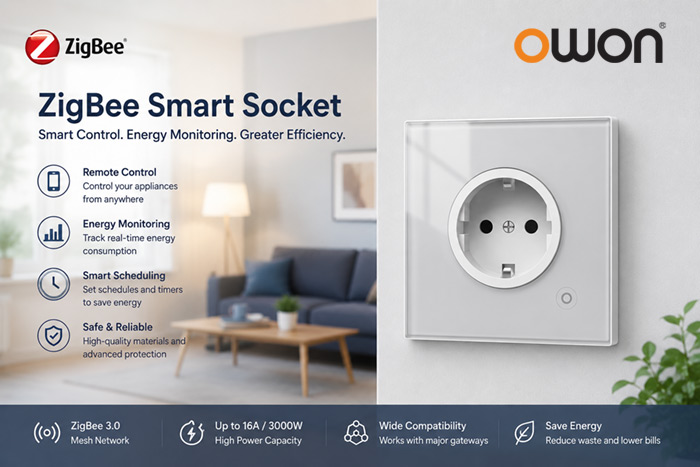
High Power Capacity (up to 3000W, 16A) for heavy-duty appliances
-
Smart Home Integration with popular platforms such as Tuya and Home Assistant
Example: A Zigbee Wall Socket Designed for Energy Monitoring
A practical example is the OWON WSP406 ZigBee Wall Socket. The device combines remote appliance control, energy consumption monitoring, scheduling automation, and ZigBee mesh networking in a single in-wall installation. According to the product specifications, it supports up to 16A and 3000W loads while providing real-time energy monitoring and automatic scheduling functions. It can also extend ZigBee network coverage by acting as a mesh repeater.
Market Trends & Industry Insights
The adoption of Zigbee smart plugs and sockets has accelerated in the last two years due to:
-
Energy Efficiency Regulations in North America & EU: Governments encourage devices that reduce standby power consumption.
-
Growing Demand for Home Automation: Both consumers and businesses want IoT-enabled devices that reduce manual control.
-
B2B Procurement Shift: Hotels, offices, and energy service providers are purchasing Zigbee sockets in bulk for centralized control.
Table: Global Smart Socket Market Growth (2023–2028)
| Region | CAGR (2023–2028) | Key Drivers |
| North America | 11.20% | Energy policy, smart homes |
| Europe | 9.80% | Sustainability & IoT adoption |
| Middle East | 8.70% | Commercial building automation |
| APAC | 13.50% | Rapid smart home penetration |
Technical Comparison: Why Zigbee Wins
| Technology | Zigbee Smart Socket | Wi-Fi Smart Plug | Bluetooth Plug |
|---|---|---|---|
| Range | Up to 100m (Mesh) | Limited, router-based | Short (10m) |
| Energy Use | Very Low | Higher standby load | Low |
| Integration | Strong ecosystem (Zigbee 3.0) | App-dependent | Limited |
| Reliability | Mesh network ensures stability | Router overload risk | Weak signal |
Zigbee sockets excel in low-power, stable mesh networks, making them the preferred option for large-scale B2B deployments.
Buyer’s Guide: What B2B Customers Should Look For
-
Protocol Compatibility – Ensure ZigBee 3.0 for wide integration.
-
Load Capacity – Look for at least 16A / 3000W for heavy-duty use.
-
Certifications – CE, FCC, RoHS compliance for safety.
-
Supplier Reputation – Partner with reliable Zigbee smart socket suppliers like OWON for consistent quality.
-
Scalability – Ability to manage hundreds of devices in a single network.
FAQ Section
What is a Zigbee socket?
A Zigbee socket is a smart electrical outlet that uses Zigbee wireless communication to enable remote control, scheduling, automation, and energy monitoring within a smart home or building management system.
Why are Zigbee sockets popular in Europe?
Rising electricity costs, stricter energy-efficiency regulations, and growing smart home adoption have increased demand for Zigbee-based energy management devices across Europe.
Can Zigbee sockets monitor energy consumption?
Yes. Many Zigbee sockets provide real-time monitoring of voltage, current, power, and energy usage, helping users identify energy-intensive appliances and reduce waste.
Do Zigbee sockets work with Home Assistant?
Many Zigbee sockets support Home Assistant through Zigbee gateways or Zigbee2MQTT integrations, allowing users to build local automation systems.
Are Zigbee sockets suitable for hotels and commercial buildings?
Yes. Zigbee sockets are widely used in hotels, apartments, offices, and smart building projects because they support centralized control, energy monitoring, and mesh-network communication.
Conclusion
The Zigbee smart socket is more than a convenience—it’s a strategic energy-saving solution for B2B customers across North America, Europe, and beyond. With OWON as a trusted smart socket supplier, businesses gain access to scalable, reliable, and certified solutions that align with the growing demand for IoT-powered energy management.
Related reading:
[Zigbee Smart Plug Solutions for Energy Monitoring and Smart Power Control]
Post time: Aug-28-2025