If you’re building a smart device portfolio, one of the first real decisions you’ll face is not about brands or pricing—but about technology.
Should you focus on WiFi sensors, which are familiar and easy to deploy, or Zigbee sensors, which are increasingly used in more scalable IoT systems?
At first glance, both seem viable. But once you start thinking like a distributor—serving different customers, handling support, and expanding your product range—the differences start to show.
What Actually Matters for You as a Distributor
As a distributor, you’re not just choosing products—you’re choosing what kind of business you can build.
You need devices that work across multiple use cases, not just one niche. You need something stable enough to reduce after-sales issues, and flexible enough to adapt to different customer needs—from small home setups to larger deployments.
For distributors, choosing the right sensor technology is not only about performance, but also about scalability, compatibility, and long-term stability.
This is where Zigbee sensor solutions for distributors begin to stand out.
Zigbee vs WiFi: The Difference Becomes Clear at Scale
WiFi sensors are straightforward. They connect directly to a router, which works well in small setups. But as more devices are added, performance often becomes inconsistent—connections drop, networks get congested, and power consumption increases.
Zigbee, on the other hand, uses a mesh network. Devices communicate with each other, which allows the system to expand more naturally and maintain stability even in more complex environments.
Here’s how they compare in practice:
| Feature | Zigbee Sensors | WiFi Sensors |
|---|---|---|
| Network Type | Mesh (device-to-device) | Router-based |
| Power Consumption | Low | High |
| Scalability | High (100+ devices) | Limited |
| Stability | High in dense setups | Variable |
| Best Use | Multi-device systems | Small setups |
Mesh-based protocols like Zigbee are generally more suitable for large-scale IoT deployments due to their ability to maintain stability as networks grow.
For you, this difference directly affects how far your product line can scale.
One Product Line, Multiple Applications
One of the biggest advantages of Zigbee is flexibility. Instead of limiting you to a single market, it allows you to serve multiple application scenarios using the same underlying technology.
Typical use cases include:
- smart home Zigbee sensors (scene triggers, occupancy-based control)
- hotel automation sensor systems (energy saving, room management)
- elderly care monitoring sensors (fall detection, safety)
- smart security sensors (intrusion, leak, gas detection)
The ability to support multiple applications makes Zigbee sensors especially valuable for distributors targeting different market segments.
This means you’re not just selling products—you’re building a portfolio that can expand into different industries over time.
Stability Means Fewer Problems Later
One of the hidden costs in distribution is support.
WiFi devices often depend heavily on the user’s network environment. If the router is unstable or overloaded, devices disconnect—and those issues usually come back to you.
Zigbee reduces that dependency. Because it runs on its own network and benefits from mesh communication, it tends to deliver more consistent performance across different environments.
Stable devices don’t just improve user experience—they reduce returns, complaints, and support pressure for distributors.
Open Compatibility Gives You More Flexibility
Another key advantage is ecosystem flexibility.
Zigbee sensors can work with platforms like Zigbee2MQTT compatible devices and Home Assistant supported sensors, allowing integration into a wide range of systems. This is particularly useful if your customers include system integrators or more advanced users.
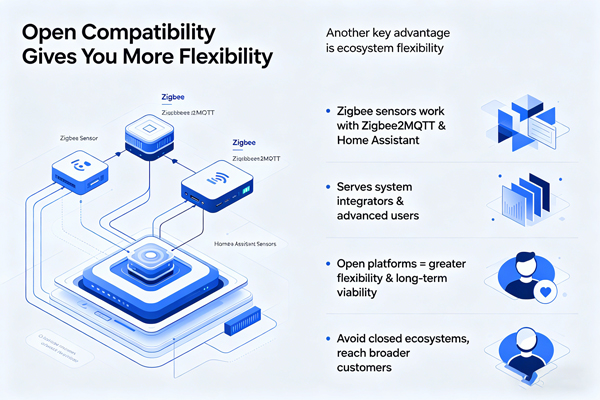
Compatibility with open platforms provides distributors with greater flexibility and long-term product viability.
Instead of being tied to a closed ecosystem, you’re able to serve a broader customer base.
Building a Scalable Business
From a business perspective, Zigbee gives you more room to grow.
You can start with entry-level sensors and expand into more advanced devices, building a natural pricing structure. You can serve different verticals without changing your core technology. And with OEM Zigbee sensor manufacturer capabilities, you can even develop your own branded product line.
Conclusion
So, which is better—Zigbee or WiFi?
If your focus is small, standalone setups, WiFi may be enough. But if you’re looking to build a scalable product portfolio, serve multiple markets, and reduce operational complexity, Zigbee offers a much stronger foundation.
Zigbee sensors are not just an alternative to WiFi—they are a more scalable and flexible solution for distributors looking to grow in the IoT space.
Related reading:
[Zigbee PIR Sensor: Complete Guide for Smart Lighting and Automation]
Post time: Apr-30-2026