Smart thermostats are increasingly becoming part of connected heating and HVAC systems rather than operating as standalone temperature controllers. For homeowners, HVAC professionals, and system integrators, one important question is whether a Zigbee thermostat can work with open automation platforms without depending entirely on a proprietary cloud ecosystem.
This is where Zigbee2MQTT thermostats become useful.
Zigbee2MQTT can connect compatible Zigbee thermostats to MQTT-based automation platforms such as Home Assistant, allowing temperature data, setpoints, operating modes, schedules, and other supported functions to become part of a wider automation system.
However, not every Zigbee thermostat exposes the same functions through Zigbee2MQTT. HVAC compatibility, device support, available controls, and sensor capabilities should all be considered before selecting a thermostat.
This guide explains what to check and how Zigbee2MQTT fits into residential and commercial HVAC applications.
How Does a Zigbee2MQTT Thermostat Work?
Zigbee2MQTT acts as a bridge between compatible Zigbee devices and MQTT-based software platforms.
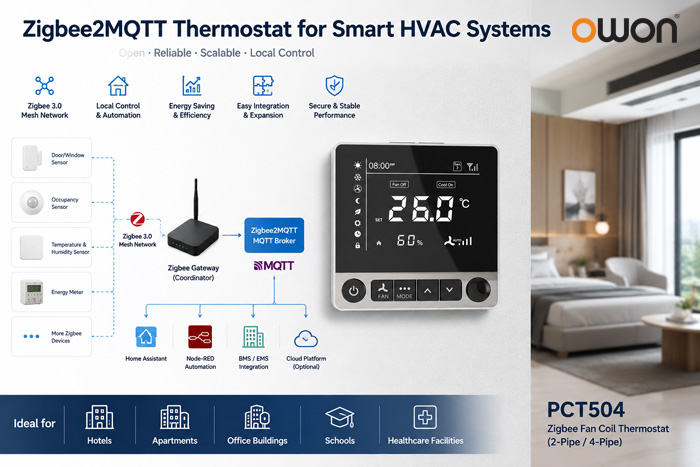
A typical architecture looks like this:
Zigbee Thermostat → Zigbee Gateway / Coordinator → Zigbee2MQTT → MQTT → Home Assistant / Automation Platform
The thermostat communicates wirelessly over Zigbee with a compatible coordinator. Zigbee2MQTT then translates supported device functions into information and controls that can be used by MQTT-based applications.
This approach makes it possible to combine thermostats with other devices such as temperature sensors, occupancy sensors, door/window sensors, radiator valves, and energy monitoring devices.
For HVAC projects, this provides an open way to build automation around actual room conditions instead of relying only on the thermostat’s local settings.
What Thermostat Functions Can Zigbee2MQTT Expose?
Connecting a thermostat to Zigbee2MQTT does not automatically mean that every thermostat will provide the same controls.
Available functions depend on the thermostat hardware, firmware, Zigbee implementation, and Zigbee2MQTT device support.
Depending on the model, available thermostat functions may include:
- current room temperature;
- target heating or cooling setpoint;
- heating or cooling mode;
- system operating state;
- fan mode and fan speed;
- temperature calibration;
- preset modes;
- heating schedules;
- external or remote temperature information.
This distinction is important.
A thermostat may technically communicate using Zigbee but still require specific device support before all of its functions can be used through Zigbee2MQTT.
For this reason, users and system integrators should evaluate both HVAC compatibility and Zigbee2MQTT compatibility rather than treating them as the same thing.
Zigbee2MQTT Thermostats and Home Assistant
One of the most common applications for Zigbee2MQTT is integration with Home Assistant.
A compatible Home Assistant Zigbee2MQTT thermostat can provide climate entities and other controls that allow users to monitor and manage heating or cooling from a centralized dashboard.
Depending on the thermostat, Home Assistant may be used to manage:
- room temperature and target setpoint;
- heating and cooling modes;
- schedules and automation;
- occupancy-based HVAC control;
- temperature alerts;
- interaction with other Zigbee devices.
For example, an automation could reduce heating when a room becomes unoccupied or adjust the target temperature according to information from another sensor.
For professional projects, the same MQTT-based architecture can also support customized automation platforms and other system integration requirements.
Thermostat Schedules and External Temperature Sensors
Two features deserve particular attention when selecting a Zigbee2MQTT thermostat: scheduling and external temperature measurement.
Can Zigbee2MQTT Manage Thermostat Schedules?
Yes, but the implementation depends on the thermostat.
Some compatible thermostats provide native daily or weekly schedules that can be exposed through Zigbee2MQTT. Other installations may use Home Assistant or another automation platform to create scheduling rules.
For example, heating can be reduced during unoccupied periods and restored before occupants return.
For professional HVAC projects, it is also worth checking whether schedules are stored locally on the thermostat or depend on the automation platform. This can affect how the system behaves during network or platform interruptions.
Can an External Sensor Be Used?
External temperature sensing can be useful when the thermostat itself is not installed in the best location for measuring room conditions.
For example, a wall thermostat installed near a doorway may measure a different temperature from the main occupied area.
However, external sensor support varies between thermostat models and system architectures. Some systems can use remote temperature information, while others rely only on the thermostat’s built-in sensor.
Before designing this type of automation, verify how the specific thermostat handles remote or external temperature data.
Choosing a Zigbee2MQTT Thermostat by HVAC Type
Wireless compatibility should never be the only consideration when choosing a thermostat.
The thermostat must first match the HVAC equipment it is expected to control.
| HVAC Application | Important Requirements | Example Application |
|---|---|---|
| Fan coil system | 2-pipe/4-pipe support, fan control, heating/cooling modes | Hotels, apartments, offices |
| Boiler heating | Heating compatibility, DHW control where required, scheduling | European homes and apartments |
| Radiator heating | Valve compatibility, room-level temperature control | Multi-room residential heating |
Fan Coil HVAC Systems
Fan coil units are commonly used in hotels, serviced apartments, offices, and other commercial buildings.
These applications require more than basic temperature adjustment. A thermostat may need to control heating and cooling valves as well as multiple fan speeds.
For example, the OWON PCT504 Zigbee Fan Coil Thermostat supports Zigbee2MQTT and is designed for 2-pipe and 4-pipe fan coil applications. This makes it suitable for projects where room-level HVAC control needs to become part of a broader Zigbee automation system.
When evaluating any fan coil thermostat, system integrators should verify the actual FCU configuration, valve control requirements, fan speeds, power supply, and automation-platform compatibility.
Boiler Heating Systems
Boiler-based heating remains common in European residential applications, but its control requirements are different from those of fan coil HVAC.
For example, the OWON PCT512 Zigbee Boiler Thermostat supports Zigbee2MQTT and is designed for European heating applications. It supports programmable heating control and domestic hot water management, together with wired or wireless installation options.
For boiler projects, installers should verify the heating-system configuration and required control functions before choosing the thermostat.
Radiator Heating Systems
In hydronic radiator heating systems, Zigbee thermostatic radiator valves can provide more granular room-level control.
Rather than applying the same temperature setting throughout a property, individual rooms can follow different setpoints or schedules.
TRVs can also become part of a broader Zigbee heating system together with room thermostats, temperature sensors, and automation platforms.
How to Check Zigbee2MQTT Thermostat Compatibility
Before purchasing or specifying a thermostat, do not rely only on the words “Zigbee compatible.”
Check the exact manufacturer and model against the current Zigbee2MQTT supported-device information whenever possible.
Then check which functions are actually available. Important items may include:
- local temperature;
- heating or cooling setpoint;
- system mode;
- fan control;
- schedules;
- external sensor data;
- battery or power status;
- additional HVAC-specific controls.
Hardware and firmware revisions may also affect functionality, so compatibility should be verified for the actual device version being deployed.
For larger projects, testing the intended thermostat, coordinator, Zigbee2MQTT version, and automation platform together before mass deployment is a sensible engineering practice.
Practical Considerations for HVAC Integrators
For professional projects, Zigbee2MQTT compatibility is only one part of system design.
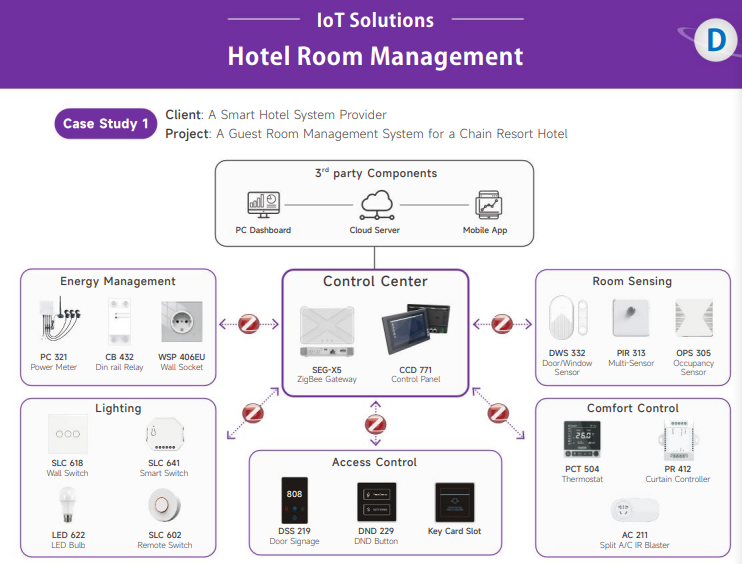
Start with the HVAC equipment. Determine whether the project uses fan coils, boilers, radiator heating, or another system, and identify the electrical and control requirements first.
Next, consider Zigbee network coverage. Larger apartments, hotels, and commercial buildings may require careful coordinator and router placement to maintain reliable communication.
Finally, decide which functions should remain local and which should depend on the automation platform. Heating and cooling are building functions, so system behavior during gateway, network, or platform interruptions should be considered during design.
These practical considerations are often more important than simply choosing a thermostat because it carries a Zigbee logo.
Conclusion
A Zigbee2MQTT thermostat can provide a flexible way to connect heating and HVAC equipment with Home Assistant, MQTT, sensors, and wider automation systems.
But compatibility should be evaluated at two levels: whether the thermostat can correctly control the HVAC equipment and which functions are actually available through Zigbee2MQTT.
For fan coil, boiler, and radiator heating applications, selecting the right thermostat therefore starts with the HVAC system itself. Zigbee2MQTT can then provide the integration layer that connects climate control with sensors and automation while allowing greater flexibility in how the overall system is designed.
FAQ
What is a Zigbee2MQTT thermostat?
A Zigbee2MQTT thermostat is a compatible Zigbee thermostat that can communicate with MQTT-based platforms through Zigbee2MQTT. Depending on device support, functions such as temperature, setpoint, operating mode, schedules, and other climate controls may be available.
How do I know if a Zigbee thermostat works with Zigbee2MQTT?
Check the exact manufacturer and model against the current Zigbee2MQTT supported-device information. You should also review which functions are exposed because different thermostats may provide different levels of control.
Can Zigbee2MQTT thermostats work with Home Assistant?
Yes. Compatible thermostats can be integrated with Home Assistant through Zigbee2MQTT. Available entities and controls depend on the individual thermostat and its Zigbee2MQTT support.
Can Zigbee2MQTT thermostats use schedules and external sensors?
Some can, but these functions vary by device. Certain thermostats expose native schedules or external temperature capabilities, while others may rely on Home Assistant or another automation platform for scheduling and remote-sensor logic.
Related reading:
[Zigbee2MQTT Door Sensors: Local Control, Security, and Building Automation]
Post time: Jul-11-2026


