Heat pumps have become one of the fastest-growing HVAC technologies in North America as homeowners, property managers, and building operators look for more energy-efficient heating and cooling solutions.
However, selecting the right heat pump thermostat is often more complex than choosing a thermostat for a conventional furnace and air conditioning system.
Modern heat pump systems may include auxiliary heat, emergency heat, multi-stage compressors, dual fuel configurations, humidity control, and remote sensors. As a result, thermostat compatibility plays a critical role in overall HVAC performance.
This guide explains how heat pump thermostats work, how wiring differs from conventional HVAC systems, and what HVAC professionals should consider when selecting a thermostat for modern heat pump applications.
What Is a Heat Pump Thermostat?
A heat pump thermostat is designed to control HVAC systems that provide both heating and cooling through a heat pump.
Unlike conventional HVAC systems that use separate heating and cooling equipment, heat pumps reverse the refrigeration cycle to switch between heating and cooling modes.
Because of this operating principle, heat pump thermostats require additional control logic to manage:
- Heating mode
- Cooling mode
- Reversing valve operation
- Auxiliary heat
- Emergency heat
- Multi-stage compressor control
A thermostat designed only for conventional HVAC systems may not properly control a heat pump.
Does a Heat Pump Need a Special Thermostat?
In most cases, yes.
Heat pump systems typically require thermostat support for reversing valve control and backup heating stages.
Modern heat pump thermostats often support:
- 1H/1C heat pump systems
- 2H/1C heat pump systems
- Multi-stage heat pumps
- Auxiliary heat
- Emergency heat
- Dual fuel systems
Selecting a thermostat specifically designed for heat pump operation helps ensure proper comfort, efficiency, and equipment protection.
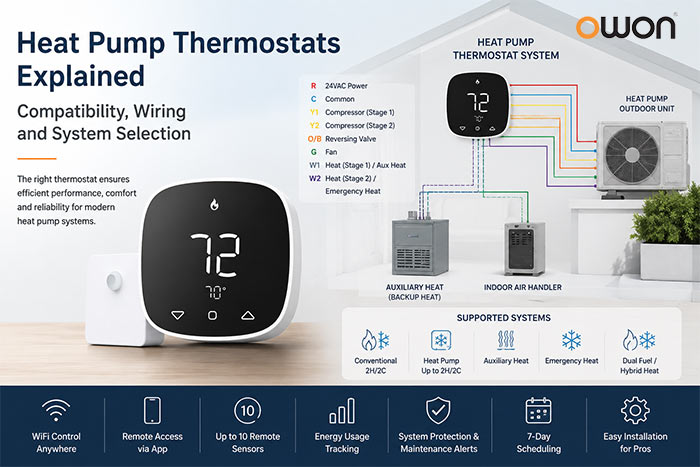
Heat Pump Thermostat Compatibility Explained
Before selecting a thermostat, HVAC professionals should verify compatibility with the HVAC equipment.
Common considerations include:
Number of Heating and Cooling Stages
Different heat pumps support different stage configurations.
Examples include:
- 1 Heat / 1 Cool
- 2 Heat / 1 Cool
- 3 Heat / 2 Cool
- 4 Heat / 2 Cool
The thermostat must support the same or higher stage configuration as the HVAC equipment.
Auxiliary Heat Support
Many heat pump systems use auxiliary heat when outdoor temperatures become very low.
The thermostat must be able to:
- Detect heating demand
- Engage auxiliary heat when necessary
- Coordinate operation with the heat pump
This is why many HVAC professionals search for a heat pump thermostat with auxiliary heat capability.
Emergency Heat Support
Emergency heat allows the backup heating source to operate independently when the heat pump is unavailable.
Typical emergency heat sources include:
- Electric resistance heating
- Gas furnace backup systems
- Hybrid heating systems
For cold-climate installations, thermostat support for emergency heat is often essential.
Heat Pump Thermostat Wiring Basics
One of the most common questions from HVAC installers is how heat pump thermostat wiring differs from conventional thermostat wiring.
Typical heat pump wiring may include:
| Terminal | Function |
|---|---|
| R | 24VAC Power |
| C | Common Wire |
| Y | Compressor |
| G | Fan |
| O/B | Reversing Valve |
| AUX/W2 | Auxiliary Heat |
| E | Emergency Heat |
| L | System Monitor (optional) |
The presence of O/B, AUX, and E terminals is one of the primary differences between conventional HVAC and heat pump systems.
Heat Pump Thermostat Wiring Diagram Considerations
While wiring configurations vary by manufacturer, HVAC professionals should always verify:
- Equipment documentation
- Terminal labeling
- Reversing valve operation mode
- Auxiliary heat configuration
- Emergency heat requirements
Improper wiring can result in:
- Heating when cooling is selected
- Cooling when heating is selected
- Auxiliary heat operating incorrectly
- Increased energy consumption
This is why thermostat compatibility should always be confirmed before installation.
Heat Pump Thermostat vs Regular Thermostat
| Feature | Regular Thermostat | Heat Pump Thermostat |
| Cooling Control | Yes | Yes |
| Heating Control | Yes | Yes |
| Reversing Valve Control | No | Yes |
| Auxiliary Heat Support | Usually No | Yes |
| Emergency Heat Support | Usually No | Yes |
| Heat Pump Compatibility | Limited | Designed for Heat Pumps |
Although some advanced thermostats support both system types, not every thermostat is suitable for heat pump operation.
Smart Heat Pump Thermostats and Modern HVAC Control
Modern HVAC projects increasingly require more than basic temperature control.
Many building owners and property managers now expect:
- Remote access
- Mobile app control
- Scheduling
- Energy reports
- Remote room sensors
- Smart HVAC automation
For example, WiFi-enabled thermostat platforms such as the OWON PCT5231 support heat pumps, auxiliary heat, dual fuel systems, and remote sensors, making them suitable for residential and light commercial HVAC projects.
For applications requiring humidity management, occupancy sensing, and advanced HVAC control, solutions such as the OWON PCT533 can provide additional smart building capabilities while maintaining heat pump compatibility.
How HVAC Professionals Select a Heat Pump Thermostat
When evaluating thermostat options, HVAC professionals typically consider:
- HVAC compatibility
- Auxiliary heat support
- Emergency heat support
- Multi-stage control
- Remote sensor support
- Smart HVAC integration
- Mobile app functionality
- Long-term reliability
The thermostat should not only work with today’s HVAC equipment but also support future system upgrades and integration requirements.
Conclusion
Heat pump thermostats play a critical role in HVAC performance, energy efficiency, and occupant comfort.
Selecting the right thermostat requires understanding HVAC compatibility, wiring requirements, auxiliary heat operation, emergency heat functionality, and future integration needs.
As heat pump adoption continues to grow across North America, choosing a thermostat designed specifically for heat pump applications can help ensure reliable operation and long-term system performance.
FAQ
What thermostats work with a heat pump?
Thermostats that support reversing valve control, auxiliary heat, and emergency heat are typically compatible with heat pump systems.
Does a heat pump need a special thermostat?
Yes. Heat pump systems generally require thermostat support for reversing valve operation and backup heating stages.
What is the difference between a heat pump thermostat and a regular thermostat?
A heat pump thermostat includes additional control functions such as reversing valve management, auxiliary heat, and emergency heat operation.
Can a smart thermostat work with a heat pump?
Yes. Many modern smart thermostats support heat pump systems, including multi-stage heat pumps, auxiliary heat, and dual fuel HVAC configurations.
Related reading:
[Dual Fuel Thermostat: Smart Control for Hybrid HVAC Systems]
Post time: Jul-06-2026