Introduction
In smart building projects, selecting Zigbee devices is only part of the equation. Long-term system performance often depends on how the Zigbee gateway is planned, deployed, and integrated into the overall building infrastructure.
Many building automation issues—including unstable communication, delayed automation responses, difficult maintenance, and limited scalability—can be traced back to gateway deployment decisions made during the early stages of a project.
Whether you are designing a hotel automation system, a commercial HVAC project, an energy management platform, or a multi-building IoT deployment, a structured gateway deployment strategy can significantly improve reliability and reduce future operational costs.
This checklist outlines the key considerations system integrators and project teams should evaluate before deploying a Zigbee gateway.
Why Gateway Deployment Planning Matters
A Zigbee gateway is the communication backbone of the entire Zigbee network.
It coordinates communication between field devices and higher-level platforms such as:
- Building Management Systems (BMS)
- Energy Management Systems (EMS)
- HVAC Control Platforms
- Home Assistant
- Private Cloud Platforms
- Mobile Applications
As device counts increase, gateway architecture becomes increasingly important.
Proper planning helps ensure:
- Reliable device communication
- Faster automation response
- Easier maintenance
- Future expansion capability
- Lower lifecycle costs
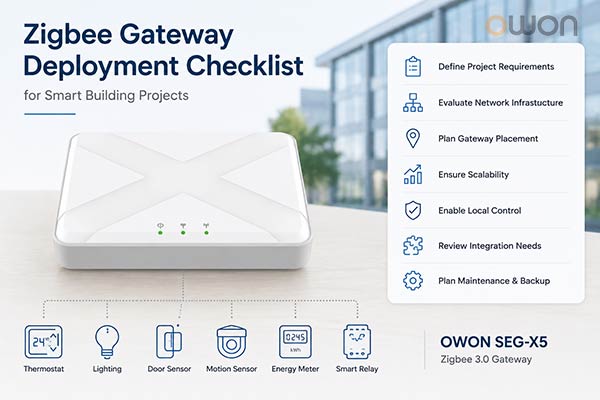
Deployment Checklist
1. Define Project Scope Before Selecting a Gateway
One of the most common mistakes is selecting a gateway before fully understanding project requirements.
Key questions include:
- How many Zigbee devices will be deployed?
- Will additional devices be added later?
- Is this a single-building or multi-building project?
- Will the gateway support HVAC, energy monitoring, security, or all three?
A gateway should be selected based on long-term project requirements rather than initial deployment size.
2. Evaluate Available Network Infrastructure
Gateway connectivity should align with the building’s existing network architecture.
Different environments may require:
- Ethernet connectivity
- WiFi connectivity
- Local-only operation
- Cloud-connected operation
For larger commercial deployments, Ethernet-based Zigbee gateways often provide greater stability and easier centralized management.
3. Plan Gateway Placement Carefully
Physical gateway location directly affects Zigbee network performance.
Best practices include:
- Central placement within coverage areas
- Minimal obstruction from concrete walls
- Distance from high-interference electrical equipment
- Accessibility for maintenance
Poor placement can reduce network reliability regardless of device quality.
4. Consider Future Device Expansion
Many smart building projects expand after initial deployment.
Additional devices may include:
- Occupancy sensors
- Thermostats
- Energy meters
- Smart relays
- Environmental sensors
Planning for future growth helps avoid costly network redesigns.
5. Verify Local Control Requirements
Internet outages should not disrupt critical building functions.
For commercial deployments, local control capability is often required to ensure:
- HVAC automation continuity
- Occupancy-based control
- Energy monitoring operation
- Alarm functionality
Gateways that support local automation can improve operational resilience.
6. Review Integration Requirements
Most modern smart building projects require integration with third-party systems.
Typical integration requirements include:
| Platform Type | Integration Requirement |
|---|---|
| BMS | Centralized building control |
| EMS | Energy monitoring and reporting |
| HVAC Platform | Climate control automation |
| Home Assistant | Local automation platform |
| Private Cloud | Custom IoT deployments |
| Mobile Apps | Remote monitoring and management |
Open APIs can significantly simplify integration and future expansion.
7. Establish Maintenance and Backup Strategies
A deployment strategy should include long-term maintenance planning.
Consider:
- Gateway replacement procedures
- Device migration capability
- Backup and recovery plans
- Firmware update management
Projects that ignore maintenance planning often experience higher operating costs later.
Real-World Gateway Selection Examples
Different projects may require different gateway architectures.
For apartment buildings, retrofit projects, and smaller automation systems, WiFi-based gateways can provide flexible deployment and simplified installation.
For example, the OWON SEG-X3 Zigbee gateway combines Zigbee 3.0 connectivity, WiFi networking, and open API support, making it suitable for HVAC control, residential automation, and small-to-medium building projects.
For larger smart building and energy management deployments, Ethernet connectivity often becomes a preferred option.
The OWON SEG-X5 Zigbee gateway supports Ethernet networking, WiFi and BLE onboarding, local control capability, and larger Zigbee device networks, helping improve long-term reliability in commercial environments.
The optimal gateway choice depends on project scale, network infrastructure, and integration requirements.
Common Deployment Mistakes
Many gateway-related issues originate from avoidable planning mistakes.
Common examples include:
- Selecting gateways based only on price
- Ignoring future expansion requirements
- Poor gateway placement
- Overreliance on cloud-only control
- Lack of API planning
- Insufficient maintenance strategy
Avoiding these mistakes during project planning can significantly improve long-term system performance.
FAQ
Is Ethernet required for commercial Zigbee gateway deployments?
Not always. However, Ethernet connectivity is often preferred for larger commercial projects due to improved stability and easier centralized management.
How many Zigbee devices should a gateway support?
The answer depends on project scale and future growth plans. Expansion requirements should be considered during initial design.
Why is local control important?
Local control allows critical automation functions to continue operating during internet outages while reducing cloud dependency.
Can Zigbee gateways integrate with third-party systems?
Yes. Gateways with open API support can integrate with BMS, EMS, HVAC platforms, Home Assistant, private cloud systems, and custom IoT applications.
Conclusion
Successful smart building projects begin with careful planning.
By evaluating network infrastructure, gateway placement, scalability, local control requirements, and integration needs before deployment, organizations can create a Zigbee network that remains reliable, maintainable, and ready for future growth.
A well-planned Zigbee gateway deployment strategy often delivers greater long-term value than simply selecting the most feature-rich hardware.
Related reading:
[How to Choose a Zigbee Gateway for Home Assistant Integration]
Post time: Jun-05-2026